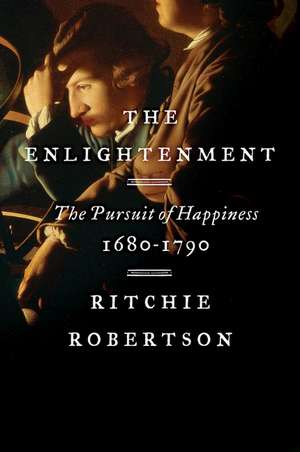
The Enlightenment: The Pursuit of Happiness, 1680-1790
Autor Ritchie Robertsonen Limba Engleză Paperback – 9 ian 2023
Observăm în The Enlightenment o resursă academică fundamentală pentru studenții și cercetătorii în istoria ideilor, filozofie și științe politice, fiind o lectură relevantă pentru examenele de istorie europeană modernă. Ritchie Robertson propune o istorie magistrală care recalibrează înțelegerea noastră asupra epocii, argumentând că nucleul Iluminismului nu a fost calculul rece, ci urmărirea fericirii umane prin mijloace practice și argumente bazate pe dovezi. Lucrarea analizează tranziția de la o viziune metafizică asupra lumii la una seculară, punând accent pe libertatea de exprimare și toleranța religioasă.
Apreciem modul în care Robertson utilizează texte originale pentru a demonta miturile conservatoare care asociază Iluminismul exclusiv cu ostilitatea față de religie. Această perspectivă completează viziunea oferită de The Portable Enlightenment Reader de Isaac Kramnick; în timp ce volumul lui Kramnick este o antologie de texte primare, Robertson oferă o sinteză narativă vastă, de peste 1000 de pagini, care integrează experiențele figurilor majore precum Voltaire și Diderot cu viața oamenilor obișnuiți. În contextul operei sale anterioare, Robertson face trecerea de la monografii critice despre autori precum Goethe sau ediții ale operelor lui Kafka, precum The Trial și The Metamorphosis and Other Stories, către o panoramă culturală mult mai largă. Dacă în lucrările precedente se concentra pe profunzimea psihologică și literară a spațiului germanic, aici desfășoară o analiză paneuropeană riguroasă, demonstrând cum rațiunea a fost permanent echilibrată de sensibilitate și emoție în formarea valorilor occidentale moderne.
Preț: 157.53 lei
Carte disponibilă
Livrare economică 07-21 mai
Livrare express 22-28 aprilie pentru 87.72 lei
Specificații
ISBN-10: 0062410660
Pagini: 1008
Dimensiuni: 152 x 229 x 64 mm
Greutate: 1 kg
Editura: HarperCollins Publishers
Colecția HarperPerennial
De ce să citești această carte
Recomandăm această carte oricărui cititor care dorește să înțeleagă rădăcinile valorilor democratice actuale. Veți câștiga o perspectivă clară asupra modului în care ideile secolului al XVIII-lea au modelat justiția modernă și drepturile omului. Este un instrument esențial pentru cei care studiază științele umaniste, oferind o bază factuală solidă împotriva interpretărilor simpliste ale istoriei europene, totul sub semnătura unui expert de la Oxford.
Despre autor
Ritchie Robertson este profesor de limba germană și membru al St. John's College din cadrul Universității Oxford. Recunoscut pentru expertiza sa în literatura și gândirea europeană, Robertson a publicat lucrări de referință despre figuri emblematice precum Goethe și a îngrijit ediții critice esențiale din opera lui Franz Kafka. Interesul său vast pentru „secolul al XVIII-lea lung” și capacitatea de a sintetiza curente filozofice complexe în narațiuni accesibile îl poziționează ca unul dintre cei mai importanți istorici culturali contemporani, The Enlightenment reprezentând încununarea cercetărilor sale asupra modernității.
Descriere scurtă
Now in paperback, a magisterial history that recasts the Enlightenment as a period not solely consumed with rationale and reason, but rather as a pursuit of practical means to achieve greater human happiness.
One of the formative periods of European and world history, the Enlightenment is the fountainhead of modern secular Western values: religious tolerance, freedom of thought, speech and the press, of rationality and evidence-based argument. Yet why, over three hundred years after it began, is the Enlightenment so profoundly misunderstood as controversial, the expression of soulless calculation? The answer may be that, to an extraordinary extent, we have accepted the account of the Enlightenment given by its conservative enemies: that enlightenment necessarily implied hostility to religion or support for an unfettered free market, or that this was “the best of all possible worlds”. Ritchie Robertson goes back into the “long eighteenth century,” from approximately 1680 to 1790, to reveal what this much-debated period was really about.
Robertson returns to the era’s original texts to show that above all, the Enlightenment was really about increasing human happiness – in this world rather than the next – by promoting scientific inquiry and reasoned argument. In so doing Robertson chronicles the campaigns mounted by some Enlightened figures against evils like capital punishment, judicial torture, serfdom and witchcraft trials, featuring the experiences of major figures like Voltaire and Diderot alongside ordinary people who lived through this extraordinary moment.
In answering the question 'What is Enlightenment?' in 1784, Kant famously urged men and women above all to “have the courage to use your own intellect”. Robertson shows how the thinkers of the Enlightenment did just that, seeking a well-rounded understanding of humanity in which reason was balanced with emotion and sensibility. Drawing on philosophy, theology, historiography and literature across the major western European languages, The Enlightenment is a master-class in big picture history about the foundational epoch of modern times.
Recenzii
“Mr. Robertson is a splendid writer, astoundingly versed in European letters and gifted at vividly sketching the views of the 'Enlighteners.' . . . Robertson, armed with a prodigious knowledge of the Enlightenment’s literary output, has captured the tone and spirit of this milieu." — Wall Street Journal
"Robertson expands the conception of the Enlightenment from familiar topics like the scientific revolution to include areas as diverse as public administration and manners. He portrays not only well-known philosophers but also the many civil servants and functionaries, from Philadelphia to St. Petersburg, who gave practical shape to Enlightenment ideals. For Robertson, this period was ultimately “an age of feeling, sympathy and sensibility,” in which the goal was human happiness in this life." — The New Yorker
"Deeply impressive . . . bracingly eloquent narrative . . . a big, enthusiastic book." — Christian Science Monitor
“There’s a certain kind of book that defies a direct approach. It arrives on the doorstep, several inches thick, dense with learning. . . . Ritchie Robertson’s thousand-page The Enlightenment [is] a beautifully written account of a period that everyone has heard of but few pause to think about." — AirMail
"A long, thoroughly satisfying history of an era that was not solely about reason but was “also the age of feeling, sympathy and sensibility.” Robertson, a professor of German at Oxford, has clearly read all the original sources and most modern scholars and arrived at his own conclusions, which are alternately unsettling and stimulating and consistently engaging." — Kirkus Reviews (starred review)
"Distinguished German scholar Robertson has produced a monumental work on a monumental topic....indispensable for advanced students and readers of history, especially those wishing to learn more about this pivotal era." — Library Journal
"Fascinating . . . fresh and expansive.” — Booklist