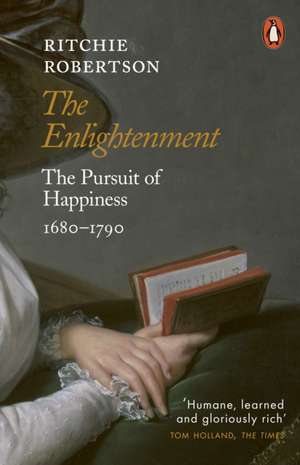
The Enlightenment
Autor Ritchie Robertsonen Limba Engleză Paperback – 28 apr 2022
Observăm în The Enlightenment o resursă academică fundamentală pentru studenții și cercetătorii în istoria ideilor, filozofie și științe politice, fiind o lectură relevantă pentru examenele de istorie europeană modernă. Ritchie Robertson propune o istorie magistrală care recalibrează înțelegerea noastră asupra epocii, argumentând că nucleul Iluminismului nu a fost calculul rece, ci urmărirea fericirii umane prin mijloace practice și argumente bazate pe dovezi. Lucrarea analizează tranziția de la o viziune metafizică asupra lumii la una seculară, punând accent pe libertatea de exprimare și toleranța religioasă. Apreciem modul în care Robertson utilizează texte originale pentru a demonta miturile conservatoare care asociază Iluminismul exclusiv cu ostilitatea față de religie. Această perspectivă completează viziunea oferită de The Portable Enlightenment Reader de Isaac Kramnick; în timp ce volumul lui Kramnick este o antologie de texte primare, Robertson oferă o sinteză narativă vastă, de peste 1000 de pagini, care integrează experiențele figurilor majore precum Voltaire și Diderot cu viața oamenilor obișnuiți. În contextul operei sale anterioare, Robertson face trecerea de la monografii critice despre autori precum Goethe sau ediții ale operelor lui Kafka, precum The Trial și The Metamorphosis and Other Stories, către o panoramă culturală mult mai largă. Dacă în lucrările precedente se concentra pe profunzimea psihologică și literară a spațiului germanic, aici desfășoară o analiză paneuropeană riguroasă, demonstrând cum rațiunea a fost permanent echilibrată de sensibilitate și emoție în formarea valorilor occidentale moderne.
Preț: 115.04 lei
Preț vechi: 145.60 lei
-21%
Carte disponibilă
Livrare economică 05-11 noiembrie
Livrare express 17-23 octombrie pentru 72.12 lei
Specificații
ISBN-10: 0141979402
Pagini: 1008
Ilustrații: 24pp b/w or colour
Dimensiuni: 129 x 198 x 45 mm
Greutate: 0.68 kg
Editura: Penguin Books
Colecția Penguin
Locul publicării:London, United Kingdom
De ce să citești această carte
Recomandăm această carte oricărui cititor care dorește să înțeleagă rădăcinile valorilor democratice actuale. Veți câștiga o perspectivă clară asupra modului în care ideile secolului al XVIII-lea au modelat justiția modernă și drepturile omului. Este un instrument esențial pentru cei care studiază științele umaniste, oferind o bază factuală solidă împotriva interpretărilor simpliste ale istoriei europene, totul sub semnătura unui expert de la Oxford.
Despre autor
Ritchie Robertson este profesor de limba germană și membru al St. John's College din cadrul Universității Oxford. Recunoscut pentru expertiza sa în literatura și gândirea europeană, Robertson a publicat lucrări de referință despre figuri emblematice precum Goethe și a îngrijit ediții critice esențiale din opera lui Franz Kafka. Interesul său vast pentru „secolul al XVIII-lea lung” și capacitatea de a sintetiza curente filozofice complexe în narațiuni accesibile îl poziționează ca unul dintre cei mai importanți istorici culturali contemporani, The Enlightenment reprezentând încununarea cercetărilor sale asupra modernității.
Notă biografică
Recenzii
the book is written out of genuine curiosity and palpable enthusiasm. Robertson's range allows him to make many illuminating comparisons and some provocative juxtapositions ... This is surely the best and most up to date single-volume study of the Enlightenment that we currently possess. It will inform the general reader while also often provoking, delighting and surprising the specialist.
The Enlightenment by Ritchie Robertson is a fine examination of how the enlightenment changed the world in different ways in different places - scintillating.
a work that is at once readable, authoritative and wide-ranging ... a handsome single volume, complete with nearly 30 images from the great first editions of the period. The author is a professor of German literature and thought at Oxford University, but whatever the specific subject addressed, the quality of scholarship is uniformly high.
learned, capacious and gloriously rich ... "The first Quality of an Historian," David Hume wrote to a friend, "is to be true and impartial; the next to be interesting." Judged by such a standard, Robertson must be reckoned a historian of very high quality indeed. His book is not just learned and balanced, it is also - in the noblest tradition of the Enlightenment itself - principled and humane.
Mr. Robertson is a splendid writer, astoundingly versed in European letters and gifted at vividly sketching the views of the "Enlighteners." ... Mr. Robertson, armed with a prodigious knowledge of the Enlightenment's literary output, has captured the tone and spirit of this milieu.
Mr. Robertson is a splendid writer, astoundingly versed in European letters and gifted at vividly sketching the views of the "Enlighteners" ... [who] has written a fitting tribute to his subject ... Often characterized as a great philosophical movement, it is better understood as a style, a set of shifting public habits and attitudes. Mr. Robertson, armed with a prodigious knowledge of the Enlightenment's literary output, has captured the tone and spirit of this milieu.
Masterly...[an] epic survey of Enlightened minds, ideas and policies across Europe and the Americas...Mr Robertson sweetens erudition with humanity, much as his subjects did. Science and statecraft, which are amply chronicled, yield to compassion, sympathy and a self-critical outlook that welcomes experimentation and changes of mind. Not least among its lessons for today, The Enlightenment shows how its sages learned "to manage even Disputes with Civility".
A thoroughly satisfying history of an era that was not solely about reason but was "also the age of feeling, sympathy and sensibility." ... a magisterial history of Europe and the West, featuring more than 100 chapters ... An entirely absorbing doorstop history of ideas.
The analyst has to stick to the ideas. Robertson does this expansively and lucidly, not just reporting them, but arguing them out in admirable thumbnail sketches, rich in detail, of literary as well as philosophical and also scientific works.
Descriere scurtă
Answering the question 'what is Enlightenment?' Kant famously urged men and women above all to 'have the courage to use your own understanding'. Robertson shows how the thinkers of the Enlightenment did just that, seeking a rounded understanding of humanity in which reason was balanced with emotion and sensibility. His book goes behind the controversies about the Enlightenment to return to its original texts and to show that above all it sought to increase human happiness in this world by promoting scientific inquiry and reasoned argument. His book overturns many received opinions - for example, that enlightenment necessarily implied hostility to religion (though it did challenge the authority traditionally assumed by the Churches). It is a master-class in 'big picture' history, about one of the foundational epochs of modern times.