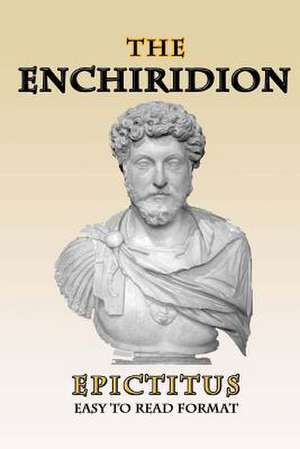
The Enchiridion
Autor Epictetusen Limba Engleză Paperback
Preț: 61.21 lei
Puncte Express: 92
Carte tipărită la comandă
Livrare economică 30 noiembrie-14 decembrie
Livrare prin curier în România Termenul estimat este afișat lângă disponibilitate.
Transport gratuit de la 400.00 lei Plată online sau ramburs, în funcție de opțiunile comenzii.
Retur gratuit în 14 zile Comandă securizată și suport în română.
Specificații
ISBN-13: 9781500465803
ISBN-10: 1500465801
Pagini: 94
Dimensiuni: 152 x 229 x 5 mm
Greutate: 0.14 kg
Editura: CREATESPACE
ISBN-10: 1500465801
Pagini: 94
Dimensiuni: 152 x 229 x 5 mm
Greutate: 0.14 kg
Editura: CREATESPACE
V-ar putea interesa
-
 The Wit and Wisdom of BridgertonJulia QuinnPreț: 103.90 lei
 -
 Letters from a StoicSeneca-18%Preț: 59.62 lei72.56 lei
 -
 On the Shortness of LifeLucius Annaeus Seneca-20%Preț: 44.96 lei56.45 lei
 -
 MeditationsMarcus Aurelius-20%Preț: 45.71 lei56.89 lei
 -
 Why I am So WiseFriedrich Nietzsche-21%Preț: 43.63 lei55.31 lei
 -
 Whatever You Think, Think the OppositePaul Arden-18%Preț: 64.86 lei79.40 lei
 -
 Tao Te ChingLao-Tzu-30%Preț: 39.42 lei56.39 lei
 -
 Of Human FreedomEpictetus-21%Preț: 44.70 lei56.30 lei
 -
 -26%Preț: 53.28 lei71.81 lei
 -
 -25%Preț: 49.42 lei65.72 lei
 -
 -25%Preț: 59.71 lei79.90 lei
 -
 Preț: 79.65 lei
 -
 -26%Preț: 59.27 lei79.65 lei
 -
 The Lady Most Likely: A Novel in Three PartsJulia Quinn-26%Preț: 59.31 lei79.66 lei
 -
 The Lady Most Willing: A Novel in Three PartsJulia Quinn-26%Preț: 59.31 lei79.65 lei
 -
 MasteryGeorge LeonardPreț: 99.70 lei
 -
 Stillness Is the KeyRyan HolidayPreț: 106.06 lei
 -
 Ten Things I Love About YouJulia Quinn-25%Preț: 60.27 lei80.23 lei
 -
 MeditationsMarcus AureliusPreț: 62.66 lei
 -
 Preț: 32.83 lei
 -
 The Meditations of Marcus AureliusMarcus AureliusPreț: 53.50 lei
 -
 ModelsMark MansonPreț: 89.73 lei
 -
 Discourses and Selected WritingsEpictetusPreț: 39.89 lei
 -
 The Way of the Superior ManDavid DeidaPreț: 112.02 lei
 -
 -19%Preț: 69.09 lei85.66 lei
 -
 -19%Preț: 64.32 lei79.09 lei
 -
 Preț: 63.54 lei
Descriere
Descriere de la o altă ediție sau format:
The Enchiridion (‘handbook’) of Epictetus is one of the most well-known and best-loved works of ancient Greek literature. Based on the solid theoretical foundation of Stoic thought, this is indeed a highly accessible handbook giving practical advice on how to live a better life. It is as relevant now as ever it was. This pocket-size edition of the classic work is presented in a lucid, jargon-free new translation, with a thought-provoking introduction by contemporary philosopher Matthew Talbert. Typeset with Boatwhistle’s customary panache, this edition is as elegant as it is engrossing.
The Enchiridion (‘handbook’) of Epictetus is one of the most well-known and best-loved works of ancient Greek literature. Based on the solid theoretical foundation of Stoic thought, this is indeed a highly accessible handbook giving practical advice on how to live a better life. It is as relevant now as ever it was. This pocket-size edition of the classic work is presented in a lucid, jargon-free new translation, with a thought-provoking introduction by contemporary philosopher Matthew Talbert. Typeset with Boatwhistle’s customary panache, this edition is as elegant as it is engrossing.
Notă biografică
Epictetus (c. 50–c. 135 AD) was a prominent Greek philosopher whose teachings became a cornerstone of Roman Stoicism. Born into slavery in Hierapolis (modern-day Turkey), he spent his youth in Rome as a slave to a wealthy administrative secretary of Nero. After gaining his freedom following Nero’s death, Epictetus began teaching philosophy in Rome until the Emperor Domitian banished all philosophers from Italy around 89 AD. He relocated to Nicopolis, Greece, where he established a highly influential philosophical school that attracted students from across the Roman Empire. Epictetus wrote nothing down himself; his profound insights on freedom, personal autonomy, and emotional resilience were meticulously recorded and preserved by his devoted student, Arrian.
Cuprins
Note on the Text 7
Introduction 9
Selected Bibliography 15
The Enchiridion 17
Introduction 9
Selected Bibliography 15
The Enchiridion 17