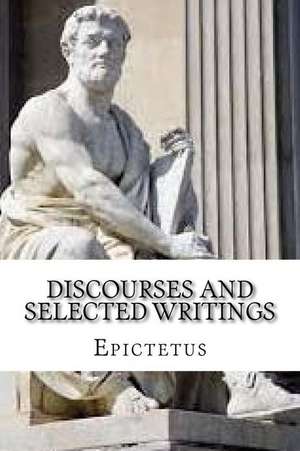
Discourses and Selected Writings
Autor Epictetusen Limba Engleză Paperback
'I must die. But must I die bawling?'
Epictetus, a Greek Stoic and freed slave, ran a thriving philosophy school in Nicopolis in the early second century AD. His animated discussions were celebrated for their rhetorical wizardry and were written down by Arrian, his most famous pupil. The Discourses argue that happiness lies in learning to perceive exactly what is in our power to change and what is not, and in embracing our fate to live in harmony with god and nature. In this personal, practical guide to the ethics of Stoicism and moral self-improvement, Epictetus tackles questions of freedom and imprisonment, illness and fear, family, friendship and love.
Translated and Edited with an Introduction by Robert Dobbin
Preț: 39.89 lei
Puncte Express: 60
Carte indisponibilă temporar
Livrare prin curier în România Termenul estimat este afișat lângă disponibilitate.
Transport gratuit de la 400.00 lei Plată online sau ramburs, în funcție de opțiunile comenzii.
Retur gratuit în 14 zile Comandă securizată și suport în română.
Specificații
ISBN-13: 9781539346128
ISBN-10: 1539346129
Pagini: 90
Dimensiuni: 152 x 229 x 5 mm
Greutate: 0.13 kg
ISBN-10: 1539346129
Pagini: 90
Dimensiuni: 152 x 229 x 5 mm
Greutate: 0.13 kg
V-ar putea interesa
-
 The Art of RhetoricAristotlePreț: 28.01 lei
 -
 LAGOM HBNiki BrantmarkPreț: 96.08 lei
 -
 Art of LivingSharon LebellPreț: 77.76 lei
 -
 Preț: 67.84 lei
 -
 Letters from a StoicSeneca-17%Preț: 60.21 lei72.56 lei
 -
 Dialogues and LettersSeneca-27%Preț: 57.09 lei77.82 lei
 -
 On the Shortness of LifeLucius Annaeus Seneca-20%Preț: 44.96 lei56.45 lei
 -
 The Cynic PhilosophersVarious-17%Preț: 78.17 lei94.27 lei
 -
 Of Human FreedomEpictetus-21%Preț: 44.70 lei56.30 lei
 -
 Letters from a StoicSeneca-27%Preț: 89.12 lei122.03 lei
 -
 MeditationsMarcus Aurelius-27%Preț: 90.10 lei122.62 lei
 -
 Einstein's Unfinished RevolutionLee Smolin-31%Preț: 64.76 lei93.41 lei
 -
 The Mathematics of the Gods and the Algorithms of MenPaolo Zellini-31%Preț: 63.80 lei92.70 lei
 -
 The Responsible GlobalistHassan Damluji-20%Preț: 56.29 lei70.16 lei
 -
 Cosmological KoansAnthony Aguirre-29%Preț: 66.48 lei94.03 lei
 -
 The Selfish Gene: 40th Anniversary editionRichard DawkinsPreț: 118.61 lei
 -
 Meditations: with selected correspondenceMarcus Aurelius-19%Preț: 52.25 lei64.17 lei
 -
 The Philosophy of EpictetusTheodore Scaltsas-12%Preț: 319.46 lei362.25 lei
 -
 Daring GreatlyBrené Brown-24%Preț: 64.94 lei86.01 lei
 -
 Becoming MyselfIrvin Yalom-28%Preț: 88.51 lei123.45 lei
 -
 Go Like HellA.J. BaimePreț: 108.42 lei
 -
 MeditationsMarcus AureliusPreț: 63.54 lei
 -
 King Leopold's GhostAdam Hochschild-41%Preț: 54.26 lei92.16 lei
 -
 Permanent RecordEdward Snowden-42%Preț: 53.79 lei93.50 lei
 -
 The Defining DecadeMeg JayPreț: 110.99 lei
 -
 The Talent WarMike SarraillePreț: 153.02 lei
 -
 The Romanian Army of World War IIMark Axworthy-32%Preț: 67.78 lei99.47 lei
Notă biografică
Epictetus (c. 55-135 CE) was a teacher and Stoic philosopher. Originally a slave from Hierapolis in Anatolia (modern Turkey), he moved to Nicopolis on the Adriatic coast of Greece after gaining his freedom and opened a school of philosophy there. His informal lectures (the Discourses) were transcribed and published by his student Arrian, who also composed a digest of Epictetus' teaching known as the Manual (or Enchiridion). Late in life Epictetus retired from teaching, adopted an orphan child and lived out his remaining years in domestic obscurity. His influence has been deep and enduring, from Marcus Aurelius in his Meditations to the contemporary psychologist Albert Ellis, who has acknowledged his debt to Epictetus in devising the school of Rational-Emotive Behavioural Therapy.
Cuprins
EpictetusIntroduction
Further Reading
Note on the Translation
The Discourses
Fragments
Enchiridion
Glossary of Names
Notes
Further Reading
Note on the Translation
The Discourses
Fragments
Enchiridion
Glossary of Names
Notes