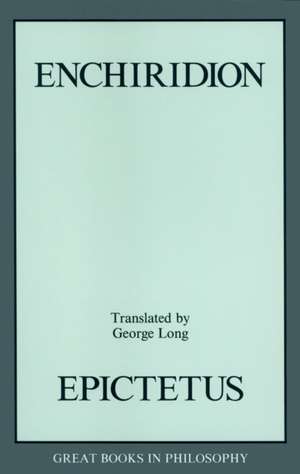
Enchiridion: Great Books in Philosophy
Autor Epictetus Editat de Robert M. Baird, Stuart E. Rosenbaumen Limba Engleză Paperback – 30 noi 1991
The Enchiridion has played a significant role in the development of modern philosophy and intellectual attitudes, showing secular thinkers how sound reasoning can free them from the shackles of absolutism and emotionalism and, in so doing, live a more tranquil and productive life.




Preț: 83.52 lei
Puncte Express: 125
Carte tipărită la comandă
Livrare economică 10-24 iulie
Livrare prin curier în România Termenul estimat este afișat lângă disponibilitate.
Transport gratuit de la 400.00 lei Plată online sau ramburs, în funcție de opțiunile comenzii.
Retur gratuit în 14 zile Comandă securizată și suport în română.
Specificații
ISBN-13: 9780879757038
ISBN-10: 0879757035
Pagini: 43
Dimensiuni: 147 x 154 x 3 mm
Greutate: 0.07 kg
Ediția:00003
Editura: Prometheus Books
Seria Great Books in Philosophy
ISBN-10: 0879757035
Pagini: 43
Dimensiuni: 147 x 154 x 3 mm
Greutate: 0.07 kg
Ediția:00003
Editura: Prometheus Books
Seria Great Books in Philosophy
V-ar putea interesa
-
 The Wit and Wisdom of BridgertonJulia QuinnPreț: 100.74 lei
 -
 Letters from a StoicSeneca-20%Preț: 57.56 lei71.51 lei
 -
 On the Shortness of LifeLucius Annaeus Seneca-22%Preț: 43.33 lei55.56 lei
 -
 MeditationsMarcus Aurelius-21%Preț: 44.04 lei55.99 lei
 -
 Why I am So WiseFriedrich Nietzsche-22%Preț: 43.08 lei55.41 lei
 -
 Whatever You Think, Think the OppositePaul Arden-20%Preț: 62.48 lei78.17 lei
 -
 Tao Te ChingLao-Tzu-32%Preț: 38.01 lei55.49 lei
 -
 Of Human FreedomEpictetus-22%Preț: 43.10 lei55.42 lei
 -
 -27%Preț: 52.61 lei71.67 lei
 -
 -33%Preț: 47.64 lei71.51 lei
 -
 -27%Preț: 56.06 lei76.77 lei
 -
 -27%Preț: 57.14 lei78.41 lei
 -
 -27%Preț: 57.14 lei78.41 lei
 -
 The Lady Most Likely: A Novel in Three PartsJulia Quinn-27%Preț: 57.18 lei78.43 lei
 -
 The Lady Most Willing: A Novel in Three PartsJulia Quinn-27%Preț: 57.14 lei78.41 lei
 -
 MasteryGeorge LeonardPreț: 94.63 lei
 -
 Stillness Is the KeyRyan HolidayPreț: 101.63 lei
 -
 Ten Things I Love About YouJulia Quinn-26%Preț: 56.35 lei76.42 lei
 -
 MeditationsMarcus AureliusPreț: 60.12 lei
 -
 Preț: 25.67 lei
 -
 The Meditations of Marcus AureliusMarcus AureliusPreț: 51.97 lei
 -
 ModelsMark MansonPreț: 87.23 lei
 -
 Discourses and Selected WritingsEpictetusPreț: 39.89 lei
 -
 The Way of the Superior ManDavid DeidaPreț: 104.46 lei
 -
 -21%Preț: 66.61 lei84.35 lei
 -
 -20%Preț: 61.95 lei77.84 lei
 -
 Man's Search For MeaningViktor E. FranklPreț: 62.55 lei
Descriere
Descriere de la o altă ediție sau format:
The Enchiridion (‘handbook’) of Epictetus is one of the most well-known and best-loved works of ancient Greek literature. Based on the solid theoretical foundation of Stoic thought, this is indeed a highly accessible handbook giving practical advice on how to live a better life. It is as relevant now as ever it was. This pocket-size edition of the classic work is presented in a lucid, jargon-free new translation, with a thought-provoking introduction by contemporary philosopher Matthew Talbert. Typeset with Boatwhistle’s customary panache, this edition is as elegant as it is engrossing.
The Enchiridion (‘handbook’) of Epictetus is one of the most well-known and best-loved works of ancient Greek literature. Based on the solid theoretical foundation of Stoic thought, this is indeed a highly accessible handbook giving practical advice on how to live a better life. It is as relevant now as ever it was. This pocket-size edition of the classic work is presented in a lucid, jargon-free new translation, with a thought-provoking introduction by contemporary philosopher Matthew Talbert. Typeset with Boatwhistle’s customary panache, this edition is as elegant as it is engrossing.
Notă biografică
Epictetus (AD 55 - 135) was a Greek speaking Stoic philosopher. He was born a slave at Hierapolis, Phrygia (present day Pamukkale, Turkey), and lived in Rome until his banishment, when he went to Nicopolis in north-western Greece for the rest of his life. His teachings were written down and published by his pupil Arrian in his Discourses. Epictetus taught that philosophy is a way of life and not just a theoretical discipline. To Epictetus, all external events are determined by fate, and are thus beyond our control; we should accept whatever happens calmly and dispassionately. However, individuals are responsible for their own actions, which they can examine and control through rigorous self-discipline.