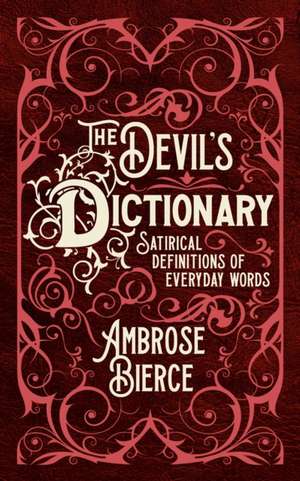
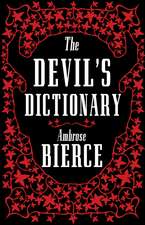
The Devil's Dictionary
Autor Ambrose Bierceen Limba Engleză Hardback – 15 dec 2026
Preț: 138.07 lei
Precomandă
Puncte Express: 207
Carte nepublicată încă
Livrare prin curier în România Precomanda se expediază când titlul devine disponibil.
Transport gratuit de la 400.00 lei Plată online sau ramburs, în funcție de opțiunile comenzii.
Retur gratuit în 14 zile Comandă securizată și suport în română.
Doresc să fiu notificat când acest titlu va fi disponibil:
Se trimite...
Specificații
ISBN-13: 9781398867765
ISBN-10: 1398867764
Pagini: 304
Dimensiuni: 135 x 216 x 25 mm
Greutate: 0.42 kg
Editura: Arcturus Publishing
ISBN-10: 1398867764
Pagini: 304
Dimensiuni: 135 x 216 x 25 mm
Greutate: 0.42 kg
Editura: Arcturus Publishing
V-ar putea interesa
-
 The Enlarged Devils DictionaryAmbrose BiercePreț: 95.24 lei
 -
 An Etymological Dictionary of the English LanguageWalter W. SkeatPreț: 423.76 lei
 -
 The Dictionary of Homeland Security and DefenseMargaret R O'LearyPreț: 274.33 lei
 -
 Dictionary of AnthropologyCharles WinichPreț: 151.36 lei
 -
 Dictionary of MagicHarry E. WedeckPreț: 64.25 lei
 -
 English-Kirundi-French DictionaryA. H. ZembackPreț: 106.33 lei
 -
 A Concise Dictionary of Middle EnglishA. L. MayhewPreț: 104.61 lei
 -
 An Occurrence at Owl Creek BridgeAmbrose BiercePreț: 41.38 lei
 -
 Diccionario Ingles-Espanol-Ingles Para EnfermerasJose Luis LeyvaPreț: 86.56 lei
 -
 Four Days in DixieAmbrose BiercePreț: 55.68 lei
 -
 English Creole French DictionaryJohn C. RigdonPreț: 272.55 lei
 -
 Learn Legal Terminology in 2015Jose Luis LeyvaPreț: 99.71 lei
 -
 The Damned ThingAmbrose BiercePreț: 42.00 lei
 -
 Learn Basic Medical Terms in SpanishJose Luis LeyvaPreț: 99.48 lei
 -
 Shapes of Clay (Annotated)Ambrose BiercePreț: 48.15 lei
 -
 The Fiend's Delight (Annotated)Ambrose BiercePreț: 39.48 lei
 -
 Self-Study Law Dictionary and Exercise BookMichael HowardPreț: 104.72 lei
 -
 Preț: 75.66 lei
 -
 Preț: 233.43 lei
 -
 A Dictionary of the First, or Oldest Words in the English LanguageColerige, HerbertPreț: 152.24 lei
 -
 Simple Dictionary of HinduismSudhir MittalPreț: 147.23 lei
 -
 -24%Preț: 55.46 lei73.02 lei
 -
 Parking BibleTanksley, Monica M.Preț: 339.30 lei
 -
 Be PracticalJose Luis LeyvaPreț: 105.35 lei
Notă biografică
Ambrose Bierce (1842-c.1914) was a short story writer, journalist, poet, and American Civil War veteran from Ohio, USA. He contributed to a number of newspapers and magazines, where he received acclaim for his work and became one of the most influential journalists in the country. Bierce was also regarded as a pioneering writer of realist fiction. His most famous work was The Devil's Dictionary, published in 1906.
Descriere
Descriere de la o altă ediție sau format:
History, n. an account mostly false, of events mostly unimportant, which are brought about by rulers mostly knaves, and soldiers mostly fools. Marriage, n. The state or condition of a community consisting of a master, a mistress, and two slaves, making in all two. Self-Esteem, n. An erroneous appraisement. These caustic aphorisms, collected in The Devil's Dictionary, helped earn Ambrose Bierce the epithets Bitter Bierce, the Devil's Lexicographer, and the Wickedest Man in San Francisco. First published as The Cynic's Word Book (1906) and later reissued under its preferred name in 1911, Bierce's notorious collection of barbed definitions forcibly contradicts Samuel Johnson's earlier definition of a lexicographer as a harmless drudge. There was nothing harmless about Ambrose Bierce, and the words he shaped into verbal pitchforks a century ago--with or without the devil's help--can still draw blood today.
History, n. an account mostly false, of events mostly unimportant, which are brought about by rulers mostly knaves, and soldiers mostly fools. Marriage, n. The state or condition of a community consisting of a master, a mistress, and two slaves, making in all two. Self-Esteem, n. An erroneous appraisement. These caustic aphorisms, collected in The Devil's Dictionary, helped earn Ambrose Bierce the epithets Bitter Bierce, the Devil's Lexicographer, and the Wickedest Man in San Francisco. First published as The Cynic's Word Book (1906) and later reissued under its preferred name in 1911, Bierce's notorious collection of barbed definitions forcibly contradicts Samuel Johnson's earlier definition of a lexicographer as a harmless drudge. There was nothing harmless about Ambrose Bierce, and the words he shaped into verbal pitchforks a century ago--with or without the devil's help--can still draw blood today.
Recenzii
'The corrosive insights of Ambrose Bierce seem as bitter and fresh as ever. He handles words with delicious precision'
'If one book should be issued to every child at birth, this is it ... What is extraordinary about Bierce's waspish definitions is how accurate they seem, more than a century after he wrote them ... This edition is exuberantly illustrated by Ralph Steadman ... Everyone should buy this, and learn from it'
'A superb book. Steadman has always been one of my heroes'
'An American classic, some of its charming (and cynical) definitions are uncannily appropriate to our own day and would make it, I fancy, an ideal Christmas stocking present'
'If one book should be issued to every child at birth, this is it ... What is extraordinary about Bierce's waspish definitions is how accurate they seem, more than a century after he wrote them ... This edition is exuberantly illustrated by Ralph Steadman ... Everyone should buy this, and learn from it'
'A superb book. Steadman has always been one of my heroes'
'An American classic, some of its charming (and cynical) definitions are uncannily appropriate to our own day and would make it, I fancy, an ideal Christmas stocking present'