
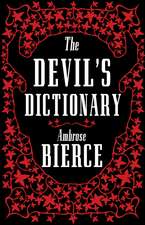
The Devil's Dictionary
Autor Ambrose Bierceen Limba Engleză Paperback – 31 dec 2006
Preț: 55.87 lei
Puncte Express: 84
Carte indisponibilă temporar
Livrare prin curier în România Termenul estimat este afișat lângă disponibilitate.
Transport gratuit de la 400.00 lei Plată online sau ramburs, în funcție de opțiunile comenzii.
Retur gratuit în 14 zile Comandă securizată și suport în română.
Specificații
ISBN-13: 9781420930047
ISBN-10: 1420930044
Pagini: 172
Dimensiuni: 152 x 229 x 10 mm
Greutate: 0.26 kg
Editura: Digireads.com
ISBN-10: 1420930044
Pagini: 172
Dimensiuni: 152 x 229 x 10 mm
Greutate: 0.26 kg
Editura: Digireads.com
V-ar putea interesa
-
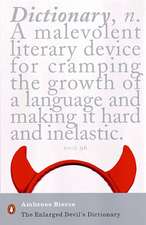 The Enlarged Devils DictionaryAmbrose BiercePreț: 95.39 lei
-
 An Etymological Dictionary of the English LanguageWalter W. SkeatPreț: 423.76 lei
-
 The Dictionary of Homeland Security and DefenseMargaret R O'LearyPreț: 283.55 lei
-
 Dictionary of AnthropologyCharles WinichPreț: 151.36 lei
-
 Dictionary of MagicHarry E. WedeckPreț: 64.25 lei
-
 English-Kirundi-French DictionaryA. H. ZembackPreț: 106.33 lei
-
 A Concise Dictionary of Middle EnglishA. L. MayhewPreț: 104.61 lei
-
 An Occurrence at Owl Creek BridgeAmbrose BiercePreț: 41.38 lei
-
 Diccionario Ingles-Espanol-Ingles Para EnfermerasJose Luis LeyvaPreț: 86.56 lei
-
 Four Days in DixieAmbrose BiercePreț: 55.68 lei
-
 English Creole French DictionaryJohn C. RigdonPreț: 272.55 lei
-
 Learn Legal Terminology in 2015Jose Luis LeyvaPreț: 99.71 lei
-
 The Damned ThingAmbrose BiercePreț: 42.00 lei
-
 Learn Basic Medical Terms in SpanishJose Luis LeyvaPreț: 99.48 lei
-
 Shapes of Clay (Annotated)Ambrose BiercePreț: 48.15 lei
-
 The Fiend's Delight (Annotated)Ambrose BiercePreț: 39.48 lei
-
 Self-Study Law Dictionary and Exercise BookMichael HowardPreț: 104.72 lei
-
 Preț: 75.66 lei
-
 Preț: 233.43 lei
-
 A Dictionary of the First, or Oldest Words in the English LanguageColerige, HerbertPreț: 152.24 lei
-
 Simple Dictionary of HinduismSudhir MittalPreț: 147.23 lei
-
 -23%Preț: 56.15 lei73.02 lei
-
 Parking BibleTanksley, Monica M.Preț: 339.30 lei
-
 Be PracticalJose Luis LeyvaPreț: 105.35 lei
Descriere
Descriere de la o altă ediție sau format:
History, n. an account mostly false, of events mostly unimportant, which are brought about by rulers mostly knaves, and soldiers mostly fools. Marriage, n. The state or condition of a community consisting of a master, a mistress, and two slaves, making in all two. Self-Esteem, n. An erroneous appraisement. These caustic aphorisms, collected in The Devil's Dictionary, helped earn Ambrose Bierce the epithets Bitter Bierce, the Devil's Lexicographer, and the Wickedest Man in San Francisco. First published as The Cynic's Word Book (1906) and later reissued under its preferred name in 1911, Bierce's notorious collection of barbed definitions forcibly contradicts Samuel Johnson's earlier definition of a lexicographer as a harmless drudge. There was nothing harmless about Ambrose Bierce, and the words he shaped into verbal pitchforks a century ago--with or without the devil's help--can still draw blood today.
History, n. an account mostly false, of events mostly unimportant, which are brought about by rulers mostly knaves, and soldiers mostly fools. Marriage, n. The state or condition of a community consisting of a master, a mistress, and two slaves, making in all two. Self-Esteem, n. An erroneous appraisement. These caustic aphorisms, collected in The Devil's Dictionary, helped earn Ambrose Bierce the epithets Bitter Bierce, the Devil's Lexicographer, and the Wickedest Man in San Francisco. First published as The Cynic's Word Book (1906) and later reissued under its preferred name in 1911, Bierce's notorious collection of barbed definitions forcibly contradicts Samuel Johnson's earlier definition of a lexicographer as a harmless drudge. There was nothing harmless about Ambrose Bierce, and the words he shaped into verbal pitchforks a century ago--with or without the devil's help--can still draw blood today.
Notă biografică
Ambrose Bierce (1842-1913?) was one of the leading men of letters in nineteenth-century America and a Civil War veteran. He served as a first lieutenant in the Union Army's 9th Indiana Infantry Regiment. After the war he became a regular columnist at The San Francisco Examiner and one of the most influential journalists on the West Coast. In addition to his journalistic work, he wrote piercingly about the ghastly things he had seen in the war and was a pioneer of the psychological horror story. At the age of seventy-one Bierce disappeared while joining Pancho Villa's army as an observer of the Mexican Revolution, and, in spite of multiple investigations, his ultimate fate remains unknown.