
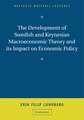
The Development of Swedish and Keynesian Macroeconomic Theory and its Impact on Economic Policy: Raffaele Mattioli Lectures
Autor Erik Filip Lundbergen Limba Engleză Hardback – 30 mai 1996
| Toate formatele și edițiile | Preț | Express |
|---|---|---|
| Paperback (1) | 291.50 lei 6-8 săpt. | |
| Cambridge University Press – 9 iun 2010 | 291.50 lei 6-8 săpt. | |
| Hardback (1) | 543.22 lei 6-8 săpt. | |
| Cambridge University Press – 30 mai 1996 | 543.22 lei 6-8 săpt. |






Preț: 543.22 lei
Preț vechi: 610.37 lei
-11% Nou
Puncte Express: 815
Preț estimativ în valută:
96.13€ • 112.10$ • 84.40£
96.13€ • 112.10$ • 84.40£
Carte tipărită la comandă
Livrare economică 16-30 ianuarie 26
Preluare comenzi: 021 569.72.76
Specificații
ISBN-13: 9780521570763
ISBN-10: 052157076X
Pagini: 224
Dimensiuni: 170 x 244 x 14 mm
Greutate: 0.79 kg
Ediția:New.
Editura: Cambridge University Press
Colecția Cambridge University Press
Seria Raffaele Mattioli Lectures
Locul publicării:Cambridge, United Kingdom
ISBN-10: 052157076X
Pagini: 224
Dimensiuni: 170 x 244 x 14 mm
Greutate: 0.79 kg
Ediția:New.
Editura: Cambridge University Press
Colecția Cambridge University Press
Seria Raffaele Mattioli Lectures
Locul publicării:Cambridge, United Kingdom
V-ar putea interesa
-
 -19%Preț: 633.70 lei784.75 lei
 -
 Macroeconomic Interactions between North and SouthDavid CurriePreț: 276.88 lei
 -
 Preț: 365.62 lei
 -
 Preț: 450.72 lei
 -
 -11%Preț: 413.35 lei464.45 lei
 -
 Preț: 273.00 lei
 -
 Information Choice in Macroeconomics and FinanceLaura L VeldkampPreț: 492.47 lei
 -
 The Selected Letters of John Kenneth GalbraithRichard P. F. HoltPreț: 369.97 lei
 -
 Against the Consensus: Reflections on the Great RecessionJustin Yifu LinPreț: 274.73 lei
 -
 The New Economics of Inequality and RedistributionSamuel BowlesPreț: 234.99 lei
 -
 Savings Shifts in AmericaConstantina Azzara-30%Preț: 338.18 lei480.66 lei
Cuprins
Editorial foreword; First Lecture: The Theories of the Older Generation Economist. Policy Applications in the 1920s: 1. Introduction; 2. The first Postwar crisis (1918–24); 3. The analysis of Swedish economists; 4. The debate on economic policies; 5. The suggested instruments of economic policy; Second Lecture: The Stockholm School and Keynes. The Experience of the 1930s: 6. The birth of the Stockholm school; 7. The Swedish economy in the 1930s; 8. General features of the Stockholm school approach to economic policy; 9. The theories of the Stockholm school and their policy implications; 10. The disequilibrium approach of the Stockholm school; 11. Further differences between the approaches of Keynes and the Stockholm school; Third Lecture: Postwar Policy Issues and Policy Theories before the 1970s: 12. Evolution of the policy environment; 13. Old traditions and innovations in policy analysis; 14. Gunnar Myrdal's contribution and his opponents; 15. Inflationary gap theories; 16. The Rehn–Meidner model and the selective fiscal policy; Fourth Lecture: The Disequilibria of the 1970s and the Need for New Policy Theories: 17. The imbalance of the Swedish economy: 1974–81; 18. The deficiency of policy models; 19. New policy condition; 20. The failure of Keynesian policies; 21. Structural problems and supply-side economics; 22. The debate about the size of the public sector; 23. The need for demand and supply policies; 24. Supply-side policies, efficiency and equity considerations; 25. Concluding remarks on the role of economists; Discussion; Comments; Biography; Bibliography; Index.
Recenzii
After applying rigorous statistical and analytical methods, Vreeland arrives at some significant, and for the IMF, sobering conclusions … Vreeland raises new questions that have important policy implications. He lays out new avenues of research and concludes with some suggestions for IMF reform.' Development Policy Review
Descriere
This book explores the historical development of the Stockholm School of Economics in the wider Keynesian tradition.