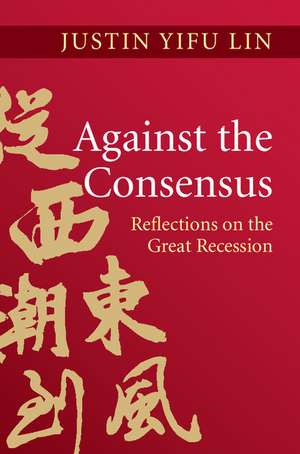
Against the Consensus
Autor Justin Yifu Linen Limba Engleză Hardback – 4 iul 2013
Ceea ce diferențiază Against the Consensus de vasta literatură dedicată Marii Recesiuni este perspectiva privilegiată a autorului Justin Yifu Lin, care a preluat rolul de Economist Șef al Băncii Mondiale chiar în pragul colapsului din 2008. Suntem de părere că această lucrare nu este doar o cronică a eșecului, ci un manifest curajos care contestă teoriile economice convenționale. Găsim în acest volum o analiză riguroasă a dezechilibrelor globale, argumentând că soluțiile standard au fost inadecvate deoarece au ignorat rădăcinile sistemice ale crizei: lichiditatea excesivă și politicile monetare laxe ale SUA. Abordarea sa diferă de cea din The Financial Crisis de P. Arestis prin nivelul de aplicabilitate și propunerile macroeconomice radicale. În timp ce Arestis se concentrează pe reglementare, Lin merge dincolo de simptome, propunând un „Plan Marshall” global pentru infrastructură și reformarea sistemului monetar prin crearea unei monede de rezervă supranaționale. Putem afirma că autorul continuă și rafinează conceptele din Demystifying the World Economic Development, aplicând cadrul „noii economii structurale” pentru a explica de ce anumite națiuni reușesc transformarea structurală în timp ce altele stagnează. Organizarea cărții urmărește o progresie logică, de la diagnosticul crizei și bula imobiliară, până la mecanismele de „catch-up” pentru țările în curs de dezvoltare (metafora „zborului gâștelor”). Cu 46 de ilustrații și 14 tabele, textul oferă suportul empiric necesar pentru a susține o viziune care, deși se opune consensului de la acea vreme, oferă o foaie de parcurs pragmatică pentru stabilitatea viitoare.
Preț: 281.30 lei
Carte tipărită la comandă
Livrare economică 21 noiembrie-05 decembrie
Specificații
ISBN-10: 1107038871
Pagini: 278
Ilustrații: 46 b/w illus. 14 tables
Dimensiuni: 157 x 235 x 20 mm
Greutate: 0.56 kg
Ediția:Nouă
Editura: Cambridge University Press
Locul publicării:New York, United States
V-ar putea interesa
-
 CrashedAdam Tooze-26%Preț: 100.51 lei136.29 lei
 -
 FreefallJoseph E. StiglitzPreț: 134.22 lei
 -
 Whoops!John LanchesterPreț: 77.73 lei
 -
 Crisis Economics: A Crash Course in the Future of FinanceNouriel Roubini-20%Preț: 63.07 lei78.51 lei
 -
 Risk and LiquidityHyun Song Shin-18%Preț: 249.74 lei304.94 lei
 -
 Preț: 138.88 lei
 -
 Preț: 262.71 lei
 -
 -26%Preț: 80.42 lei108.58 lei
 -
 The Death of MoneyJames Rickards-31%Preț: 63.50 lei92.05 lei
 -
 This Time is DifferentCarmen M. ReinhartPreț: 143.00 lei
 -
 Preț: 100.95 lei
 -
 The Shifts and the ShocksMartin Wolf-28%Preț: 77.69 lei108.55 lei
 -
 The Great DevaluationAdam BarattaPreț: 135.45 lei
 -
 -26%Preț: 74.71 lei100.42 lei
 -
 The Collapse of Global LiberalismPhilip PilkingtonPreț: 115.00 lei
 -
 Paper Dragons: China and the Next CrashWalden Bello-43%Preț: 79.62 lei140.09 lei
 -
 Firefighting: The Financial Crisis and its LessonsBen S. Bernanke-21%Preț: 66.82 lei84.13 lei
 -
 Doom LoopEswar S. PrasadPreț: 185.03 lei
 -
 The Return of Depression EconomicsPaul Krugman-32%Preț: 62.97 lei92.20 lei
De ce să citești această carte
Această carte este esențială pentru economiști și decidenți politici care caută alternative la modelele economice tradiționale. Cititorul va câștiga o înțelegere profundă a legăturii dintre dereglementarea financiară și dezechilibrele globale, primind în același timp o perspectivă unică asupra modului în care investițiile masive în infrastructură pot servi drept motor de creștere sustenabilă. Este un ghid strategic pentru a evita repetarea greșelilor din 2008.
Despre autor
Justin Yifu Lin este un economist de renume mondial, fiind primul doctor în științe sociale care s-a întors în China după reformele din 1979. Cu un doctorat obținut la Universitatea din Chicago, Lin a servit ca Vicepreședinte Senior și Economist Șef al Băncii Mondiale. Este fondatorul Centrului de Cercetare Economică din cadrul Universității din Beijing și autorul a numeroase lucrări de referință, printre care The China Miracle și Demystifying the Chinese Economy. Expertiza sa îmbină rigoarea academică occidentală cu o înțelegere profundă a transformărilor economice din Asia și Africa.
Descriere scurtă
Cuprins
Recenzii
'No theory explains development if it can't explain China. Lin is the best economist to challenge received wisdom through authoritative exploration of the Chinese experience. [His] book provides a challenging reassessment of development policy and important prescriptions for global stability.' Ross Garnaut, Vice-Chancellor's Fellow and Professorial Fellow of Economics, University of Melbourne
'Justin Yifu Lin and I have travelled on the same intellectual journey. When we were young, we assumed that the West had all the intellectual answers. As we grew older, we realized that the West did not. This is perfectly normal. No one civilization has a monopoly on wisdom. As we move into a multi-civilizational world, we need to listen to alternative views. Justin explains brilliantly why China's economy has been so successful. And, yes, the West can learn a lesson or two from China. Hence, this book is an essential read.' Kishore Mahbubani, Dean, Lee Kuan Yew School of Public Policy, National University of Singapore, and author of The Great Convergence: Asia, the West, and the Logic of One World
'… Yifu Lin has written a superb appraisal which allows us a bird's eye view of the world economy as it stands - or rather, flutters, today. Against the Consensus' two concluding sentences say it all: "The time is right for reforming the international monetary system. WE should seize it now, before another crisis deals the system a lethal blow." ' Cambridge Business