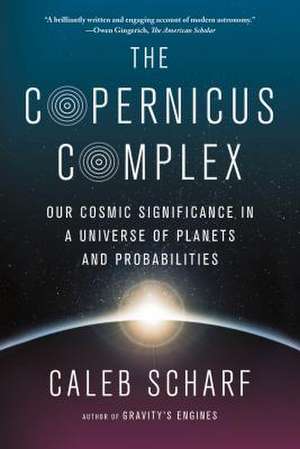
The Copernicus Complex: Our Cosmic Significance in a Universe of Planets and Probabilities
Autor Caleb Scharfen Limba Engleză Paperback – 9 noi 2015
Prezentat în format paperback de la editura Penguin, acest volum reprezintă o incursiune fascinantă în astrobiologia modernă, fiind recunoscut rapid de critici prin nominalizări la premii prestigioase precum PEN/E.O. Wilson Literary Science Writing Award. Apreciem modul în care Caleb Scharf reușește să transforme o dezbatere academică complexă într-o aventură narativă ce pornește de la revoluția inițiată de Nicolaus Copernicus în secolul al XVI-lea.
În The Copernicus Complex, găsim o analiză echilibrată a poziției noastre în cosmos. Dacă timp de secole am acceptat ideea că Pământul este o planetă banală într-un univers infinit, datele recente despre exoplanete și probabilități încep să nuanțeze acest tablou. Ca și Alone in the Universe, lucrarea explorează ideea că existența noastră ar putea fi rezultatul unui lanț de evenimente extrem de puțin probabile, însă, spre deosebire de perspectiva lui John Gribbin care pune accent pe miracolul izolării, Scharf caută o „a treia cale”. El ne propune să îmbrățișăm particularitatea circumstanțelor noastre fără a nega viziunea coperniciană, integrând chimia comună a universului cu diversitatea uluitoare a sistemelor solare nou descoperite.
Această abordare a echilibrului între semnificația cosmică și haos continuă explorările autorului din The Zoomable Universe, unde analiza scările realității, dar aici miza este una filosofică și existențială. Textul este fluid, evitând jargonul excesiv, și reușește să poziționeze descoperirile despre „super-Pământuri” și „Jupiteri fierbinți” într-un context care ne privește direct: suntem sau nu un accident al evoluției cosmice?
Preț: 110.12 lei
Carte disponibilă
Livrare economică 02-16 noiembrie
Specificații
ISBN-10: 0374535574
Pagini: 288
Dimensiuni: 140 x 208 x 18 mm
Greutate: 0.23 kg
Editura: Scientific American
V-ar putea interesa
-
 Human UniverseAndrew CohenPreț: 79.93 lei
 -
 Goldilocks EnigmaPaul DaviesPreț: 92.13 lei
 -
 -16%Preț: 170.10 lei201.83 lei
 -
 Preț: 147.33 lei
 -
 Webb's CosmosMarcin SawickiPreț: 350.63 lei
 -
 -26%Preț: 69.92 lei94.22 lei
 -
 The Grand DesignLeonard Mlodinow-28%Preț: 77.17 lei107.25 lei
 -
 -6%Preț: 74.87 lei79.52 leiRecomandat
 -
 A Brief History of the Universe (and our place in it)Sarah Alam Malik-19%Preț: 98.37 lei121.91 lei
 -
 Our StoryColin Butfield-21%Preț: 130.21 lei165.17 lei
 -
 Space OdditiesHarry Cliff-40%Preț: 46.68 lei77.58 lei
 -
 Frequently Asked Questions About the UniverseDaniel Whiteson-27%Preț: 68.00 lei93.08 lei
 -
 The PrincipiaIsaac NewtonPreț: 153.10 lei
 -
 Preț: 205.89 lei
 -
 Eight Improbable PossibilitiesJohn GribbinPreț: 70.14 lei
 -
 Alien EarthsLisa KalteneggerPreț: 77.96 lei
 -
 Our Accidental UniverseChris LintottPreț: 84.58 lei
 -
 -20%Preț: 62.14 lei77.32 lei
 -
 BiocentrismRobert LanzaPreț: 96.88 lei
 -
 Preț: 101.35 lei
De ce să citești această carte
Recomandăm această carte cititorilor pasionați de astronomie și filosofie care doresc să înțeleagă unde se situează omenirea în era descoperirilor exoplanetare. Veți câștiga o perspectivă proaspătă asupra „Principiului Copernician”, învățând cum cele mai noi date de la NASA și din astrobiologie ne redefinesc statutul. Este o lectură esențială pentru a înțelege de ce întrebarea „suntem singuri?” are acum răspunsuri mult mai nuanțate decât în urmă cu un deceniu.
Despre autor
Caleb Scharf este directorul Centrului de Astrobiologie de la Universitatea Columbia și o voce autoritară în popularizarea științei. Colaborator constant pentru publicații de renume precum „Scientific American”, „Nature” și „The New York Times”, Scharf îmbină rigoarea academică cu talentul narativ. Expertiza sa l-a transformat într-un consultant căutat pentru Discovery Channel și Science Channel. Printre lucrările sale notabile se numără The Ascent of Information și The Giant Leap, volume care explorează tranzițiile majore ale vieții și informației în context universal.
Descriere scurtă
Longlisted for the 2015 PEN/E.O. Wilson Literary Science Writing Award
Short-listed for "Physics World"'s Book of the Year
"The Sunday Times (UK) Best Science Book of 2014"
""A "Publishers Weekly" Top 10 Science Book of Fall 2014
An NBC News Top Science and Tech Book of 2014
A Politics & Prose 2014 Staff Pick
In the sixteenth century, Nicolaus Copernicus dared to go against the establishment by proposing that Earth rotates around the Sun. Having demoted Earth from its unique position in the cosmos to one of mediocrity, Copernicus set in motion a revolution in scientific thought. This perspective has influenced our thinking for centuries. However, recent evidence challenges the Copernican Principle, hinting that we do in fact live in a special place, at a special time, as the product of a chain of unlikely events. But can we be significant if the Sun is still just one of a billion trillion stars in the observable universe? And what if our universe is just one of a multitude of others-a single slice of an infinity of parallel realities?
In "The Copernicus Complex," the renowned astrophysicist Caleb Scharf takes us on a scientific adventure, from tiny microbes within the Earth to distant exoplanets, probability theory, and beyond, arguing that there is a solution to this contradiction, a third way of viewing our place in the cosmos, if we weigh the evidence properly. As Scharf explains, we do occupy an unusual time in a 14-billion-year-old universe, in a somewhat unusual type of solar system surrounded by an ocean of unimaginable planetary diversity: hot Jupiters with orbits of less than a day, planet-size rocks spinning around dead stars, and a wealth of alien super-Earths. Yet life here is built from the most common chemistry in the universe, and we are a snapshot taken from billions of years of biological evolution. Bringing us to the cutting edge of scientific discovery, Scharf shows how the answers to fundamental questions of existence will come from embracing the peculiarity of our circumstance without denying the Copernican vision.
With characteristic verve, Scharf uses the latest scientific findings to reconsider where we stand in the balance between cosmic significance and mediocrity, order and chaos. Presenting a compelling and bold view of our true status, "The Copernicus Complex" proposes a way forward in the ultimate quest: determining life's abundance, not just across this universe but across all realities.
Notă biografică
Recenzii
The Copernicus Complex delivers its argument with comparable clarity, insight and humour. There is much to enjoy along the way, including a compelling account of the extraordinary diversity of planetary systems we now know to exist
The Copernicus Complex addresses a perennial mystery: the cosmic significance (or perhaps the insignificance) of life on Earth. Caleb Scharf summarizes current debates on how life began and how pervasive it is, explaining how our perspective has been changed by the recent discovery that there are millions of Earth-like planets in the Milky Way. He sets his theme in a historical context, writing in an engaging and accessible style
A tantalising approach to the mysteries of the universe
[A] witty, adroitly marshalled treatise on human significance
An intoxicating collection of questions answered with other questions, and startling discoveries that make creation even more mysterious . . . Books such as these remind us that we are lucky to be here at all, and even luckier to be here now
How reasonable is it to think that we are alone in the vast expanses of space? And how significant is life on Earth on the Universal (or multiversal) scale? These are the questions that astrobiologist Caleb Scharf addresses intelligently and comprehensively in his beautifully written The Copernicus Complex