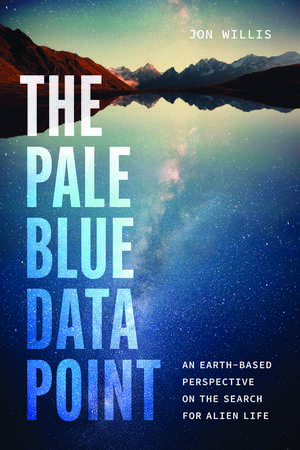
The Pale Blue Data Point: An Earth-Based Perspective on the Search for Alien Life
Autor Jon Willisen Limba Engleză Hardback – 30 oct 2025
A thrilling tour of Earth that shows the search for extraterrestrial life starts in our own backyard.
Is there life off Earth? Bound by the limitations of spaceflight, a growing number of astrobiologists investigate the question by studying life on our planet. Astronomer and author Jon Willis shows us how it’s done, allowing readers to envision extraterrestrial landscapes by exploring their closest Earth analogs. With Willis, we dive into the Pacific Ocean from the submersible-equipped E/V Nautilus to ponder the uncharted seas of Saturn’s and Jupiter’s moons; search the Australian desert for some of Earth’s oldest fossils and consider the prospects for a Martian fossil hunt; visit mountaintop observatories in Chile to search for the telltale twinkle of extrasolar planets; and eavesdrop on dolphins in the Bahamas to imagine alien minds.
With investigations ranging from meteorite hunting to exoplanet detection, Willis conjures up alien worlds and unthought-of biological possibilities, speculating what life might look like on other planets by extrapolating from what we can see on Earth, our single “pale blue dot”—as Carl Sagan famously called it—or, in Willis’s reframing, scientists’ “pale blue data point.”
Preț: 147.33 lei
Puncte Express: 221
Carte disponibilă
Livrare economică 28 octombrie-11 noiembrie
Livrare express 14-20 octombrie pentru 68.79 lei
Livrare prin curier în România Termenul estimat este afișat lângă disponibilitate.
Transport gratuit de la 400.00 lei Plată online sau ramburs, în funcție de opțiunile comenzii.
Retur gratuit în 14 zile Comandă securizată și suport în română.
Specificații
ISBN-13: 9780226822402
ISBN-10: 0226822400
Pagini: 256
Ilustrații: 10 color plates, 10 halftones
Dimensiuni: 140 x 216 x 25 mm
Greutate: 0.43 kg
Ediția:First Edition
Editura: University of Chicago Press
Colecția University of Chicago Press
ISBN-10: 0226822400
Pagini: 256
Ilustrații: 10 color plates, 10 halftones
Dimensiuni: 140 x 216 x 25 mm
Greutate: 0.43 kg
Ediția:First Edition
Editura: University of Chicago Press
Colecția University of Chicago Press
Notă biografică
Jon Willis is professor of astronomy at the University of Victoria in British Columbia where he studies both the properties of the universe we live in and the formation of life within it. He is the author of All These Worlds Are Yours: The Scientific Search for Alien Life.
Cuprins
Preface
1 The Pale Blue Data Point
2 Twenty Thousand Pings Under the Sea: In Search of Alien Oceans
3 Swimming with Stromatolites: The Hunt for Martian Fossils
4 The Arc of the Firmament: Mapping Exoplanets
5 To Catch a Falling Star: Meteorites and the Clues to Earth’s Origin as a Life-Bearing Planet
6 So Long and Thanks for All the Fish: A Dolphin-Led Guide to Alien Communication
Acknowledgments
Further Travels
Index
1 The Pale Blue Data Point
2 Twenty Thousand Pings Under the Sea: In Search of Alien Oceans
3 Swimming with Stromatolites: The Hunt for Martian Fossils
4 The Arc of the Firmament: Mapping Exoplanets
5 To Catch a Falling Star: Meteorites and the Clues to Earth’s Origin as a Life-Bearing Planet
6 So Long and Thanks for All the Fish: A Dolphin-Led Guide to Alien Communication
Acknowledgments
Further Travels
Index
Recenzii
"[Willis's] book brilliantly explains the technical details of astronomy and robotic space exploration—including missions to retrieve samples of asteroids, and the discovery of vast subsurface oceans in the frozen moons of Jupiter and Saturn—but he also wants to show what his science looks like ‘in the field,’ and so he takes the reader with him to marvel at large observatory telescopes in the Andes, to Morocco to scour the desert for meteorites, and on board a ship that uses submersibles to probe hot volcanic vents in the deep ocean floor. . . . Here is Willis’s fundamental argument: The more we learn about Earth—our one ‘pale blue data point’ for a planet on which life has definitively arisen—the more qualified we will be to recognize signs of life elsewhere. . . . [A] joyful account.”
"The search for alien life has captured the popular imagination for decades. Are they friendly . . . intelligent . . . green? The average person may conceive of alien life as anything from the large-brained villains of Mars Attacks! to the haunting and ghostly apparitions of Arrival, but what might aliens really resemble? . . . In his most recent book, The Pale Blue Data Point, [Willis] examines what alien life might really look like, and how we can use Earth as a magnifying glass to help us in our search for extraterrestrial intelligence."
"Willis’s title is a play on Carl Sagan’s poignant description of how Earth appeared in a photograph taken by Voyager 1 as it was heading toward the edge of the solar system some thirty-five years ago. Sagan referred to our world as a 'pale blue dot' that covers mere pixels on that spacecraft photo. To us, of course, our planet is much more than a dot, and, as Willis emphasizes, it may tell us a great deal about possible realms, and possible life forms, in the far beyond. To that end, Willis takes us on a tour of some of Earth’s most seemingly inhospitable environments."
“In 1990, before it left the Solar System, Voyager 1 took an image of Earth famously described by astronomer Carl Sagan as a ‘pale blue dot.’ Astronomer Willis refers to Earth as a ‘pale blue data point’ instead, and takes the reader from deep in the Pacific Ocean to observatories in Chile that examine exoplanets. He writes about how ‘at certain places, whether they be wind-blown deserts, the ocean’s depths, advanced laboratories, or mountaintop observatories, Earth also offers clues as to the prospects for life beyond it.’”
"Absolutely riveting. . . . If you have an interest in astrobiology, astronomy, biology, Earth science, or simply enjoy reading a book that will cause you to say 'Wow!' with great regularity whilst reading it, I very much encourage you to read The Pale Blue Data Point for yourself. After having done so, I very much doubt that you’ll ever look up into the night sky ever again and not find your mind filled with new questions, curiosities, and dreams of what may one day be found on one of those glittering—perhaps red, perhaps green, perhaps even blue—dots."
"What Willis wants to do is to look at the ways we can use facilities and discoveries here on Earth to make our suppositions as tenable as possible. To that end, he travels over the globe seeking out environs as diverse as the deep ocean’s black smokers, the meteorite littered sands of Morocco’s Sahara and Chile’s high desert. It's a lively read. . . . It’s also a heartening work, because in the end the sense of life’s tenacity in all the environments Willis studies cannot help but make the reader optimistic. "
“The underlying theme of the book rings true: to search for life beyond Earth, we have to understand life on Earth and what lessons it can offer for what to look for elsewhere, from fossils on Mars to biosignatures of telltale gases in the atmospheres of exoplanets. We may—in a year or a decade or longer—finally find that firm evidence that we are not alone. For now, we are that solitary pale blue dot in a bleak cosmos.”
"Very readable and accessible. . . . Worth a look."
"A highly engaging, captivating and timely book."
“The search for alien life actually begins right in our own backyard. . . . Willis investigates the question 'Is there life off Earth?' by joining astrobiologists to study life right here on our planet. By envisioning extraterrestrial landscapes through the exploration of Earth’s closest analogs, Willis conjures up alien worlds and unthought-of biological possibilities, speculating what life might look like on other planets by extrapolating from what we can see on Earth.”
“Each chapter reveals a new location Willis traveled to and a different research technique he tested to search for life. . . . These Earth analogs provide direction for future space missions to consider as the search for alien life continues. Written in an engaging style, this volume is supported by black-and-white and color illustrations and a reading list. . . . Recommended.”
"As a professor of astronomy at the University of Victoria in British Columbia, Willis has written a highly-engaging, captivating and timely book….Given the rise of astrobiology and the search for life elsewhere in the cosmos, Willis asks 'can a collection of tangential ideas, drawn from all points of the scientific compass, be made to fit into the circle of a new discipline?' This book offers the reader the answer to that question, expertly written to spotlight astrobiology in action."
"The search for alien life has captured the popular imagination for decades. Are they friendly . . . intelligent . . . green? The average person may conceive of alien life as anything from the large-brained villains of Mars Attacks! to the haunting and ghostly apparitions of Arrival, but what might aliens really resemble? . . . In his most recent book, The Pale Blue Data Point, [Willis] examines what alien life might really look like, and how we can use Earth as a magnifying glass to help us in our search for extraterrestrial intelligence."
"Five stars. . . . The most fascinating and eye-opening book about extraterrestrial life that I’ve read for a long time."
"Willis’s title is a play on Carl Sagan’s poignant description of how Earth appeared in a photograph taken by Voyager 1 as it was heading toward the edge of the solar system some thirty-five years ago. Sagan referred to our world as a 'pale blue dot' that covers mere pixels on that spacecraft photo. To us, of course, our planet is much more than a dot, and, as Willis emphasizes, it may tell us a great deal about possible realms, and possible life forms, in the far beyond. To that end, Willis takes us on a tour of some of Earth’s most seemingly inhospitable environments."
“In 1990, before it left the Solar System, Voyager 1 took an image of Earth famously described by astronomer Carl Sagan as a ‘pale blue dot.’ Astronomer Willis refers to Earth as a ‘pale blue data point’ instead, and takes the reader from deep in the Pacific Ocean to observatories in Chile that examine exoplanets. He writes about how ‘at certain places, whether they be wind-blown deserts, the ocean’s depths, advanced laboratories, or mountaintop observatories, Earth also offers clues as to the prospects for life beyond it.’”
"Absolutely riveting. . . . If you have an interest in astrobiology, astronomy, biology, Earth science, or simply enjoy reading a book that will cause you to say 'Wow!' with great regularity whilst reading it, I very much encourage you to read The Pale Blue Data Point for yourself. After having done so, I very much doubt that you’ll ever look up into the night sky ever again and not find your mind filled with new questions, curiosities, and dreams of what may one day be found on one of those glittering—perhaps red, perhaps green, perhaps even blue—dots."
"What Willis wants to do is to look at the ways we can use facilities and discoveries here on Earth to make our suppositions as tenable as possible. To that end, he travels over the globe seeking out environs as diverse as the deep ocean’s black smokers, the meteorite littered sands of Morocco’s Sahara and Chile’s high desert. It's a lively read. . . . It’s also a heartening work, because in the end the sense of life’s tenacity in all the environments Willis studies cannot help but make the reader optimistic. "
“The underlying theme of the book rings true: to search for life beyond Earth, we have to understand life on Earth and what lessons it can offer for what to look for elsewhere, from fossils on Mars to biosignatures of telltale gases in the atmospheres of exoplanets. We may—in a year or a decade or longer—finally find that firm evidence that we are not alone. For now, we are that solitary pale blue dot in a bleak cosmos.”
"Very readable and accessible. . . . Worth a look."
"A highly engaging, captivating and timely book."
“The search for alien life actually begins right in our own backyard. . . . Willis investigates the question 'Is there life off Earth?' by joining astrobiologists to study life right here on our planet. By envisioning extraterrestrial landscapes through the exploration of Earth’s closest analogs, Willis conjures up alien worlds and unthought-of biological possibilities, speculating what life might look like on other planets by extrapolating from what we can see on Earth.”
“Stimulating. . . . The book shines in its attention to scale, shifting with ease between sensory-rich observations drawn from life, microhistories of major scientific personalities and engineering marvels, and technical descriptions. . . . Rich with firsthand fieldwork and unexpected connections, The Pale Blue Data Point is a thorough primer on humanity’s centuries-long search for alien life in the observable universe.”
“Each chapter reveals a new location Willis traveled to and a different research technique he tested to search for life. . . . These Earth analogs provide direction for future space missions to consider as the search for alien life continues. Written in an engaging style, this volume is supported by black-and-white and color illustrations and a reading list. . . . Recommended.”
“A lively introduction to the field of astrobiology.”
“[Willis] conveys great enthusiasm alongside necessary scientific skepticism.”
“Energizing. . . . Through humorous, concise, accessible writing, Willis eloquently presents the growing—though still circumstantial—evidence that we are not alone.”
“A concise overview of astrobiology and what we know—and, more importantly, what we don’t—about the search for life elsewhere in our solar system and beyond.”
“The Pale Blue Data Point is goosebump inducing. Willis grapples with deep questions about our place in the universe, and readers may be astonished to learn that the answers could be breathtakingly close at hand.”
"As a professor of astronomy at the University of Victoria in British Columbia, Willis has written a highly-engaging, captivating and timely book….Given the rise of astrobiology and the search for life elsewhere in the cosmos, Willis asks 'can a collection of tangential ideas, drawn from all points of the scientific compass, be made to fit into the circle of a new discipline?' This book offers the reader the answer to that question, expertly written to spotlight astrobiology in action."
“Willis’s book is quite novel: He shows how the search for life in the cosmos is guided by our studies of life on Earth. And he does so with anecdotes of his own travels to experience the different Earth-bound investigations—of life in hydrothermal vents, fossilized bacteria, exoplanets, traces in meteorites, and more—which makes the book extremely fun. An enlightening read (even as a physicist), The Pale Blue Data Point is a charming, compelling, and approachable look at how scientists are hunting beyond the Earth for life unknown to us.”