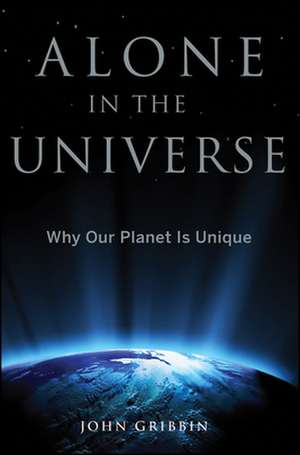
Alone in the Universe
Autor John Gribbinen Limba Engleză Paperback – dec 2011
În literatura academică și de popularizare a științei, discuția despre exobiologie pendulează adesea între optimismul matematic al ecuației lui Drake și tăcerea mormântală a Paradoxului lui Fermi. Alone in the Universe vine să completeze o lacună esențială în această dezbatere, oferind o perspectivă riguroasă din punct de vedere astrofizic asupra rarității vieții inteligente. Considerăm că abordarea lui John Gribbin este una curajoasă: el nu se limitează la a specula, ci analizează o succesiune de evenimente cosmice, petrecute acum aproximativ 600 de milioane de ani, care au transformat Pământul într-o excepție biologică. Descoperim aici o argumentație solidă despre cum impactul unui „supercomet” cu Venus și formarea Lunii au fost pilonii unei stabilități climatice fără de care civilizația umană nu ar fi existat. Cititorii familiarizați cu The Privileged Planet (20th Anniversary Edition) de Guillermo Gonzalez vor aprecia modul în care John Gribbin aduce noi date științifice pentru a susține teza unicității noastre, însă spre deosebire de alte lucrări care adoptă un ton pur teoretic, acest volum se ancorează în mecanica cerească și istoria galactică. Merită menționat că această lucrare continuă explorarea probabilităților științifice începută în Eight Improbable Possibilities și Impossible, Possible, and Improbable, consolidând reputația autorului de a transforma concepte complexe în narațiuni accesibile. Stilul este precis, ritmul alert, iar structura narativă ne poartă prin miliarde de ani de evoluție pentru a demonstra că, deși suntem singuri în galaxie, acest lucru face existența noastră cu atât mai valoroasă.
Preț: 103.91 lei
Carte disponibilă
Livrare economică 30 octombrie-13 noiembrie
Specificații
ISBN-10: 1683366891
Pagini: 240
Dimensiuni: 154 x 233 x 20 mm
Greutate: 0.37 kg
Editura: Turner Publishing Company
V-ar putea interesa
-
 Trilobite!Richard ForteyPreț: 78.14 lei
 -
 Isaac Asimov's Guide to Earth and SpaceIsaac AsimovPreț: 45.44 lei
 -
 Eclipse!Philip S HarringtonPreț: 121.25 lei
 -
 The Scientific Companion, 2nd Ed.Cesare EmilianiPreț: 160.65 lei
 -
 Planetary DreamsRobert ShapiroPreț: 223.80 lei
 -
 Skywatchers, Shamans & KingsE C KruppPreț: 189.55 lei
 -
 Scientific American the Amateur AstronomerScientific AmericanPreț: 121.25 lei
 -
 Preț: 122.10 lei
 -
 In Search Of Schrodinger's CatJohn Gribbin-30%Preț: 61.33 lei87.50 lei
 -
 A Brief History of TimeStephen HawkingPreț: 71.21 lei
 -
 -44%Preț: 75.30 lei133.43 lei
 -
 -39%Preț: 85.84 lei139.94 lei
 -
 Rust: The Longest WarJonathan WaldmanPreț: 103.79 lei
 -
 AstronomyDinah L. MochePreț: 170.39 lei
 -
 Scientific Babel: The language of science from the fall of Latin to the rise of EnglishProfessor Michael Gordin-20%Preț: 74.17 lei92.57 lei
 -
 Clark, S: The Unknown UniverseStuart Clark-29%Preț: 82.15 lei115.14 lei
 -
 Storm in a TeacupHelen Czerski-19%Preț: 64.02 lei78.73 lei
 -
 Destination MarsAndrew MayPreț: 70.57 lei
 -
 Everything You Know about Science Is WrongMatt Brown-8%Preț: 67.87 lei73.94 lei
De ce să citești această carte
Recomandăm această carte pasionaților de astronomie și astrobiologie care caută un răspuns fundamentat la întrebarea „Suntem singuri?”. Cititorul câștigă o înțelegere profundă a factorilor critici care permit apariția vieții inteligente, depășind clișeele science-fiction. Este o lectură esențială pentru a înțelege fragilitatea și unicitatea poziției noastre în Calea Lactee, oferind un argument științific solid împotriva dogmei mediocrității cosmice.
Despre autor
John Gribbin este unul dintre cei mai respectați scriitori de literatură științifică contemporani, deținând un doctorat în astrofizică de la Universitatea Cambridge. Este celebru pentru capacitatea sa de a explica fizica cuantică și cosmologia publicului larg, lucrarea sa de referință fiind In Search of Schrodinger's Cat. De-a lungul carierei sale, a colaborat cu instituții prestigioase precum Universitatea din Sussex și a scris numeroase volume care explorează originile universului și probabilitățile matematice ale existenței, fiind un fin observator al paradoxurilor cosmice.
Recenzii
"This book's title exaggerates the author's argument about the rarity of life in the "universe": Gribbin (astronomy, Univ. of Sussex, UK; In Search of the Multiverse) claims only that intelligent life in the Milky Way galaxy (not the entire universe) is almost certainly limited to Earth. Since there are billions of galaxies in the visible universe (and possibly an infinite number beyond the reach of our instruments), his carefully limited claim is sensible. He presents a formidable array of evidence from astronomy, astrophysics, geology, and evolutionary biology to support his basic assertion. Gribbin's definition of intelligent life on Earth includes only Homo sapiens, so he is weighing the likelihood that species on other planets within the local galaxy have intelligence equaling or exceeding that of humans. His case is well presented, but the odds may shift in the next few decades as more data are gathered on the Earthlike planets outside our solar system. VERDICT Gribbin is a veteran author of popular science books; this new volume should be of great interest for all readers curious about the possibility of life beyond our own planet. Strongly recommended."--Jack W. Weigel, formerly with Univ. of Michigan Lib., Ann Arbor ("Library Journal," November 15, 2011) "The Milky Way contains a few hundred billion stars, but almost certainly contains only one intelligent civilization," says astrophysicist and veteran popular science writer Gribbin (The Theory of Everything). In an infinite universe, on the other hand, anything is possible, but we can only explore such questions closer to home. Gribbin makes a thoroughly lucid and convincing case. Recent astronomical observations have shown that exoplanets--worlds orbiting other stars--are more common than we expected, but Earth-like worlds are rare. And even planets in a "habitable zone" of both a galaxy and an individual star need water and the right organic compounds to engender and sustain carbon-based life. "Life go
* ""This book's title exaggerates the author's argument about the rarity of life in the ""universe"": Gribbin (astronomy, Univ. of Sussex, UK; In Search of the Multiverse) claims only that intelligent life in the Milky Way galaxy (not the entire universe) is almost certainly limited to Earth. Since there are billions of galaxies in the visible universe (and possibly an infinite number beyond the reach of our instruments), his carefully limited claim is sensible. He presents a formidable array of evidence from astronomy, astrophysics, geology, and evolutionary biology to support his basic assertion. Gribbin's definition of intelligent life on Earth includes only Homo sapiens, so he is weighing the likelihood that species on other planets within the local galaxy have intelligence equaling or exceeding that of humans. His case is well presented, but the odds may shift in the next few decades as more data are gathered on the Earthlike planets outside our solar system. VERDICT Gribbin is a veteran author of popular science books; this new volume should be of great interest for all readers curious about the possibility of life beyond our own planet. Strongly recommended.""--Jack W. Weigel, formerly with Univ. of Michigan Lib., Ann Arbor ("Library Journal," November 15, 2011) ""The Milky Way contains a few hundred billion stars, but almost certainly contains only one intelligent civilization,"" says astrophysicist and veteran popular science writer Gribbin (The Theory of Everything). In an infinite universe, on the other hand, anything is possible, but we can only explore such questions closer to home. Gribbin makes a thoroughly lucid and convincing case. Recent astronomical observations have shown that exoplanets--worlds orbiting other stars--are more common than we expected, but Earth-like worlds are rare. And even planets in a ""habitable zone"" of both a galaxy and an individual star need water and the right organic compounds to engender and sustain carbon-based life. ""Life got a grip on Earth with almost indecent haste,"" but it took Earth's metallic core and a near-twin Moon to stabilize Earth's tilt and steer off dangerous radiation; equally advantageous to Earth, Jupiter's mass pulls in most of the comets and asteroids that might otherwise smash into us. Gribbin lays out the details one by one, building a concise case that ""[w]e are alone, and we had better get used to the idea."" (Dec.) ("Publishers Weekly," October 24, 2011)
Textul de pe ultima copertă
Critical acclaim for John Gribbin
"The master of popular science."
--"The Sunday Times" (London)
"Gribbin explains things very well indeed, and there's not an equation in sight."
--David Goodstein, "The New York Times Book Review," on "Almost Everyone's Guide to Science"
"Gribbin takes us through the basics [of chaos theory] with his customary talent for accessibility and clarity. [His] arguments are driven not by impersonal equations but by a sense of wonder at the presence in the universe and in nature of simple, self-organizing harmonies underpinning all structures, whether they are stars or flowers."
--"The Sunday Times" (London) on Deep Simplicity
"Gribbin breathes life into the core ideas of complexity science, and argues convincingly that the basic laws, even in biology, will ultimately turn out to be simple."
--"Nature" magazine on Deep Simplicity
"In the true quantum realm, Gribbin remains the premier expositor of its latest developments."
--"Booklist" on Schrodinger's Kittens and the Search for Reality
Notă biografică
Descriere
The acclaimed author of "In Search of Schrodinger's Cat" searches for life on other planets Are we alone in the universe? Surely amidst the immensity of the cosmos there must be other intelligent life out there. Don't be so sure, says John Gribbin, one of today's best popular science writers. In this fascinating and intriguing new book, Gribbin argues that the very existence of intelligent life anywhere in the cosmos is, from an astrophysicist's point of view, a miracle. So why is there life on Earth and (seemingly) nowhere else? What happened to make this planet special? Taking us back some 600 million years, Gribbin lets you experience the series of unique cosmic events that were responsible for our unique form of life within the Milky Way Galaxy.Written by one of our foremost popular science writers, author of the bestselling "In Search of Schrodinger's Cat"Offers a bold answer to the eternal question, ""Are we alone in the universe?""Explores how the impact of a ""supercomet"" with Venus 600 million years ago created our moon, and along with it, the perfect conditions for life on Earth
From one of our most talented science writers, this book is a daring, fascinating exploration into the dawning of the universe, cosmic collisions and their consequences, and the uniqueness of life on Earth.