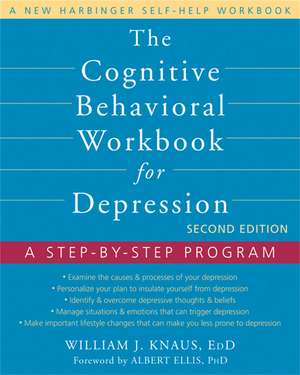
The Cognitive Behavioral Workbook for Depression, Second Edition: A Step-by-Step Program: A New Harbinger Self-Help Workbook
Autor William J Knausen Limba Engleză Paperback – 2 aug 2012
First, readers learn the basics for defeating the most damaging symptoms of depression and create a master plan for overcoming their condition. Later, readers discover the roots of their depression in depressive beliefs, worthlessness beliefs, and helplessness beliefs. The final section of this workbook helps readers anchor these positive changes for long-term relapse prevention and increased motivation.
Recommended by therapists nationwide, this second edition of The Cognitive Behavioral Workbook for Depression offers all the skills readers need to overcome depression with cognitive behavioral therapy.






Preț: 141.16 lei
Preț vechi: 201.54 lei
-30%
Puncte Express: 212
Carte disponibilă
Livrare economică 05-19 noiembrie
Livrare express 21-27 octombrie pentru 103.23 lei
Livrare prin curier în România Termenul estimat este afișat lângă disponibilitate.
Transport gratuit de la 400.00 lei Plată online sau ramburs, în funcție de opțiunile comenzii.
Retur gratuit în 14 zile Comandă securizată și suport în română.
Specificații
ISBN-13: 9781608823802
ISBN-10: 1608823806
Pagini: 336
Dimensiuni: 202 x 252 x 22 mm
Greutate: 0.66 kg
Ediția:2nd edition
Editura: Little Brown
Colecția New Harbinger
Seria A New Harbinger Self-Help Workbook
Locul publicării:London, United Kingdom
ISBN-10: 1608823806
Pagini: 336
Dimensiuni: 202 x 252 x 22 mm
Greutate: 0.66 kg
Ediția:2nd edition
Editura: Little Brown
Colecția New Harbinger
Seria A New Harbinger Self-Help Workbook
Locul publicării:London, United Kingdom
V-ar putea interesa
-
 The Back Sufferer's BibleSarah Key-34%Preț: 94.08 lei143.20 lei
 -
 The Down's Syndrome HandbookDowns Syndrome AssociationPreț: 93.27 lei
 -
 Should I Be Tested for Cancer?H. Gilbert Welch-5%Preț: 135.65 lei142.79 lei
 -
 Feel The Fear & BeyondSusan Jeffers-20%Preț: 84.77 lei106.14 lei
 -
 -29%Preț: 147.20 lei208.01 lei
 -
 -27%Preț: 112.14 lei153.68 lei
 -
 -24%Preț: 127.49 lei167.39 lei
 -
 Preț: 175.92 lei
 -
 A User Guide to the GF/CF Diet for Autism, Asperger Syndrome and AD/HDMarilyn Le BretonPreț: 173.40 lei
 -
 -19%Preț: 134.20 lei166.43 lei
 -
 -20%Preț: 163.74 lei203.49 lei
 -
 -20%Preț: 116.91 lei145.60 lei
 -
 Broken OpenElizabeth Lesser-23%Preț: 108.25 lei140.93 lei
 -
 Stammering: Advice For All AgesRenee Byrne-26%Preț: 46.99 lei63.81 lei
 -
 How to Master AnxietyIvan TyrrellPreț: 72.79 lei
Recenzii
For anyone in the prison of depression, this workbook might help you get out. It's both scholarly and practical, and leaves no stone unturned in laying out self-help strategies for helping deal with this widespread problem.
William Knaus has been a leading practitioner and teacher of cognitive behavior therapy for over four decades. In The Cognitive Behavioral Workbook for Depression, he draws from his vast store of experience to provide people who struggle with depression practical, usable strategies they can put to immediate use to not only feel better, but to get better. Written in an engaging, accessible manner, the book is chock full of powerful tools that, when compiled into a personal action plan, can both defeat depression and build a happy, productive life. I think this is a substantial book anyone, not just the depressive, will find valuable, and I highly endorse it for both the lay public and the clinical community alike. I know that I will keep it handy for my own personal reference and repeatedly encourage my clients to purchase it.
I have waited for this book my entire career! With compassion, flexibility, and scientifically sound earnestness, Knaus helps the depressed reader navigate the wide variety of cognitive behavioral treatments to choose the package that is right for him or her. Second editions often contain few, if any, theoretical concepts and clinical exercises that are significantly different from those in the first edition. Not so with this volume! It is full of fresh ideas and therapeutic assignments that help the motivated depressed individual finally crawl out of self-defeating misery.
William Knaus has been a leading practitioner and teacher of cognitive behavior therapy for over four decades. In The Cognitive Behavioral Workbook for Depression, he draws from his vast store of experience to provide people who struggle with depression practical, usable strategies they can put to immediate use to not only feel better, but to get better. Written in an engaging, accessible manner, the book is chock full of powerful tools that, when compiled into a personal action plan, can both defeat depression and build a happy, productive life. I think this is a substantial book anyone, not just the depressive, will find valuable, and I highly endorse it for both the lay public and the clinical community alike. I know that I will keep it handy for my own personal reference and repeatedly encourage my clients to purchase it.
I have waited for this book my entire career! With compassion, flexibility, and scientifically sound earnestness, Knaus helps the depressed reader navigate the wide variety of cognitive behavioral treatments to choose the package that is right for him or her. Second editions often contain few, if any, theoretical concepts and clinical exercises that are significantly different from those in the first edition. Not so with this volume! It is full of fresh ideas and therapeutic assignments that help the motivated depressed individual finally crawl out of self-defeating misery.