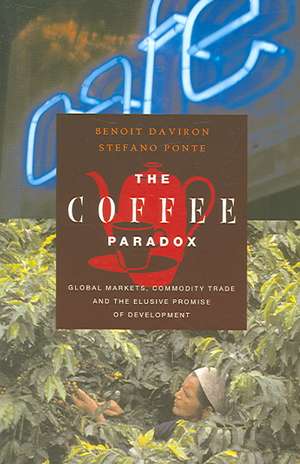
The Coffee Paradox: Global Markets, Commodity Trade and the Elusive Promise of Development
Autor Benoit Daviron, Stefano Ponteen Limba Engleză Paperback – noi 2005
Through the study of the global value chain for coffee, the authors recast the 'development problem' for countries relying on commodity exports in entirely new ways. They do so by analysing the so-called coffee paradox - the coexistence of a 'coffee boom' in consuming countries and of a 'coffee crisis' in producing countries. New consumption patterns have emerged with the growing importance of specialty, fair trade and other 'sustainable' coffees. In consuming countries, coffee has become a fashionable drink and coffee bar chains have expanded rapidly. At the same time, international coffee prices have fallen dramatically and producers receive the lowest prices in decades.
This book shows that the coffee paradox exists because what farmers sell and what consumers buy are becoming increasingly 'different' coffees. It is not material quality that contemporary coffee consumers pay for, but mostly symbolic quality and in-person services. As long as coffee farmers and their organizations do not control at least parts of this 'immaterial' production, they will keep receiving low prices. The Coffee Paradox seeks ways out from this situation by addressing some key questions: What kinds of quality attributes are combined in a coffee cup or coffee package? Who is producing these attributes? How can part of these attributes be produced by developing country farmers? To what extent are specialty and sustainable coffees achieving these objectives?
Preț: 264.12 lei
Preț vechi: 310.30 lei
-15%
Puncte Express: 396
Carte tipărită la comandă
Livrare economică 01-15 decembrie
Livrare prin curier în România Termenul estimat este afișat lângă disponibilitate.
Transport gratuit de la 400.00 lei Plată online sau ramburs, în funcție de opțiunile comenzii.
Retur gratuit în 14 zile Comandă securizată și suport în română.
Specificații
ISBN-13: 9781842774571
ISBN-10: 1842774573
Pagini: 324
Dimensiuni: 138 x 216 x 20 mm
Greutate: 0.4 kg
Editura: Bloomsbury Publishing
Colecția Zed Books
Locul publicării:London, United Kingdom
ISBN-10: 1842774573
Pagini: 324
Dimensiuni: 138 x 216 x 20 mm
Greutate: 0.4 kg
Editura: Bloomsbury Publishing
Colecția Zed Books
Locul publicării:London, United Kingdom
V-ar putea interesa
-
 The Elements of PowerNicolas NiarchosPreț: 125.36 lei
 -
 The Prosperity ParadoxClayton M. ChristensenPreț: 196.91 lei
 -
 A Good African StoryAndrew Rugasira-20%Preț: 73.24 lei91.28 lei
 -
 CoffeelandAugustine Sedgewick-29%Preț: 66.57 lei94.31 lei
 -
 The Undercover EconomistTim Harford-26%Preț: 69.96 lei94.06 lei
 -
 The Philosophy of CoffeeBrian WilliamsPreț: 71.62 lei
 -
 The Travels of a T-Shirt in the Global EconomyPietra RivoliPreț: 130.70 lei
 -
 -16%Preț: 162.89 lei194.37 lei
 -
 Violent Saviours: The West, the Rest, and Capitalism Without ConsentWilliam Easterly-25%Preț: 101.94 lei136.36 lei
 -
 Value Chain StrugglesBill Pritchard-19%Preț: 456.32 lei563.36 lei
 -
 -25%Preț: 117.75 lei157.58 lei
 -
 -26%Preț: 122.17 lei165.50 lei
 -
 -28%Preț: 147.34 lei204.06 lei
 -
 Preț: 238.31 lei
 -
 CoffeePaul CollinsPreț: 109.67 lei
 -
 -19%Preț: 69.08 lei85.65 lei
 -
 The Future of AgricultureSarah BearchellPreț: 71.26 lei
 -
 The World for SaleJavier Blas-24%Preț: 65.92 lei86.98 lei
 -
 Preț: 79.84 lei
 -
 Let Them Eat Fair-Trade Chocolate CakeKathleen Gish-20%Preț: 638.98 lei798.72 lei
Cuprins
Preface
1. Commodity Trade, Development and Global Value Chains
2. What's in a Cup? Coffee from Bean to Brew
3. Who Calls the Shots? Regulation and Governance
4. Is this any Good? Material and Symbolic Production of Coffee Quality
5. For Whose Benefit? 'Sustainable' Coffee Initiatives
6. Value Chains or Values Changed?
7. A Way Forward
1. Commodity Trade, Development and Global Value Chains
2. What's in a Cup? Coffee from Bean to Brew
3. Who Calls the Shots? Regulation and Governance
4. Is this any Good? Material and Symbolic Production of Coffee Quality
5. For Whose Benefit? 'Sustainable' Coffee Initiatives
6. Value Chains or Values Changed?
7. A Way Forward
Recenzii
Ponte and Daviron bring fresh insights to the persistent difficulties of trade as a lever of development for poor nations. Their well-crafted and historically grounded arguments precisely characterize the important intangible attributes of value and market power that are often overlooked and offer some stimulating perspectives for anyone interested in development and in coffee.
Recasts the so-called coffee paradox - the coexistence of a 'coffee boom' in consuming countries and of a 'coffee crisis' in producing countries. While coffee bar chains have expanded rapidly in consuming countries international coffee prices have fallen dramatically and producers receive the lowest prices in decades.
An important contribution to the literature on primary products and economic development.
....is an intriguing study..is likely to make an important contribution to the research, debates and initiatives addressing the relationship between commodity trade and development, as well as to the future potential of more equitable North/South relations amidst the rapid changes in production, trade and consumption in the global economy.
The Coffee Paradox offers a fascinating account of how our favourite morning cup of coffee travels from poor producer regions in the Global South to relatively affluent consumer regions in the Global North. Analyzing recent transformations in coffee quality specifications and global trade networks, Daviron and Ponte illuminate the challenges and opportunities inherent in tropical export production, global trade, and shifting consumption trends. The book is theoretically sophisticated, empirically grounded, and goes the extra mile to identify promising pathways for fuelling development.
Daviron and Ponte have done a masterful job both of showing the limits to 'free' trade in agricultural products as well as providing some concrete proposals as to what must be done to promote greater equity. The story of the global coffee trade is an essential lesson for all those concerned about international development. This volume should be read by anyone who is interested in how international trade takes place on the ground as opposed to abstract theorizing about it.
Aimed at academics and researchers, the Coffee Paradox raises interesting questions, using the example of coffee to explore a complex, but important subject.
This book uses value chain analysis to go beyond the normal hand-wringing about the coffee crisis. The authors blend theory and practice (including new data) to provide all those interested in coffee with new insights, ideas and perspective.
Recasts the so-called coffee paradox - the coexistence of a 'coffee boom' in consuming countries and of a 'coffee crisis' in producing countries. While coffee bar chains have expanded rapidly in consuming countries international coffee prices have fallen dramatically and producers receive the lowest prices in decades.
An important contribution to the literature on primary products and economic development.
....is an intriguing study..is likely to make an important contribution to the research, debates and initiatives addressing the relationship between commodity trade and development, as well as to the future potential of more equitable North/South relations amidst the rapid changes in production, trade and consumption in the global economy.
The Coffee Paradox offers a fascinating account of how our favourite morning cup of coffee travels from poor producer regions in the Global South to relatively affluent consumer regions in the Global North. Analyzing recent transformations in coffee quality specifications and global trade networks, Daviron and Ponte illuminate the challenges and opportunities inherent in tropical export production, global trade, and shifting consumption trends. The book is theoretically sophisticated, empirically grounded, and goes the extra mile to identify promising pathways for fuelling development.
Daviron and Ponte have done a masterful job both of showing the limits to 'free' trade in agricultural products as well as providing some concrete proposals as to what must be done to promote greater equity. The story of the global coffee trade is an essential lesson for all those concerned about international development. This volume should be read by anyone who is interested in how international trade takes place on the ground as opposed to abstract theorizing about it.
Aimed at academics and researchers, the Coffee Paradox raises interesting questions, using the example of coffee to explore a complex, but important subject.
This book uses value chain analysis to go beyond the normal hand-wringing about the coffee crisis. The authors blend theory and practice (including new data) to provide all those interested in coffee with new insights, ideas and perspective.