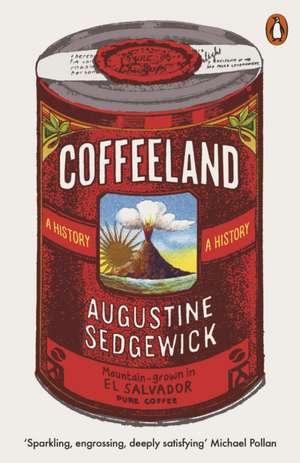
Coffeeland
Autor Augustine Sedgewicken Limba Engleză Paperback – apr 2021
Publicul țintă format din studenți ai istoriei economice, cercetători în domeniul globalizării și practicieni interesați de etica lanțurilor de aprovizionare va găsi în acest volum o analiză riguroasă a modului în care o plantă tropicală a devenit motorul productivității moderne. Găsim în Coffeeland o perspectivă inedită asupra relației dintre energie și muncă; Augustine Sedgewick nu se rezumă la o cronică a comerțului, ci demonstrează cum cafeaua a fost recalibrată pentru a susține ritmul Revoluției Industriale. Observăm o structură narativă care pornește din zonele muntoase ale El Salvadorului, unde James Hill a aplicat inovațiile industriale din Manchester pentru a crea o monocultură intensivă, marcată de productivitate și violență. Cititorii familiarizați cu The Global Coffee Economy in Africa, Asia, and Latin America, 1500–1989 de William Gervase Clarence-Smith vor aprecia modul în care Sedgewick restrânge focusul pe un studiu de caz micro-istoric (familia Hill) pentru a explica fenomene macroeconomice globale. Spre deosebire de abordările sociologice din Coffee, Society and Power in Latin America, această lucrare pune accent pe transformarea biologică și psihologică a consumatorului, devenit dependent de acest „drog” servit la ceașcă pentru a face față cerințelor pieței muncii. În contextul operei sale anterioare, Fatherhood, care explora construcția socială a rolului patern, Sedgewick își păstrează interesul pentru modul în care forțele istorice invizibile ne modelează comportamentele și identitățile cotidiene cele mai intime.
Preț: 66.94 lei
Preț vechi: 94.31 lei
-29%
Carte disponibilă
Livrare economică 20 noiembrie-01 decembrie
Livrare express 31 octombrie-06 noiembrie pentru 52.34 lei
Specificații
ISBN-10: 0141991909
Pagini: 433
Dimensiuni: 132 x 198 x 27 mm
Greutate: 0.32 kg
Editura: Penguin Books
Colecția Penguin
Locul publicării:London, United Kingdom
De ce să citești această carte
Recomandăm această carte pentru modul în care demitizează istoria cafelei, transformând-o dintr-o poveste despre arome într-una despre putere, energie și exploatare. Cititorul câștigă o înțelegere profundă a costului uman din spatele unei cești de cafea și a modului în care economia globală a fost modelată de nevoia de stimulare. Este o lectură esențială pentru a înțelege rădăcinile inegalității din America Latină.
Despre autor
Augustine Sedgewick este un istoric preocupat de intersecția dintre istoria muncii, a energiei și a capitalismului global. În cercetările sale, acesta explorează modul în care structurile economice transformă viața cotidiană. După succesul lucrării Fatherhood, unde a analizat evoluția conceptului de tată din epoca bronzului până în prezent, autorul își îndreaptă atenția în Coffeeland către istoria regională a Americii Latine, oferind o perspectivă critică asupra modului în care industria cafelei a redefinit productivitatea umană.
Notă biografică
Recenzii
Thoroughly engrossing ... his literary gifts and prodigious research make for a deeply satisfying reading experience studded with narrative surprise. Sedgewick has a knack for the sparkling digression and arresting jump cut, hopping back and forth between El Salvador and the wider world.
Both a curio-shop of forgotten snippets of history and quirky facts - who knew mocha was so called because it was shipped out of a Yemeni port of the same name? - as well as a theory of the modern world ... there is much here to entertain, educate and - dare one say it of a book about coffee - stimulate.
Sedgewick's gripping book exposes the dark heart of what goes into making a ubiquitous commodity, cherished every morning, enshrined in the workplace and appreciated after a meal. It provides a devastating answer to the question: 'What does it mean to be connected to faraway people and places through everyday things?'
An erudite and engrossing socioeconomic history ... With a forensic grasp of detail, Sedgewick charts the rise of mass-marketing and modern retail strategies through the story of the humble coffee bean ... Yet Coffeeland's poignant message runs wider still. Ultimately, the story of coffee, today's 'unrivaled work drug', is also the story of globalisation.
Many fascinating details... Mr Sedgewick's book is a parable of how a commodity can link producers, consumers, markets and politics in unexpected ways. Like the drink it describes, it is an eye-opening, stimulating brew.
[A] beautifully written, engaging and sprawling portrait of how coffee made modern El Salvador, while it also helped to remake consumer habits worldwide.
It's a rich and complex story and the book is full of glances at the history of the times ... This is a staggeringly well-researched piece of work.
Impressive ... People and food as much as coffee itself are the focus of Sedgewick's concern and the nexus of some of the most surprising connections in Coffeeland ... A powerful indictment of labour relations in El Salvador and capitalism in general.
Epic, illuminating ... Coffeeland functions not just as the story of one country's relationship to coffee, but as a pocket history of globalisation itself ... It is a story very worth telling - and one that reaches out far beyond so-called "Coffeeland" itself.
Informed and entertaining ... Coffeeland is thoroughly researched and Sedgewick is a stylish writer.
Extremely wide-ranging and well researched, Sedgewick's story reaches out into American political history ... The originality and ambition of Sedgewick's work is that he insistently sees the dynamic between producer and consumer-Central American peasant and North American proletarian-not merely as one of exploited and exploiter but as a manufactured co-dependence between two groups both exploited by capitalism.
Meticulously researched, vivid in its scene-setting, fine-toothed in its sociopolitical analysis . . . Coffeeland lays bare the history and reality behind that cup of joe you're drinking.
How did a cup of coffee become the everyday addiction of millions? In this impressively wide-ranging, personality-filled history, Augustine Sedgewick untangles the routes that carried coffee from the slopes of El Salvador's volcanoes ... To enter Coffeeland is to visit a realm of ruthless entrepreneurs, hard-working laborers, laboratory chemists, and guerrilla fighters.
Capitalism has remade the global countryside in radical ways. Coffeeland brilliantly chronicles this most consequential revolution by telling the global history of one family. After reading Augustine Sedgewick's fast-paced book you will never be able to think about your morning coffee in quite the same way.
Coffeeland will set a new standard ... an innovative study of work, of the work involved to produce a drink needed by workers to keep working. Sedgewick treats coffee not so much as a material commodity but rather more like intangible energy ... provocative and convincing.
Descriere scurtă
'Wonderful, energising' Kathryn Hughes, The Guardian
Coffee is one of the most valuable commodities in the history of the global economy and the world's most popular drug. The very word 'coffee' is one of the most widespread on the planet. Augustine Sedgewick's brilliant new history tells the hidden and surprising story of how this came to be, tracing coffee's 400-year transformation into an everyday necessity.
The story is one that few coffee drinkers know. Coffeeland centres on the volcanic highlands of El Salvador, where James Hill, born in the slums of nineteenth-century Manchester, founded one of the world's great coffee dynasties. Adapting the innovations of the industrial revolution to plantation agriculture, Hill helped to turn El Salvador into perhaps the most intensive monoculture in modern history, a place of extraordinary productivity, inequality and violence.
The book follows coffee from the Hill family plantations into the United States, through the San Francisco roasting plants into supermarkets, kitchens and work places, and finally into today's omnipresent cafés. Sedgewick reveals the unexpected consequences of the rise of coffee, which reshaped large areas of the tropics, transformed understandings of energy, and ultimately made us dependent on a drug served in a cup.
'Gripping' The Spectator
'An eye-opening, stimulating brew' The Economist