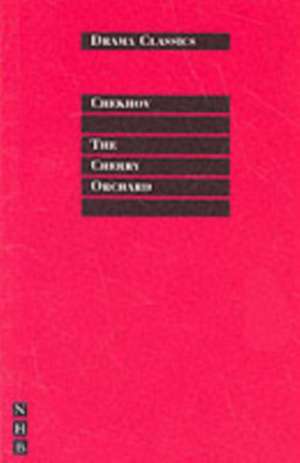
The Cherry Orchard
Autor Anton Chekhov Traducere de Stephen Mulrineen Limba Engleză Paperback – apr 1999
Preț: 34.74 lei
Puncte Express: 52
Carte indisponibilă temporar
Doresc să fiu notificat când acest titlu va fi disponibil:
Se trimite...
Specificații
ISBN-13: 9781854594129
ISBN-10: 1854594125
Pagini: 96
Ilustrații: illustrations
Dimensiuni: 106 x 160 x 8 mm
Greutate: 0.09 kg
Ediția:Revised edition
Editura: Theatre Communications Group
Locul publicării:United Kingdom
ISBN-10: 1854594125
Pagini: 96
Ilustrații: illustrations
Dimensiuni: 106 x 160 x 8 mm
Greutate: 0.09 kg
Ediția:Revised edition
Editura: Theatre Communications Group
Locul publicării:United Kingdom
V-ar putea interesa
-
 Wuthering HeightsEmily BrontëPreț: 28.01 lei
 -
 The Plays of Anton ChekhovAnton ChekhovPreț: 104.83 lei
 -
 PlaysAnton Chekhov-25%Preț: 58.95 lei78.59 lei
 -
 Death of a SalesmanArthur Miller-28%Preț: 49.73 lei69.43 lei
 -
 Preț: 53.88 lei
 -
 Preț: 171.01 lei
 -
 Preț: 214.75 lei
 -
 Anton Chekhov: Selected StoriesAnton Chekhov-29%Preț: 34.98 lei49.23 lei
 -
 The Singular Life of Albert NobbsSimone Benmussa-13%Preț: 67.92 lei77.86 lei
 -
 Four Plays and Three JokesAnton Chekhov-17%Preț: 96.06 lei115.66 lei
 -
 Crooked DancesMr Robin French-24%Preț: 84.39 lei110.97 lei
 -
 Cash CowOli ForsythPreț: 14.65 lei
 -
 RadioAl Smith-26%Preț: 84.23 lei113.80 lei
 -
 On the Other Hand, We're HappyDaf James-24%Preț: 84.23 lei110.87 lei
 -
 Adapting Chekhov in the 21st Century: Seven Contemporary PlaysFrances Babbage-21%Preț: 185.13 lei233.74 lei
 -
 The Changeling: Revised EditionThomas Middleton-18%Preț: 72.72 lei89.10 lei
 -
 Uncle VanyaAnton Pavlovich ChekhovPreț: 42.62 lei
 -
 The SeagullAnton ChekhovPreț: 26.76 lei
 -
 IvanovAnton ChekhovPreț: 31.07 lei
 -
 Uncle VanyaAnton ChekhovPreț: 31.69 lei
 -
 Three SistersAnton ChekhovPreț: 31.11 lei
 -
 The Three Theban PlaysSophoclesPreț: 45.74 lei
 -
 Chekhov Selected StoriesAnton ChekhovPreț: 56.41 lei
 -
 Preț: 97.89 lei
 -
 CaterpillarAlison CarrPreț: 67.73 lei
 -
 An Inspector Calls: Annotation-Friendly EditionJ. B. PriestleyPreț: 86.14 lei
 -
 CuttingsOllie George Clarke-13%Preț: 65.05 lei74.80 lei
 -
 The Importance of Being EarnestOscar WildePreț: 33.23 lei
 -
 Long Day's Journey into NightEugene O'NeillPreț: 56.14 lei
Descriere
Descriere de la o altă ediție sau format:
The funny thing is the harder I work the more clearly I understand things. When I'm worn out after a day's work then it's like my brain relaxes. And sometimes then I get it. The meaning of my life. My purpose on this earth. How many people ever get to say that? And you know what? It doesn't matter. Doesn't change anything. It is not important.
In Chekhov's tragi-comedy - arguably his most popular play - the Gayev family is torn by powerful forces deeply rooted in history and the society in which they live. Their estate is hopelessly in debt. Urged to cut down their beautiful cherry orchard and sell the land for holiday cottages, the family struggles to act decisively.
Vigorous and profound, this new version of Chekhov's classic play by Olivier award-winner Simon Stephens, from a literal translation by Helen Rappaport, is an anguished and heartbreaking love letter to a society in violent transition. It received its world premiere at the Young Vic, London, on 10 October 2014.
The funny thing is the harder I work the more clearly I understand things. When I'm worn out after a day's work then it's like my brain relaxes. And sometimes then I get it. The meaning of my life. My purpose on this earth. How many people ever get to say that? And you know what? It doesn't matter. Doesn't change anything. It is not important.
In Chekhov's tragi-comedy - arguably his most popular play - the Gayev family is torn by powerful forces deeply rooted in history and the society in which they live. Their estate is hopelessly in debt. Urged to cut down their beautiful cherry orchard and sell the land for holiday cottages, the family struggles to act decisively.
Vigorous and profound, this new version of Chekhov's classic play by Olivier award-winner Simon Stephens, from a literal translation by Helen Rappaport, is an anguished and heartbreaking love letter to a society in violent transition. It received its world premiere at the Young Vic, London, on 10 October 2014.
Recenzii
Now Chekhov's final and finest play, from 1903, is the latest twentieth-century masterpiece to get a good going-over. Actually, make that an excellent going-over . . . It's been pruned, yes, but this grimly witty tragicomedy is unmistakably Chekhov . . . and it teems with life.
Stephens [has] refocussed Chekhov's play into a potent study in feminine - rather than societal - collapse.
Chekhov was superb on the destructive impact of people who take no heed: who turn other people's lives upside down (Uncle Vanya) or blithely ignore warnings (Cherry Orchard). He was superb too on those who can see the dangers, but are powerless to do anything. Little wonder then, that these great plays feel so painfully pertinent now to audiences keenly aware of intractable global problems. Little wonder either that contemporary theatre-makers seek to meet his works in the spirit of innovation.
If Chekhov were planning a revenant visit to see how his work fares in England in the 21 century, this would be an opportune moment to come.
Revivals of classic plays are the lifeblood of theatre. They are the way in which the art form tests the reputation, relevance and validity of the masterpieces of the past.
Stephens [has] refocussed Chekhov's play into a potent study in feminine - rather than societal - collapse.
Chekhov was superb on the destructive impact of people who take no heed: who turn other people's lives upside down (Uncle Vanya) or blithely ignore warnings (Cherry Orchard). He was superb too on those who can see the dangers, but are powerless to do anything. Little wonder then, that these great plays feel so painfully pertinent now to audiences keenly aware of intractable global problems. Little wonder either that contemporary theatre-makers seek to meet his works in the spirit of innovation.
If Chekhov were planning a revenant visit to see how his work fares in England in the 21 century, this would be an opportune moment to come.
Revivals of classic plays are the lifeblood of theatre. They are the way in which the art form tests the reputation, relevance and validity of the masterpieces of the past.
Notă biografică
Anton Chekhov (1860-1904) first turned to writing as a medical student at Moscow University, from which he graduated in 1884. Among his early plays were short monologues (The Evils of Tobacco, 1885), one-act farces such as The Bear, The Proposal and The Wedding (1888-89) and the 'Platonov' material, adapted by Michael Frayn as Wild Honey. The first three full-length plays to be stage, Ivanov (1887), The Wood Demon (1889) and The Seagull (1896) were initially failures. But the Moscow Arts Theatre's revival of The Seagull two years later was successful and was followed by his masterpieces, Uncle Vanya (1889), Three Sisters (1901), and The Cherry Orchard in 1904, the year of his death.