
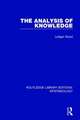
The Analysis of Knowledge: Routledge Library Editions: Epistemology
Autor Ledger Wooden Limba Engleză Hardback – 21 mai 2015
| Toate formatele și edițiile | Preț | Express |
|---|---|---|
| Paperback (1) | 306.99 lei 6-8 săpt. | |
| Taylor & Francis – 10 mai 2016 | 306.99 lei 6-8 săpt. | |
| Hardback (1) | 785.10 lei 6-8 săpt. | |
| Taylor & Francis – 21 mai 2015 | 785.10 lei 6-8 săpt. |
Din seria Routledge Library Editions: Epistemology
- 38%
 Preț: 5751.52 lei
 - 20%
 Preț: 306.99 lei
 - 20%
 Preț: 309.92 lei
 -
 Preț: 411.61 lei
 - 20%
 Preț: 335.04 lei
 - 20%
 Preț: 306.49 lei
 -
 Preț: 416.23 lei
 - 46%
 Preț: 196.47 lei
 - 20%
 Preț: 308.45 lei
 - 21%
 Preț: 305.52 lei
 - 20%
 Preț: 306.99 lei
 - 19%
 Preț: 314.31 lei
 - 20%
 Preț: 306.99 lei
 - 29%
 Preț: 129.00 lei
 - 21%
 Preț: 330.66 lei
 - 21%
 Preț: 304.56 lei
Preț: 785.10 lei
Preț vechi: 1340.36 lei
-41% Nou
Puncte Express: 1178
Preț estimativ în valută:
138.93€ • 162.91$ • 122.01£
138.93€ • 162.91$ • 122.01£
Carte tipărită la comandă
Livrare economică 30 ianuarie-13 februarie 26
Preluare comenzi: 021 569.72.76
Specificații
ISBN-13: 9781138906709
ISBN-10: 1138906700
Pagini: 266
Dimensiuni: 156 x 234 x 13 mm
Greutate: 0.36 kg
Ediția:1
Editura: Taylor & Francis
Colecția Routledge
Seria Routledge Library Editions: Epistemology
Locul publicării:Oxford, United Kingdom
ISBN-10: 1138906700
Pagini: 266
Dimensiuni: 156 x 234 x 13 mm
Greutate: 0.36 kg
Ediția:1
Editura: Taylor & Francis
Colecția Routledge
Seria Routledge Library Editions: Epistemology
Locul publicării:Oxford, United Kingdom
V-ar putea interesa
-
 Fear of Knowledge: Against Relativism and ConstructivismPaul Boghossian-19%Preț: 151.10 lei185.46 lei
 -
 Perspectival Thought: A Plea for (Moderate) RelativismFrançois RecanatiPreț: 351.56 lei
 -
 The Philosophy of InformationLuciano Floridi-12%Preț: 330.99 lei375.98 lei
 -
 The Nature of PerceptionJohn Foster-14%Preț: 350.77 lei409.46 lei
 -
 Transcendental Arguments: Problems and ProspectsRobert Stern-24%Preț: 394.26 lei519.81 lei
 -
 The Realm of ReasonChristopher PeacockePreț: 344.37 lei
 -
 -34%Preț: 674.61 lei1027.58 lei
 -
 Truth and RealismPatrick Greenough-8%Preț: 307.93 lei336.33 lei
 -
 -25%Preț: 496.73 lei658.10 lei
 -
 Constructivism in Practical PhilosophyJames Lenman-28%Preț: 691.26 lei954.17 lei
 -
 The Nature and Value of Knowledge: Three InvestigationsDuncan PritchardPreț: 319.10 lei
 -
 Scepticism and Reliable BeliefJosé L. Zalabardo-14%Preț: 604.11 lei702.45 lei
 -
 -11%Preț: 454.00 lei510.11 lei
 -
 Preț: 369.30 lei
 -
 Human Knowledge: Its Scope and ValueBertrand RussellPreț: 448.28 lei
 -
 Our Knowledge of the External WorldBertrand RussellPreț: 134.08 lei
 -
 Human Knowledge: Its Scope and LimitsBertrand RussellPreț: 154.65 lei
 -
 The Scientific OutlookBertrand RussellPreț: 134.37 lei
 -
 Preț: 189.90 lei
 -
 Philosophy of Science: A Unified ApproachGerhard SchurzPreț: 457.91 lei
 -
 Preț: 419.82 lei
 -
 Preț: 427.31 lei
 -
 An Introduction to the Theory of KnowledgeNoah LemosPreț: 325.21 lei
 -
 Preț: 239.54 lei
 -
 Dialogues IIGilles Deleuze-43%Preț: 120.96 lei213.69 lei
 -
 Why Truth MattersJeremy Stangroom-43%Preț: 109.16 lei190.24 lei
 -
 The Ecstasy of Communication, New EditionJean BaudrillardPreț: 78.67 lei
Public țintă
Postgraduate and UndergraduateCuprins
Preface 1. The Knowledge-Situation 2. Sensory Knowledge 3. The Perception of ‘Things’ 4. Perceptual Memory 5. Introspective Knowledge 6. Knowledge of Other Selves 7. Conceptual Knowledge 8. Categorical Knowledge 9. Formal Knowledge 10. Valuational Knowledge 11. Knowledge, Meaning and Truth
Descriere
Originally published in 1940. This book seeks to combine epistemology and the new developments of the time in psychology and suggests a single structural pattern underlying every type of cognitive situation.