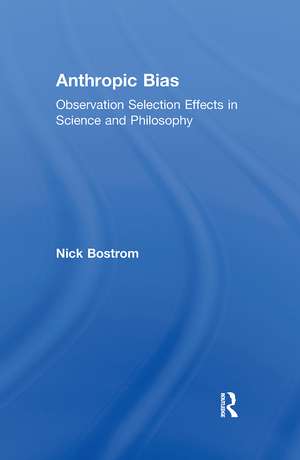
Anthropic Bias: Observation Selection Effects in Science and Philosophy: Studies in Philosophy
Autor Nick Bostromen Limba Engleză Paperback – 18 iun 2010
There are the philosophical thought experiments and paradoxes: the Doomsday Argument; Sleeping Beauty; the Presumptuous Philosopher; Adam & Eve; the Absent-Minded Driver; the Shooting Room.
And there are the applications in contemporary science: cosmology ("How many universes are there?", "Why does the universe appear fine-tuned for life?"); evolutionary theory ("How improbable was the evolution of intelligent life on our planet?"); the problem of time's arrow ("Can it be given a thermodynamic explanation?"); quantum physics ("How can the many-worlds theory be tested?"); game-theory problems with imperfect recall ("How to model them?"); even traffic analysis ("Why is the 'next lane' faster?").
Anthropic Bias argues that the same principles are at work across all these domains. And it offers a synthesis: a mathematically explicit theory of observation selection effects that attempts to meet scientific needs while steering clear of philosophical paradox.
Din seria Studies in Philosophy
- 15%
 Preț: 461.36 lei
 - 15%
 Preț: 455.27 lei
 - 15%
 Preț: 463.17 lei
 - 15%
 Preț: 460.64 lei
 - 15%
 Preț: 460.27 lei
 - 15%
 Preț: 471.41 lei
 - 15%
 Preț: 453.55 lei
 - 18%
 Preț: 1062.03 lei
 - 15%
 Preț: 456.01 lei
 - 15%
 Preț: 467.14 lei
 - 15%
 Preț: 463.52 lei
 -
 Preț: 485.55 lei
 - 18%
 Preț: 1250.55 lei
 - 18%
 Preț: 1256.91 lei
 - 15%
 Preț: 470.40 lei
 - 21%
 Preț: 424.22 lei
 - 15%
 Preț: 462.55 lei
 -
 Preț: 486.40 lei
 -
 Preț: 488.09 lei
 - 18%
 Preț: 1308.72 lei
 - 15%
 Preț: 456.65 lei
 - 15%
 Preț: 460.39 lei
 - 18%
 Preț: 1248.98 lei
 - 15%
 Preț: 454.73 lei
 - 18%
 Preț: 1246.62 lei
 - 15%
 Preț: 434.24 lei
 - 15%
 Preț: 457.38 lei
 - 15%
 Preț: 464.61 lei
 - 18%
 Preț: 1250.97 lei
 -
 Preț: 390.72 lei
 - 15%
 Preț: 458.46 lei
 - 15%
 Preț: 476.50 lei
 -
 Preț: 242.62 lei
 - 15%
 Preț: 465.67 lei
 - 18%
 Preț: 1342.52 lei
Preț: 428.57 lei
Preț vechi: 465.83 lei
-8%
Puncte Express: 643
Carte indisponibilă temporar
Livrare prin curier în România Termenul estimat este afișat lângă disponibilitate.
Transport gratuit pentru acest produs Plată online sau ramburs, în funcție de opțiunile comenzii.
Retur gratuit în 14 zile Comandă securizată și suport în română.
Specificații
ISBN-13: 9780415883948
ISBN-10: 0415883946
Pagini: 244
Ilustrații: black & white illustrations
Dimensiuni: 152 x 229 x 13 mm
Greutate: 0.44 kg
Ediția:1
Editura: Taylor & Francis
Colecția Routledge
Seria Studies in Philosophy
Locul publicării:Oxford, United Kingdom
ISBN-10: 0415883946
Pagini: 244
Ilustrații: black & white illustrations
Dimensiuni: 152 x 229 x 13 mm
Greutate: 0.44 kg
Ediția:1
Editura: Taylor & Francis
Colecția Routledge
Seria Studies in Philosophy
Locul publicării:Oxford, United Kingdom
V-ar putea interesa
-
 Concepts: Where Cognitive Science Went WrongJerry A. Fodor-29%Preț: 376.80 lei527.55 lei
 -
 Superintelligence: Paths, Dangers, StrategiesNick Bostrom-17%Preț: 79.83 lei95.74 lei
 -
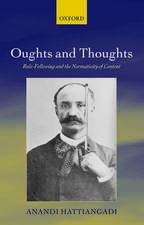 Oughts and Thoughts: Rule-Following and the Normativity of ContentAnandi Hattiangadi-32%Preț: 693.14 lei1023.03 lei
 -
 Human EnhancementJulian Savulescu-31%Preț: 777.84 lei1126.02 lei
 -
 Scepticism Comes AliveBryan Frances-22%Preț: 396.36 lei505.64 lei
 -
 Human EnhancementJulian Savulescu-12%Preț: 308.24 lei350.18 lei
 -
 Superintelligence: Paths, Dangers, StrategiesNick Bostrom-17%Preț: 144.97 lei175.31 lei
 -
 Human Knowledge: Its Scope and ValueBertrand RussellPreț: 507.95 lei
 -
 Our Knowledge of the External WorldBertrand RussellPreț: 155.27 lei
 -
 Human Knowledge: Its Scope and LimitsBertrand RussellPreț: 179.23 lei
 -
 The Scientific OutlookBertrand RussellPreț: 155.74 lei
 -
 Preț: 236.49 lei
 -
 -8%Preț: 458.59 lei498.46 lei
 -
 Preț: 285.69 lei
 -
 Art and SexGray Watson-25%Preț: 188.53 lei251.67 lei
Cuprins
1. Introduction; 2. Fine-Tuning in Cosmology; 3. Anthropic Principles; 4. Thought Experiments Supporting the Self-Sampling Assumption; 5. The Self-Sampling Assumption in Science; 6. The Doomsday Argument; 7. ::; 8. ::; 9. ::; ch0010 Observation Selection Theory; 11. Observation Selection Theory Applied;
Recenzii
"From traffic analysis via a many-worlds interpretation of quantum mechanics and the problem of the fine-tuning of the universe to the purely philosophical problems of the Doomsday argument and the Sleeping Beauty problem, Bostrom succeeds in shining a new and interesting light on all of these issues." --Wouter Meijs
"Bostrom presents a highly readable and widely relevant work which can be warmly recommended to everyone in philosophy of science."--Christian Wuthrich, Philosophy of Science
"Probably the worst thing one can say about this book is that it is too short....Anthropic Bias is a wonderful achievement, which should find place on the shelf of every serious student of modern philosophy of science, epistemology, and cosmology." --Milan Cirkovic, Foundations of Science
"Anthropic Bias is a synthesis of some of the most interesting and important ideas to emerge from discussion of cosmic fine-tuning, the anthropic principle, and the Doomsday Argument. It deserves a place on the shelves of epistemologists and philosophers of science, as well as specialists interested in the topics just mentioned."--Neil Manson, Notre Dame Philosophical Reviews
"Bostrom presents a highly readable and widely relevant work which can be warmly recommended to everyone in philosophy of science."--Christian Wuthrich, Philosophy of Science
"Probably the worst thing one can say about this book is that it is too short....Anthropic Bias is a wonderful achievement, which should find place on the shelf of every serious student of modern philosophy of science, epistemology, and cosmology." --Milan Cirkovic, Foundations of Science
"Anthropic Bias is a synthesis of some of the most interesting and important ideas to emerge from discussion of cosmic fine-tuning, the anthropic principle, and the Doomsday Argument. It deserves a place on the shelves of epistemologists and philosophers of science, as well as specialists interested in the topics just mentioned."--Neil Manson, Notre Dame Philosophical Reviews
Descriere
Anthropic Bias explores how to reason when you suspect that your evidence is biased by "observation selection effects"--that is, evidence that has been filtered by the precondition that there be some suitably positioned observer to "have" the evidence. This conundrum--sometimes alluded to as "the anthropic principle," "self-locating belief," or "indexical information"--turns out to be a surprisingly perplexing and intellectually stimulating challenge, one abounding with important implications for many areas in science and philosophy.
There are the philosophical thought experiments and paradoxes: the Doomsday Argument; Sleeping Beauty; the Presumptuous Philosopher; Adam & Eve; the Absent-Minded Driver; the Shooting Room.
And there are the applications in contemporary science: cosmology ("How many universes are there?", "Why does the universe appear fine-tuned for life?"); evolutionary theory ("How improbable was the evolution of intelligent life on our planet?"); the problem of time's arrow ("Can it be given a thermodynamic explanation?"); quantum physics ("How can the many-worlds theory be tested?"); game-theory problems with imperfect recall ("How to model them?"); even traffic analysis ("Why is the 'next lane' faster?").
Anthropic Bias argues that the same principles are at work across all these domains. And it offers a synthesis: a mathematically explicit theory of observation selection effects that attempts to meet scientific needs while steering clear of philosophical paradox.
There are the philosophical thought experiments and paradoxes: the Doomsday Argument; Sleeping Beauty; the Presumptuous Philosopher; Adam & Eve; the Absent-Minded Driver; the Shooting Room.
And there are the applications in contemporary science: cosmology ("How many universes are there?", "Why does the universe appear fine-tuned for life?"); evolutionary theory ("How improbable was the evolution of intelligent life on our planet?"); the problem of time's arrow ("Can it be given a thermodynamic explanation?"); quantum physics ("How can the many-worlds theory be tested?"); game-theory problems with imperfect recall ("How to model them?"); even traffic analysis ("Why is the 'next lane' faster?").
Anthropic Bias argues that the same principles are at work across all these domains. And it offers a synthesis: a mathematically explicit theory of observation selection effects that attempts to meet scientific needs while steering clear of philosophical paradox.