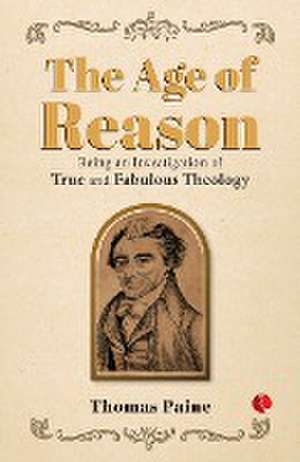
THE AGE OF REASON
Autor Thomas Paineen Limba Engleză Paperback – 5 feb 2023
Preț: 113.94 lei
Puncte Express: 171
Carte tipărită la comandă
Livrare economică 08-22 iunie
Specificații
ISBN-13: 9789357020558
ISBN-10: 9357020551
Pagini: 234
Dimensiuni: 129 x 198 x 14 mm
Greutate: 0.28 kg
Editura: Rupa Publications India
ISBN-10: 9357020551
Pagini: 234
Dimensiuni: 129 x 198 x 14 mm
Greutate: 0.28 kg
Editura: Rupa Publications India
V-ar putea interesa
-
 Thomas Paine ReaderThomas Paine-30%Preț: 72.57 lei103.19 lei
 -
 The PrinceNiccolo Machiavelli-22%Preț: 42.24 lei53.89 lei
 -
 Common SenseThomas Paine-22%Preț: 41.99 lei53.75 lei
 -
 The Imitation of ChristThomas a. Kempis-38%Preț: 55.14 lei88.63 lei
 -
 -15%Preț: 186.95 lei220.95 lei
 -
 Socrates: A Very Short IntroductionC.C.W. Taylor-21%Preț: 53.24 lei67.63 lei
 -
 -16%Preț: 47.86 lei57.30 lei
 -
 Preț: 53.37 lei
 -
 Atheist Delusions: The Christian Revolution and Its Fashionable EnemiesDavid Bentley HartPreț: 111.41 lei
 -
 Thomas Paine and the Clarion Call for American IndependenceHarlow Giles Unger-31%Preț: 125.04 lei181.95 lei
 -
 In the Shadow of the LawKermit RooseveltPreț: 178.13 lei
 -
 The Reason for God: Belief in an age of scepticismTimothy KellerPreț: 88.71 lei
 -
 The Rights of ManThomas Paine-17%Preț: 23.40 lei28.36 lei
 -
 Why I Am Not a ChristianBertrand RussellPreț: 102.06 lei
 -
 Locke: Political WritingsJohn Locke-11%Preț: 133.22 lei150.15 lei
 -
 -23%Preț: 72.84 lei94.11 lei
 -
 Thomas PaineThomas PainePreț: 68.02 lei
 -
 ProphetKahlil GibranPreț: 24.63 lei
 -
 Common SenseThomas PainePreț: 25.92 lei
 -
 PenseesBlaise PascalPreț: 49.15 lei
 -
 The Devils' GospelsChristopher GassonPreț: 73.88 lei
 -
 God Is Not GreatChristopher Hitchens-21%Preț: 70.41 lei88.67 lei
 -
 EthicsBenedict De SpinozaPreț: 42.29 lei
 -
 Wealth of NationsAdam SmithPreț: 48.32 lei
 -
 The Rights Of Man And Common SenseThomas PainePreț: 92.24 lei
Recenzii
The Age of Reason is one of the most influential defences of Deism (the idea that God can be known without organized religion) ever written. This edition presents Part 1, Paine’s controversial philosophical argument against revealed religion, with representative excerpts of his biblical analysis from Parts 2 and 3.
Appendices include numerous selections from Paine’s other religious writing, his Deist influences, and his contemporary opposition.
“There are many editions of The Age of Reason available for students and modern readers. Kerry Walters’ Broadview Edition is the best. It combines an astute introduction with up-to-the-moment bibliographic material. Walters also illuminates crucial aspects of the book and its arguments with hard-to-find contemporary documents that put Paine’s work in an international context.” — Bruce Kuklick, University of Pennsylvania
“Kerry Walters’ new edition of Thomas Paine’s Age of Reason, along with its collection of pre- and post-publication material, is an invaluable addition to the Paine library. Most impressive is Walters’s eloquent and lucid introduction, which concisely places Paine’s Deism in the greater context of the British and French Enlightenment. It is an indispensable edition for undergraduate and graduate students studying history, philosophy, the history of religion, and the psychology of social ideas.” — Jack Fruchtman Jr., Towson University
Appendices include numerous selections from Paine’s other religious writing, his Deist influences, and his contemporary opposition.
“There are many editions of The Age of Reason available for students and modern readers. Kerry Walters’ Broadview Edition is the best. It combines an astute introduction with up-to-the-moment bibliographic material. Walters also illuminates crucial aspects of the book and its arguments with hard-to-find contemporary documents that put Paine’s work in an international context.” — Bruce Kuklick, University of Pennsylvania
“Kerry Walters’ new edition of Thomas Paine’s Age of Reason, along with its collection of pre- and post-publication material, is an invaluable addition to the Paine library. Most impressive is Walters’s eloquent and lucid introduction, which concisely places Paine’s Deism in the greater context of the British and French Enlightenment. It is an indispensable edition for undergraduate and graduate students studying history, philosophy, the history of religion, and the psychology of social ideas.” — Jack Fruchtman Jr., Towson University
Descriere
Descriere de la o altă ediție sau format:
The Age of Reason is one of the most influential defences of Deism (the idea that God can be known without organized religion) ever written. This edition presents Part 1, Paine’s controversial philosophical argument against revealed religion, with representative excerpts of his biblical analysis from Parts 2 and 3.
Appendices include numerous selections from Paine’s other religious writing, his Deist influences, and his contemporary opposition.
The Age of Reason is one of the most influential defences of Deism (the idea that God can be known without organized religion) ever written. This edition presents Part 1, Paine’s controversial philosophical argument against revealed religion, with representative excerpts of his biblical analysis from Parts 2 and 3.
Appendices include numerous selections from Paine’s other religious writing, his Deist influences, and his contemporary opposition.
Cuprins
Acknowledgements
Introduction
Thomas Paine: A Brief Chronology
A Note on the Text
The Age of Reason
Introduction
Thomas Paine: A Brief Chronology
A Note on the Text
The Age of Reason
- Part 1
Selections from Part 2
Selections from Part 3
- A Letter, Being an Answer to a Friend on the Publication of The Age of Reason (1797)
- “The Existence of God.” A Discourse Delivered at the Society of Theophilanthropists (1797)
- “An Answer to the Bishop of Llandaff” (1797-1800)
- “Worship and Church Bells: A Letter to Camille Jordan” (1797)
- Exchange of Letters with Samuel Adams (1802-03)
- “Of the Word Religion, and Other Words of Uncertain Signification” (1804)
- “My Private Thoughts on a Future State” (1807)
- From Anthony Collins, A Discourse of Free-Thinking (1713)
- From David Hume, “Of Miracles” (1748)
- From Paul Henri Thiry, Baron d’Holbach, Of the Confused and Contradictory Ideas of Theology (1770)
- Thomas Jefferson, An Act for Establishing Religious Freedom (1779) and A Letter to Peter Carr (1787)
- From William Paley, Natural Theology (1802)
- From “A Layman” [Thomas Williams], The Age of Infidelity: In Answer to Thomas Paine’s Age of Reason (1794)
- From Gilbert Wakefield, An Examination of The Age of Reason (1794)
- From “Anonymous” [Elihu Palmer], The Examiners Examined: Being a Defense of The Age of Reason(1794)
- From Joseph Priestley, An Answer to Mr. Paine’s Age of Reason (1794)
- From Uzal Ogden, An Antidote to Deism (1795)
- From Richard Watson, An Apology for the Bible (1796)
Notă biografică
Thomas Paine (born Thomas Pain[1]) (February 9, 1737 [O.S. January 29, 1736]- June 8, 1809) was an English-born American political activist, philosopher, political theorist, and revolutionary. He authored the two most influential pamphlets at the start of the American Revolution and inspired the patriots in 1776 to declare independence from Great Britain.[2] His ideas reflected Enlightenment-era ideals of transnational human rights.[3] Historian Saul K. Padover described him as "a corsetmaker by trade, a journalist by profession, and a propagandist by inclination".[4]
Born in Thetford in the English county of Norfolk, Paine migrated to the British American colonies in 1774 with the help of Benjamin Franklin, arriving just in time to participate in the American Revolution. Virtually every rebel read (or listened to a reading of) his powerful pamphlet Common Sense (1776), proportionally the all-time best-selling[5][6] American title, which catalysed the rebellious demand for independence from Great Britain. His The American Crisis (1776-1783) was a pro-revolutionary pamphlet series. Common Sense was so influential that John Adams said: "Without the pen of the author of Common Sense, the sword of Washington would have been raised in vain".[7] Paine lived in France for most of the 1790s, becoming deeply involved in the French Revolution. He wrote Rights of Man (1791), in part a defense of the French Revolution against its critics. His attacks on Anglo-Irish conservative writer Edmund Burke led to a trial and conviction in absentia in England in 1792 for the crime of seditious libel.
The British government of William Pitt the Younger, worried by the possibility that the French Revolution might spread to England, had begun suppressing works that espoused radical philosophies. Paine's work, which advocated the right of the people to overthrow their government, was duly targeted, with a writ for his arrest issued in early 1792. Paine fled to France in September where, despite not being able to speak French, he was quickly elected to the French National Convention. The Girondists regarded him as an ally. Consequently, the Montagnards, especially Maximilien Robespierre, regarded him as an enemy.
In December 1793, he was arrested and was taken to Luxembourg Prison in Paris. While in prison, he continued to work on The Age of Reason (1793-1794). James Monroe, a future President of the United States, used his diplomatic connections to get Paine released in November 1794. Paine became notorious because of his pamphlets. The Age of Reason, in which he advocated deism, promoted reason and free thought and argued against institutionalized religion in general and Christian doctrine in particular. He published the pamphlet Agrarian Justice (1797), discussing the origins of property and introduced the concept of a guaranteed minimum income through a one-time inheritance tax on landowners. In 1802, he returned to the U.S. When he died on June 8, 1809 only six people attended his funeral as he had been ostracized for his ridicule of Christianity