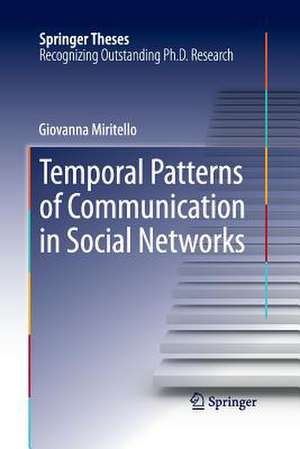
Temporal Patterns of Communication in Social Networks: Springer Theses
Autor Giovanna Miritelloen Limba Engleză Paperback – 24 iun 2015
| Toate formatele și edițiile | Preț | Express |
|---|---|---|
| Paperback (1) | 609.71 lei 6-8 săpt. | |
| Springer International Publishing – 24 iun 2015 | 609.71 lei 6-8 săpt. | |
| Hardback (1) | 615.52 lei 6-8 săpt. | |
| Springer International Publishing – 3 iun 2013 | 615.52 lei 6-8 săpt. |
Din seria Springer Theses
- 18%
 Preț: 959.13 lei
 -
 Preț: 372.50 lei
 - 15%
 Preț: 611.89 lei
 - 18%
 Preț: 906.80 lei
 -
 Preț: 384.13 lei
 - 18%
 Preț: 908.31 lei
 - 15%
 Preț: 612.23 lei
 - 15%
 Preț: 616.15 lei
 - 15%
 Preț: 618.34 lei
 - 18%
 Preț: 1060.72 lei
 - 15%
 Preț: 611.27 lei
 - 18%
 Preț: 1069.04 lei
 - 18%
 Preț: 907.54 lei
 - 18%
 Preț: 1066.78 lei
 - 18%
 Preț: 1169.91 lei
 - 15%
 Preț: 615.35 lei
 - 15%
 Preț: 611.43 lei
 - 15%
 Preț: 615.35 lei
 -
 Preț: 370.62 lei
 -
 Preț: 378.41 lei
 - 15%
 Preț: 617.89 lei
 -
 Preț: 372.31 lei
 - 15%
 Preț: 613.31 lei
 - 15%
 Preț: 617.08 lei
 - 18%
 Preț: 1335.19 lei
 - 20%
 Preț: 596.68 lei
 - 18%
 Preț: 1181.26 lei
 - 15%
 Preț: 614.60 lei
 - 18%
 Preț: 960.64 lei
 - 15%
 Preț: 615.35 lei
 - 18%
 Preț: 1172.94 lei
 - 18%
 Preț: 1072.85 lei
 - 18%
 Preț: 1171.41 lei
 - 18%
 Preț: 962.00 lei
 - 18%
 Preț: 856.59 lei
 - 15%
 Preț: 615.35 lei
 - 5%
 Preț: 1109.23 lei
 - 15%
 Preț: 616.15 lei
 - 18%
 Preț: 904.53 lei
 - 15%
 Preț: 621.97 lei
 - 18%
 Preț: 960.64 lei
 -
 Preț: 370.62 lei
 -
 Preț: 374.91 lei
 - 18%
 Preț: 962.14 lei
 - 18%
 Preț: 1069.04 lei
 -
 Preț: 375.07 lei
 - 15%
 Preț: 612.55 lei
 - 20%
 Preț: 599.77 lei
 - 20%
 Preț: 601.24 lei
Preț: 609.71 lei
Preț vechi: 717.30 lei
-15% Nou
Puncte Express: 915
Preț estimativ în valută:
107.87€ • 125.87$ • 94.31£
107.87€ • 125.87$ • 94.31£
Carte tipărită la comandă
Livrare economică 16-30 ianuarie 26
Preluare comenzi: 021 569.72.76
Specificații
ISBN-13: 9783319033419
ISBN-10: 3319033417
Pagini: 168
Ilustrații: XIV, 153 p.
Dimensiuni: 155 x 235 x 9 mm
Greutate: 0.25 kg
Ediția:2013
Editura: Springer International Publishing
Colecția Springer
Seria Springer Theses
Locul publicării:Cham, Switzerland
ISBN-10: 3319033417
Pagini: 168
Ilustrații: XIV, 153 p.
Dimensiuni: 155 x 235 x 9 mm
Greutate: 0.25 kg
Ediția:2013
Editura: Springer International Publishing
Colecția Springer
Seria Springer Theses
Locul publicării:Cham, Switzerland
V-ar putea interesa
-
 Social Networks and the Semantic WebPeter Mika-20%Preț: 623.52 lei779.40 lei
 -
 The Social Dynamics of Web 2.0: Interdisciplinary PerspectivesCharalambos Tsekeris-37%Preț: 832.79 lei1321.26 lei
 -
 Recruiting with Social MediaClinton R. Lanier-20%Preț: 91.40 lei114.24 lei
 -
 Facebook DemystifiedDon Wilson-20%Preț: 85.50 lei106.88 lei
 -
 -20%Preț: 58.21 lei72.76 lei
 -
 Spaghetti on the WallApril Kelly-20%Preț: 92.86 lei116.08 lei
 -
 Simple Facebook PrivacyRussell Mickler-20%Preț: 55.16 lei68.94 lei
 -
 Sold! a Proven Social Media Strategy for Generating Real Estate LeadsDarren K. Tunstall-20%Preț: 105.43 lei131.79 lei
 -
 -20%Preț: 111.09 lei138.86 lei
 -
 Social Media at BBC News: The Re-Making of Crisis ReportingValerie Belair-Gagnon-18%Preț: 1115.36 lei1360.19 lei
 -
 Social Networking and Education: Global PerspectivesTomayess Issa-20%Preț: 635.92 lei794.89 lei
 -
 Social Media and Local Governments: Theory and PracticeMehmet Zahid Sobaci-15%Preț: 624.01 lei734.13 lei
 -
 -20%Preț: 323.23 lei404.04 lei
 -
 Ubiquitous Social Media AnalysisMartin Atzmueller-20%Preț: 298.88 lei373.59 lei
 -
 Trends and Applications of Serious Gaming and Social MediaYoungkyun Baek-15%Preț: 616.95 lei725.82 lei
Public țintă
ResearchCuprins
Introduction and Motivation.- Social and Communication Networks.- Social Strategies in Communication Networks.- Predicting Tie Creation and Decay.- Information Spreading on Communication Networks.- Conclusion, contributions and vision for the future.- Data and Materials.
Textul de pe ultima copertă
The main interest of this research has been in understanding and characterizing large networks of human interactions as continuously changing objects. In fact, although many real social networks are dynamic networks whose elements and properties continuously change over time, traditional approaches to social network analysis are essentially static, thus neglecting all temporal aspects. Specifically, we have investigated the role that temporal patterns of human interaction play in three main fields of social network analysis and data mining: characterization of time (or attention) allocation in social networks, prediction of link decay/persistence, and information spreading. In order to address this we analyzed large anonymized data sets of phone call communication traces over long periods of time. Access to these observations was granted by Telefonica Research, Spain. The findings that emerge from our research indicate that the observed heterogeneities and correlations of human temporal patterns of interaction significantly affect the traditional view of social networks, shifting from a very steady to a highly complex entity. Since structure and dynamics are tightly coupled, they cannot be disentangled in the analysis and modeling of human behavior, though traditional models seek to do so. Our results impact not only the way in which social network are traditionally characterized, but more importantly also the understanding and modeling phenomena such as group formation, spread of epidemics, and the dissemination of ideas, opinions and information.
Caracteristici
Nominated by Universidad Carlos III de Madrid as an outstanding Ph.D. thesis Reveals new and unexpected features of how complex social networks develop over time Based on data mining of massive records of telephone connections Includes supplementary material: sn.pub/extras