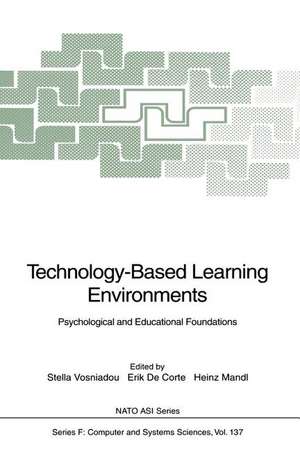
Technology-Based Learning Environments: Psychological and Educational Foundations: NATO ASI Subseries F:, cartea 137
Editat de Stella Vosniadou, Erik De Corte, Heinz Mandlen Limba Engleză Paperback – 13 dec 2011
Din seria NATO ASI Subseries F:
- 20%
 Preț: 642.70 lei
 - 20%
 Preț: 953.88 lei
 - 18%
 Preț: 1190.96 lei
 - 20%
 Preț: 1847.73 lei
 - 20%
 Preț: 631.95 lei
 - 18%
 Preț: 1185.98 lei
 - 20%
 Preț: 682.34 lei
 - 20%
 Preț: 630.68 lei
 - 18%
 Preț: 1782.54 lei
 - 20%
 Preț: 360.65 lei
 - 20%
 Preț: 953.40 lei
 - 20%
 Preț: 645.09 lei
 - 20%
 Preț: 1850.75 lei
 - 20%
 Preț: 956.09 lei
 -
 Preț: 374.71 lei
 - 20%
 Preț: 632.58 lei
 - 20%
 Preț: 629.88 lei
 - 18%
 Preț: 1177.62 lei
 - 18%
 Preț: 915.13 lei
 - 20%
 Preț: 319.42 lei
 - 20%
 Preț: 1234.45 lei
 - 20%
 Preț: 619.89 lei
 -
 Preț: 380.82 lei
 - 18%
 Preț: 1173.54 lei
 - 20%
 Preț: 620.52 lei
 - 20%
 Preț: 1233.02 lei
 - 20%
 Preț: 631.00 lei
 - 20%
 Preț: 1233.33 lei
 - 20%
 Preț: 1849.02 lei
 - 20%
 Preț: 348.43 lei
 - 20%
 Preț: 621.81 lei
 - 20%
 Preț: 322.93 lei
 - 20%
 Preț: 634.14 lei
 - 20%
 Preț: 331.17 lei
Preț: 621.94 lei
Preț vechi: 777.43 lei
-20%
Puncte Express: 933
Carte tipărită la comandă
Livrare economică 28 iulie-11 august
Livrare prin curier în România Termenul estimat este afișat lângă disponibilitate.
Transport gratuit pentru acest produs Plată online sau ramburs, în funcție de opțiunile comenzii.
Retur gratuit în 14 zile Comandă securizată și suport în română.
Specificații
ISBN-13: 9783642791512
ISBN-10: 3642791514
Pagini: 324
Ilustrații: X, 302 p.
Dimensiuni: 155 x 235 x 17 mm
Greutate: 0.46 kg
Ediția:Softcover reprint of the original 1st ed. 1994
Editura: Springer Berlin, Heidelberg
Colecția Springer
Seria NATO ASI Subseries F:
Locul publicării:Berlin, Heidelberg, Germany
ISBN-10: 3642791514
Pagini: 324
Ilustrații: X, 302 p.
Dimensiuni: 155 x 235 x 17 mm
Greutate: 0.46 kg
Ediția:Softcover reprint of the original 1st ed. 1994
Editura: Springer Berlin, Heidelberg
Colecția Springer
Seria NATO ASI Subseries F:
Locul publicării:Berlin, Heidelberg, Germany
V-ar putea interesa
-
 -23%Preț: 926.32 lei1203.01 lei
 -
 Similarity and Analogical ReasoningStella Vosniadou-11%Preț: 455.39 lei511.68 lei
 -
 What's Inside My Computer?Christine Zuchora-Walske-36%Preț: 35.01 lei54.39 lei
 -
 Impulse für die BildungsforschungBirgitta Kopp-8%Preț: 448.27 lei487.26 lei
 -
 Automated Modeling of Physical SystemsP. Pandurang Nayak-20%Preț: 320.14 lei400.17 lei
 -
 Evolutionary Programming VIPeter J. Angeline-20%Preț: 331.16 lei413.95 lei
 -
 MultiBody System SIMulation: Numerical Methods, Algorithms, and SoftwareReinhold von Schwerin-20%Preț: 1116.07 lei1395.09 lei
 -
 Formal Methods in Systems BiologyJasmin Fisher-20%Preț: 314.81 lei393.51 lei
 -
 Articulated Motion and Deformable ObjectsFrancisco J. Perales-20%Preț: 331.16 lei413.95 lei
 -
 Biomedical SimulationFernando Bello-20%Preț: 319.49 lei399.37 lei
 -
 Multi-Agent-Based Simulation VIIILuis Antunes-20%Preț: 314.81 lei393.51 lei
 -
 AsiaSim 2007Jin Woo Park-20%Preț: 334.15 lei417.69 lei
 -
 Origins and Foundations of ComputingFriedrich L. Bauer-20%Preț: 174.64 lei218.29 lei
 -
 -20%Preț: 324.99 lei406.23 lei
 -
 Computer-Based Learning Environments and Problem SolvingErik De Corte-15%Preț: 628.86 lei739.84 lei
 -
 Was ist "guter" Unterricht?Titus GuldimannPreț: 139.37 lei
 -
 Handbuch LernstrategienHeinz MandlPreț: 276.12 lei
 -
 Neue Wege wagenRolf OerterPreț: 330.60 lei
Public țintă
ResearchCuprins
Editors’ Introduction.- I Design Principles for Learning Environments.- From cognitive theory to educational technology.- Toward the integration of computers in powerful learning environment.- Learning with computer-based exploratory environments in science and mathematics.- Modelling, a means for expressing thinking: ESRC Tools for exploratory learning research programme.- Knowledge application in complex systems.- Internalization and Learning Environments.- Learning: From interactivity to cooperation.- Peer interactions among adolescents using computer networks in an international role playing exercise.- Implementing a model of cognitive development in an intelligent learning environment.- Differences in patterns: Studying computer enhanced learning environments.- II Using Educational Technology to Promote Conceptual Change in the Physical Sciences.- Multimedia environments for enhancing science instruction.- The Mars Mission Challenge: A generative problem-solving school science environment.- Studying and teaching model-based reasoning in science.- Promoting studies on conceptual change.- Diagnosing students’ physics knowledge and remediating learning difficulties: A computer-based approach.- Development of a learning environment for basic electricity.- Development of an information system to help conceptual change concerning the human nervous system.- Analysis of physics knowledge for learning environments.- Integrating computer software tools in learning environments for meaningful learning.- Ecoland: A hypermedia prototype for environmental education.- III Technology-Based Learning Environments for Knowledge Acquisition in Mathematics and in Language.- Multimedia environments for enhancing student learning in mathematics.- Tutoring mathematical text problems:From cognitive task analysis to didactic tools.- Less can be more: Unintelligent tutoring based on psychological theories and experimentation.- The use of an intermediate model for solving word problems.- Qualitative analysis of children’s learning of programming in the context of a developing culture of open-ended project work in a primary school.- Computer-assisted learning to read and write: A three-year longitudinal study.- Computer facilitations of the writing process.- Flow driven English course.- IV Taking into Consideration the Needs of the Learner.- Investigating the use of knowledge profiles in a flexible learning environment: Analyzing students’ prior knowledge states.- Knowledge and learning skill student model.- Semantic networks of action.- Representation systems in mathematics and science: The era of computers.- Use of graphics in computer aided learning in chemistry.- Effects of visible link-types on learning in hypertext systems.- Knowledge construction and acquisition in a hypermedia environment customized for learning purposes.- Hypertext learning environments and epistemic beliefs: A preliminary investigation.- Investigating motivation and cooperation in computer-assisted learning: A pilot study.