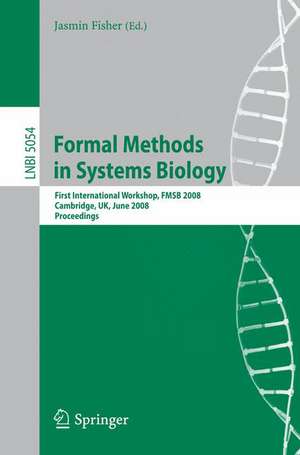
Formal Methods in Systems Biology
Editat de Jasmin Fisheren Limba Engleză Paperback – 26 mai 2008
Preț: 314.81 lei
Preț vechi: 393.51 lei
-20%
Puncte Express: 472
Carte tipărită la comandă
Livrare economică 18 noiembrie-02 decembrie
Livrare prin curier în România Termenul estimat este afișat lângă disponibilitate.
Transport gratuit de la 400.00 lei Plată online sau ramburs, în funcție de opțiunile comenzii.
Retur gratuit în 14 zile Comandă securizată și suport în română.
Specificații
ISBN-13: 9783540684107
ISBN-10: 3540684107
Pagini: 156
Ilustrații: VII, 139 p.
Dimensiuni: 155 x 235 x 9 mm
Greutate: 0.25 kg
Ediția:2008
Editura: Springer
Locul publicării:Berlin, Heidelberg, Germany
ISBN-10: 3540684107
Pagini: 156
Ilustrații: VII, 139 p.
Dimensiuni: 155 x 235 x 9 mm
Greutate: 0.25 kg
Ediția:2008
Editura: Springer
Locul publicării:Berlin, Heidelberg, Germany
V-ar putea interesa
-
 What's Inside My Computer?Christine Zuchora-Walske-18%Preț: 43.11 lei52.67 lei
 -
 -20%Preț: 459.48 lei574.36 lei
 -
 Simulating Complex Systems by Cellular AutomataAlfons G. Hoekstra-20%Preț: 654.71 lei818.39 lei
 -
 Spatial Cognition VIIICyrill Stachniss-20%Preț: 346.11 lei432.63 lei
 -
 Artificial Immune SystemsCarlos A. Coello-Coello-20%Preț: 335.91 lei419.88 lei
 -
 Algorithmic Game TheoryMaria Serna-20%Preț: 430.84 lei538.55 lei
 -
 Advances in Conceptual ModelingSilvana Castano-20%Preț: 341.85 lei427.31 lei
 -
 System Simulation and Scientific Computing, Part IITianyuan Xiao-20%Preț: 336.64 lei420.80 lei
 -
 Simulation diskreter ProzesseUlrich Hedtstück-20%Preț: 207.27 lei259.09 lei
 -
 -20%Preț: 330.00 lei412.51 lei
 -
 An Introductory Guide to Scientific VisualizationRae Earnshaw-20%Preț: 316.06 lei395.07 lei
Public țintă
ResearchCuprins
Contributed Papers.- Generic Reactive Animation: Realistic Modeling of Complex Natural Systems.- Bounded Asynchrony: Concurrency for Modeling Cell-Cell Interactions.- Computational Probability for Systems Biology.- Design Issues for Qualitative Modelling of Biological Cells with Petri Nets.- Combining Intra- and Inter-cellular Dynamics to Investigate Intestinal Homeostasis.- Approximating Continuous Systems by Timed Automata.- From Reaction Models to Influence Graphs and Back: A Theorem.- Rule-Based Modelling, Symmetries, Refinements.- One Modelling Formalism & Simulator Is Not Enough! A Perspective for Computational Biology Based on James II.
Textul de pe ultima copertă
This book constitutes the refereed proceedings of the First International Workshop on Formal Methods in Systems Biology, FMSB 2008, held in Cambridge, UK, in June, 2008.
The 9 revised full papers presented were carefully reviewed and selected from the workshop lectures that all were invited contributions. The purpose of this meeting was to identify techniques for the specification, development and verification of biological models. It also focused on the design of tools to execute and analyze biological models that can significantly advance our understanding of biological systems.
The 9 revised full papers presented were carefully reviewed and selected from the workshop lectures that all were invited contributions. The purpose of this meeting was to identify techniques for the specification, development and verification of biological models. It also focused on the design of tools to execute and analyze biological models that can significantly advance our understanding of biological systems.