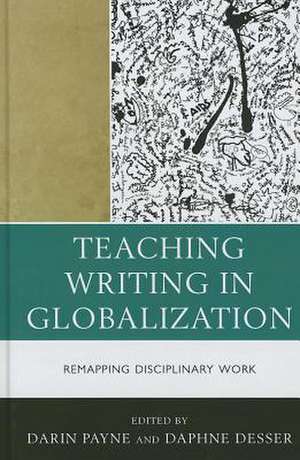
Teaching Writing in Globalization: Remapping Disciplinary Work: Cultural Studies/Pedagogy/Activism
Editat de Darin Payne, Daphne Desseren Limba Engleză Hardback – 29 dec 2011






Preț: 594.28 lei
Preț vechi: 910.42 lei
-35%
Puncte Express: 891
Carte tipărită la comandă
Livrare economică 28 noiembrie-12 decembrie
Livrare prin curier în România Termenul estimat este afișat lângă disponibilitate.
Transport gratuit pentru acest produs Plată online sau ramburs, în funcție de opțiunile comenzii.
Retur gratuit în 14 zile Comandă securizată și suport în română.
Specificații
ISBN-13: 9780739167960
ISBN-10: 0739167960
Pagini: 178
Dimensiuni: 163 x 239 x 18 mm
Greutate: 0.44 kg
Ediția:New.
Editura: Bloomsbury Publishing
Colecția Lexington Books
Seria Cultural Studies/Pedagogy/Activism
Locul publicării:New York, United States
ISBN-10: 0739167960
Pagini: 178
Dimensiuni: 163 x 239 x 18 mm
Greutate: 0.44 kg
Ediția:New.
Editura: Bloomsbury Publishing
Colecția Lexington Books
Seria Cultural Studies/Pedagogy/Activism
Locul publicării:New York, United States
V-ar putea interesa
-
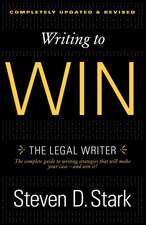 Writing to WinSteven D. StarkPreț: 110.29 lei
 -
 Clear and Simple as the TruthFrancis-Noël ThomasPreț: 223.69 lei
 -
 -20%Preț: 368.55 lei462.80 lei
 -
 The Storm Komrade SokratesHermann Sudermann-26%Preț: 354.05 lei480.76 lei
 -
 Modern ParadigmsIlie Gyurcsik-30%Preț: 405.25 lei578.57 lei
 -
 Preț: 93.71 lei
 -
 You Can Be an AuthorBettye W KnightonPreț: 80.82 lei
 -
 A Free Press in FreeHandMichael Ray SmithPreț: 191.10 lei
 -
 The Editor's CompanionJanet MackenziePreț: 493.26 lei
 -
 What to ChargeLaurie LewisPreț: 153.38 lei
 -
 Beyond Horatio's PhilosophyDavid StevensPreț: 121.63 lei
 -
 Destination DissertationSonja K FossPreț: 344.99 lei
 -
 Watch Your WordsMarda DunskyPreț: 197.66 lei
 -
 Teaching Plagiarism Prevention to College Students: An Ethics-Based ApproachConnie Strittmatter-19%Preț: 319.50 lei394.37 lei
 -
 The MLA Style SheetModern Language AssociationPreț: 52.39 lei
 -
 A Guide to Writing Your AutobiographyJackie Sherman-42%Preț: 54.88 lei94.18 lei
 -
 U.S. Government Printing Office Style ManualGpo Style BoardPreț: 218.61 lei
 -
 Histoire de l'imprimerie. Tome 2 (Éd.1854)Paul DupontPreț: 262.81 lei
 -
 Histoire de l'imprimerie. Tome 1 (Éd.1854)Paul DupontPreț: 246.33 lei
Cuprins
Foreword by Rachel Riedner and Randi Grey Kristensen
Acknowledgments
Chapter 1: Pedagogy of the Globalized: Education as a Practice of Intervention, by Darin Payne
Chapter 2: Nga Tamatoa and the Rhetoric of Brown Power: Re-Situating Collective Rhetorics in Global Colonialism, by Sharon Stevens and Lachlan Paterson
Chapter 3: Think Global, Eat Local: Teaching Alternative Agrarian Literacy in a Globalized Age, by Eileen Schell
Chapter 4: Globalization and the Composition Program: The WPA as Broker, by Bruce Horner
Chapter 5: Anxieties of Globalization: Networked Subjects in Rhetoric and Composition Studies, by Rebecca Dingo and Donna Strickland
Chapter 6: Mapping Everyday Articulations: Gender, Blackness, and Urban Revolution in Washington, D.C., by L. Hill Taylor, Jr.
Chapter 7: "The People's Challenge": Rhetorics of Globalization from Above and Below, by Daphne Desser
Chapter 8: Worldwide Composition: Virtual Uncertainties, by Chris Anson
Acknowledgments
Chapter 1: Pedagogy of the Globalized: Education as a Practice of Intervention, by Darin Payne
Chapter 2: Nga Tamatoa and the Rhetoric of Brown Power: Re-Situating Collective Rhetorics in Global Colonialism, by Sharon Stevens and Lachlan Paterson
Chapter 3: Think Global, Eat Local: Teaching Alternative Agrarian Literacy in a Globalized Age, by Eileen Schell
Chapter 4: Globalization and the Composition Program: The WPA as Broker, by Bruce Horner
Chapter 5: Anxieties of Globalization: Networked Subjects in Rhetoric and Composition Studies, by Rebecca Dingo and Donna Strickland
Chapter 6: Mapping Everyday Articulations: Gender, Blackness, and Urban Revolution in Washington, D.C., by L. Hill Taylor, Jr.
Chapter 7: "The People's Challenge": Rhetorics of Globalization from Above and Below, by Daphne Desser
Chapter 8: Worldwide Composition: Virtual Uncertainties, by Chris Anson
Recenzii
A rich, nuanced discussion of the ways that composition can sustain a radically democratic globalization from below. These essays trace the oppositional literacies and rhetorics of solidarity informing the movements struggling against the global network of sweatshops where poisoned workers toil twelve or fourteen hours for ten dollars a day.
Teaching Writing in Globalization investigates competing meanings of 'globalization' to explore ways of using writing and the teaching of writing to negotiate the economic, geo-political, cultural, institutional, and disciplinary relations impacting our lives. Offering perspectives from some of the leading voices in rhetoric and composition, it provides a necessary and welcome opening into the multiple and specific ways we might (re)write and (re)read the global-local.
Teaching Writing in Globalization investigates competing meanings of 'globalization' to explore ways of using writing and the teaching of writing to negotiate the economic, geo-political, cultural, institutional, and disciplinary relations impacting our lives. Offering perspectives from some of the leading voices in rhetoric and composition, it provides a necessary and welcome opening into the multiple and specific ways we might (re)write and (re)read the global-local.