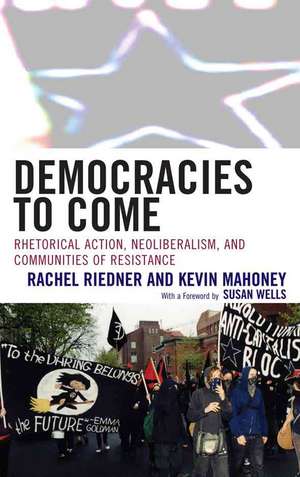
Democracies to Come: Rhetorical Action, Neoliberalism, and Communities of Resistance: Cultural Studies/Pedagogy/Activism
Autor Rachel Riedner, Kevin A. Mahoney, Susan Wellsen Limba Engleză Hardback – 16 mai 2008
Each chapter of the book answers these questions: How can pedagogy be conceptualized as a site in which to intervene in culture and to act politically? How can pedagogy help cultivate the kairotic act of opening spaces for inquiring into the social relations that education helps shape? How can we re-imagine practices capable of contextualizing education within larger educational and market forces? How do we develop the desire and habit to recognize moments when we move beyond norms and develop new ways of seeing, acting, and relating? How do we see pedagogical activism not as an end in itself but as an integral process of revitalizing democracy? How can we create moments to process new arguments, respond to particular conjunctures, and create languages that articulate the contingencies and affinities of the particular moment?





Preț: 561.22 lei
Preț vechi: 862.15 lei
-35%
Puncte Express: 842
Carte tipărită la comandă
Livrare economică 23 noiembrie-07 decembrie
Livrare prin curier în România Termenul estimat este afișat lângă disponibilitate.
Transport gratuit pentru acest produs Plată online sau ramburs, în funcție de opțiunile comenzii.
Retur gratuit în 14 zile Comandă securizată și suport în română.
Specificații
ISBN-13: 9780739111048
ISBN-10: 0739111043
Pagini: 142
Dimensiuni: 162 x 240 x 17 mm
Greutate: 0.36 kg
Ediția:New.
Editura: Bloomsbury Publishing
Colecția Lexington Books
Seria Cultural Studies/Pedagogy/Activism
Locul publicării:New York, United States
ISBN-10: 0739111043
Pagini: 142
Dimensiuni: 162 x 240 x 17 mm
Greutate: 0.36 kg
Ediția:New.
Editura: Bloomsbury Publishing
Colecția Lexington Books
Seria Cultural Studies/Pedagogy/Activism
Locul publicării:New York, United States
Cuprins
Chapter 1 Table of Contents
Chapter 2 Foreword
Chapter 3 Preface
Chapter 4 Acknowledgments
Chapter 5 1 Introduction
Chapter 6 2 Articulating Action in a Neoliberal World
Chapter 7 3 Circulation of Affect in University Spaces
Chapter 8 4 Circulation of Benevolence
Chapter 9 5 Affective Intervention: Rhetorics of Despair and Hope
Chapter 10 6 "The War for the Word has Begun"
Chapter 11 Bibliography
Chapter 12 Index
Chapter 2 Foreword
Chapter 3 Preface
Chapter 4 Acknowledgments
Chapter 5 1 Introduction
Chapter 6 2 Articulating Action in a Neoliberal World
Chapter 7 3 Circulation of Affect in University Spaces
Chapter 8 4 Circulation of Benevolence
Chapter 9 5 Affective Intervention: Rhetorics of Despair and Hope
Chapter 10 6 "The War for the Word has Begun"
Chapter 11 Bibliography
Chapter 12 Index
Recenzii
Democracies to Come may prove particularly useful for community engaged educators, activists, and composition scholars as it leaves us with lists of questions that lead to reflective praxis. . . .Whether we work with non-profits or individual community members, in correctional facilities or with activist organizations, Democracies to Come provides ways to understand our everyday work with language as action that has the potential to rupture geo-political and shift geopolitical systems. It provides a path toward critically engaging across the individual and systemic, as well as the local and global, a challenging move because of the neoliberal frameworks which conscribe our work and relationships, but a necessary move if we wish to work toward 'the out to be.'
Perhaps the most important thing that Democracies to Come accomplishes is to remind rhetors, teachers, and activists to search for the cracks in neoliberal hegemony and transform them into moments of rhetorical action. If the context of the current economic crisis makes this work more urgent, then the narrative hope and change that has also wept the recent national media makes Riedner and Mahoney's project viable as an invitation to kairotic practice in the face of despair.
Drawing on example from Zapatistas in Chiapas to demonstrations against the WTO,Democracies to Come takes on the problem of neoliberalism in the university and wider world to explore the possibilities of consequential rhetorical action in the era of late capitalism. To my mind, Rachel Riedner and Kevin Mahoney raise key theoretical and pedagogical issues, challenging readers with their adept analyses of benevolence and despair in student consciousness and with the sense of solidarity and struggle that comes from their anti-imperialist politics. This is the first book I know of in rhetoric and writing studies to capture the radical energies of the anti-globalization movement and its belief that another world is possible.
Democracies to Come offers a dynamic look at the role pedagogy can play as an act of social, political, and cultural intervention against neoliberal rhetorics and economics. Riedner and Mahoney provide us with a hopeful vision of the ways in which public protest and public discourse can function as acts of critical resistance and as new modes of being and thinking. Drawing on critical theory, critical pedagogy, cultural studies, and rhetorical studies, Democracies to Come is also a model of interdisciplinary inquiry and scholarship in action.
Democracies to Come does an excellent job defining and explaining how rhetorical action intervenes into neoliberal politics both inside and outside of the classroom, making it a good read for composition teachers who engage in service learning, participatory action research, or critical pedagogy. It is an important addition to composition scholarship in critical pedagogy and social action in that it is concerned with how neoliberalism, when left unchecked, can forestall even the best intentions for social justice.
Perhaps the most important thing that Democracies to Come accomplishes is to remind rhetors, teachers, and activists to search for the cracks in neoliberal hegemony and transform them into moments of rhetorical action. If the context of the current economic crisis makes this work more urgent, then the narrative hope and change that has also wept the recent national media makes Riedner and Mahoney's project viable as an invitation to kairotic practice in the face of despair.
Drawing on example from Zapatistas in Chiapas to demonstrations against the WTO,Democracies to Come takes on the problem of neoliberalism in the university and wider world to explore the possibilities of consequential rhetorical action in the era of late capitalism. To my mind, Rachel Riedner and Kevin Mahoney raise key theoretical and pedagogical issues, challenging readers with their adept analyses of benevolence and despair in student consciousness and with the sense of solidarity and struggle that comes from their anti-imperialist politics. This is the first book I know of in rhetoric and writing studies to capture the radical energies of the anti-globalization movement and its belief that another world is possible.
Democracies to Come offers a dynamic look at the role pedagogy can play as an act of social, political, and cultural intervention against neoliberal rhetorics and economics. Riedner and Mahoney provide us with a hopeful vision of the ways in which public protest and public discourse can function as acts of critical resistance and as new modes of being and thinking. Drawing on critical theory, critical pedagogy, cultural studies, and rhetorical studies, Democracies to Come is also a model of interdisciplinary inquiry and scholarship in action.
Democracies to Come does an excellent job defining and explaining how rhetorical action intervenes into neoliberal politics both inside and outside of the classroom, making it a good read for composition teachers who engage in service learning, participatory action research, or critical pedagogy. It is an important addition to composition scholarship in critical pedagogy and social action in that it is concerned with how neoliberalism, when left unchecked, can forestall even the best intentions for social justice.