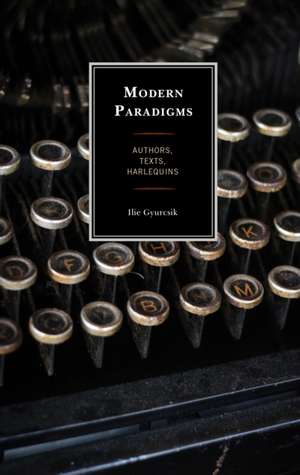
Modern Paradigms: Authors, Texts, Harlequins
Autor Ilie Gyurcsiken Limba Engleză Hardback – 30 mai 2017
Preț: 385.75 lei
Preț vechi: 560.48 lei
-31%
Puncte Express: 579
Carte tipărită la comandă
Livrare economică 10-24 august
Livrare prin curier în România Termenul estimat este afișat lângă disponibilitate.
Transport gratuit de la 400.00 lei Plată online sau ramburs, în funcție de opțiunile comenzii.
Retur gratuit în 14 zile Comandă securizată și suport în română.
Specificații
ISBN-13: 9780761869351
ISBN-10: 0761869352
Pagini: 160
Dimensiuni: 162 x 236 x 18 mm
Greutate: 0.41 kg
Editura: Bloomsbury Publishing
Colecția Hamilton Books
Locul publicării:New York, United States
ISBN-10: 0761869352
Pagini: 160
Dimensiuni: 162 x 236 x 18 mm
Greutate: 0.41 kg
Editura: Bloomsbury Publishing
Colecția Hamilton Books
Locul publicării:New York, United States
V-ar putea interesa
-
 Extended Essay Online Course Book: Oxford IB Diploma ProgrammeKosta Lekanides-16%Preț: 348.21 lei415.72 lei
 -
 -29%Preț: 382.03 lei539.77 lei
 -
 My Publishing JourneyTamara L DeverPreț: 165.43 lei
 -
 -34%Preț: 676.41 lei1021.46 lei
 -
 -22%Preț: 351.34 lei448.62 lei
 -
 Beginning the NovelPeter Porosky-30%Preț: 358.90 lei512.11 lei
 -
 SleuthGail BowenPreț: 103.15 lei
 -
 How to Write a Children's Picture BookDarcy PattisonPreț: 83.63 lei
 -
 The Write State of MindEmily GoworPreț: 155.22 lei
 -
 Creative Visualization for WritersNina AmirPreț: 131.57 lei
 -
 Destination DissertationSonja K FossPreț: 331.98 lei
 -
 Watch Your WordsMarda DunskyPreț: 197.66 lei
 -
 Teaching Plagiarism Prevention to College Students: An Ethics-Based ApproachConnie Strittmatter-21%Preț: 297.60 lei375.74 lei
 -
 Outskirts Press Presents Publish Your PassionBrent SampsonPreț: 71.48 lei
 -
 An American TravelerRandy Wayne WhitePreț: 152.66 lei
 -
 A Guide to Writing for Human Service ProfessionalsMorley D. Glicken-30%Preț: 681.78 lei975.62 lei
 -
 A Guide to Writing for Human Service ProfessionalsMorley D. Glicken-20%Preț: 317.83 lei397.00 lei
 -
 Legislative Drafter's DeskbookTobias A Dorsey-9%Preț: 837.02 lei919.80 lei
 -
 Inking the Deal: A Guide for Successful Academic PublishingStanley E. PorterPreț: 190.29 lei
 -
 -21%Preț: 305.66 lei385.14 lei
 -
 Writing Performance Poetry: A Straightforward GuideStephen Wade-31%Preț: 54.18 lei78.69 lei
Cuprins
Explanation
Introductory Dream
Chapter 1: The "Author" As Player and Master of the Game: Dostoyevsky
Chapter 2: Unweaving the Textual Costume: Thomas Mann
Chapter 3: The Mantle of the Reading and the Reading of the Mantle: Proust
Chapter 4: The Fringe of the Harlequin's Mantle: Joyce
Chapter 5: The Trial of the Letter and the Letter of the Trial: Kafka
Chapter 6: The (Un)Mytho-Historiographic Mantle: Faulkner
Chapter 7: The Mantle Of The Mega(Un)Syllogism: Cioran
Author, Mantle, Toys
References
Introductory Dream
Chapter 1: The "Author" As Player and Master of the Game: Dostoyevsky
Chapter 2: Unweaving the Textual Costume: Thomas Mann
Chapter 3: The Mantle of the Reading and the Reading of the Mantle: Proust
Chapter 4: The Fringe of the Harlequin's Mantle: Joyce
Chapter 5: The Trial of the Letter and the Letter of the Trial: Kafka
Chapter 6: The (Un)Mytho-Historiographic Mantle: Faulkner
Chapter 7: The Mantle Of The Mega(Un)Syllogism: Cioran
Author, Mantle, Toys
References
Recenzii
A reference study in comparative literature, Professor Ilie Gyurcsik's book represents an exceptional analysis of certain exemplary ('paradigmatic') texts and comprises, displayed into a postmodern spirit, the tension inherent to a double perspective: the direct perspective, which is 'Renaissance-like' and proper to historical modernity, and the inverted perspective, which is literally-semantic, ludic, and fragmentary, and is proper to radical aesthetic modernity; a tension between the work and the text, between the paralogical delirium and the logic of the paradox, between a "pharaohic" vision and an "archeological" one.