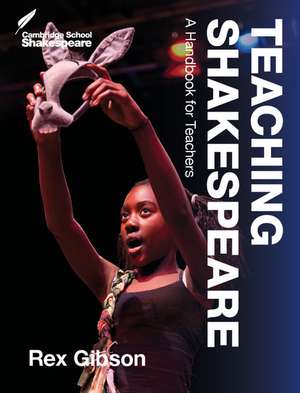
Teaching Shakespeare
Autor Rex Gibsonen Limba Engleză Paperback – 21 apr 2016
| Toate formatele și edițiile | Preț | Express |
|---|---|---|
| Paperback (2) | 198.43 lei 3-5 săpt. | |
| Cambridge University Press – 26 feb 1998 | 198.43 lei 3-5 săpt. | |
| Cambridge University Press – 21 apr 2016 | 219.52 lei 3-5 săpt. | +19.44 lei 7-13 zile |
Preț: 219.52 lei
Puncte Express: 329
Preț estimativ în valută:
38.79€ • 44.48$ • 33.66£
38.79€ • 44.48$ • 33.66£
Carte disponibilă
Livrare economică 23 aprilie-07 mai
Livrare express 09-15 aprilie pentru 29.43 lei
Specificații
ISBN-13: 9781316609873
ISBN-10: 1316609871
Pagini: 237
Dimensiuni: 187 x 244 x 12 mm
Greutate: 0.47 kg
Ediția:Revizuită
Editura: Cambridge University Press
Locul publicării:Cambridge, United Kingdom
ISBN-10: 1316609871
Pagini: 237
Dimensiuni: 187 x 244 x 12 mm
Greutate: 0.47 kg
Ediția:Revizuită
Editura: Cambridge University Press
Locul publicării:Cambridge, United Kingdom
V-ar putea interesa
-
 Shakespearean TragedyA. Bradley-20%Preț: 71.87 lei89.70 lei
 -
 The Oxford Handbook of ShakespeareArthur F Kinney-6%Preț: 289.31 lei307.95 lei
 -
 Shakespeare's Nature: From Cultivation to CultureCharlotte Scott-34%Preț: 663.31 lei997.87 lei
 -
 Shakespeare's NoiseKenneth GrossPreț: 264.40 lei
 -
 -18%Preț: 85.90 lei104.94 lei
 -
 Shakespearean and Jacobean TragedyRex GibsonPreț: 192.41 lei
 -
 Macbeth: A Critical ReaderProfessor John Drakakis-17%Preț: 172.43 lei208.27 lei
 -
 Shakespeare's WifeGermaine Greer-28%Preț: 83.41 lei115.92 lei
 -
 -14%Preț: 783.22 lei910.71 lei
 -
 -11%Preț: 672.36 lei755.45 lei
 -
 -14%Preț: 746.09 lei867.54 lei
 -
 A Shakespeare Manual for SchoolsW. A. IllsleyPreț: 179.18 lei
 -
 The Shakespearean Stage SpaceMariko IchikawaPreț: 289.83 lei
 -
 Shakespeare and World CinemaMark Thornton BurnettPreț: 292.61 lei
 -
 Religion and Revelry in Shakespeare's Festive WorldPhebe JensenPreț: 292.03 lei
 -
 -30%Preț: 41.74 lei59.95 lei
 -
 King Lear: Third SeriesWilliam Shakespeare-16%Preț: 69.08 lei82.38 lei
 -
 Romeo and Juliet: Third SeriesWilliam Shakespeare-16%Preț: 69.77 lei82.82 lei
Cuprins
Foreword; Introduction: Active methods; Teaching Shakespeare: an overview; 1. Why teach Shakespeare?: Abiding and familiar concerns; Student development; Language; Otherness; 2. Principles: Treat Shakespeare as a script; Make Shakespeare learner-centred; Shakespeare is social; Shakespeare celebrates imagination; Shakespeare is physical; Make Shakespeare exploratory; Address the distinctive qualities of the play; Choice and variety; Shakespeare and plurality; Negative capability; Shakespeare is about enjoyment; 3. Perspectives: Feminism; Psychoanalysis; Structuralism; Deconstruction; Political perspectives; Reception theory; Using perspectives; 4. Shakespeare's language: Introduction; Dramatic language; Imagery; Personification; Antithesis; Repetition; Rhyme; Lists; Verse; Prose; Rhetoric; Bombast; Hyperbole; Irony; Oxymoron; Puns; Malapropism; Monosyllables; Pronouns; Changing language; Inventing language; Everyday language; Two types of language; The development of Shakespeare's language; The Sonnets; 5. Story: The Story of the play; Enacting the story; Stories in the play; Recapitulating the story; Point of view narratives; Ariel's story; 6. Character: Introduction; Fundamental questions; Complexity of character; Language and character; Introduction to activities; Cast the play; Job interviews; Absent characters; This is your life; Obituaries; Point of view; Hot-seating; Public and private; Props; Free-wheeling associations; List of characters; Ranking characters; Journeys through the play; Relationships; Exploring character; Character types; Character names; 7. Themes: Introduction; Four common themes; Levels; Particular themes; Fathers and daughters; Acting and theatre; 8. Stagecraft: Introduction; Stage directions; Critical incidents; Creating atmosphere; Opening scenes; 9. Active methods: Content; The teacher's role; Organising the classroom; Introduction to activities; Acting a scene; Beginning the play; Sense units; Speaking Shakespeare; Teacher leading; Five investigations; Sections and headlines; Student as director; Point of view: theory; Improvisations; Warm-ups; A memory game; Tableaux; Chroal speaking; Insults; Using films; Trials and inquiries; Writing and design; Sequencing; Shakespeare's life and times; Theatre visits; Staging a Shakespeare play; Shakespeare festivals; Researching the classics; Other resources; 10. Shakespeare for younger students: Introduction; Shakespeare's life and times; Storytelling; Dramatic storytelling; A co-ordinated approach across the curriculum; A Shakespeare term; A puppet Macbeth; 11. Assessment: Process or product? Principles; Student self-assessment; Assessment of performance; Essays; Assessment tasks; Examinations; Evaluating a lesson; Quotations used in the text; Index
Descriere
An improved, larger-format edition of the Cambridge School Shakespeare plays, extensively rewritten, expanded and produced in an attractive new design.