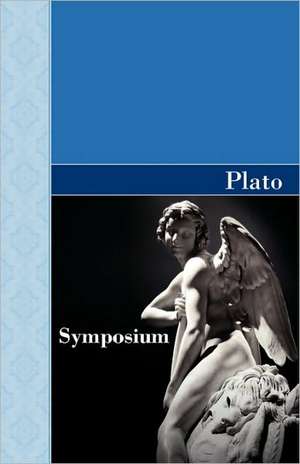
Symposium
Autor Platoen Limba Engleză Hardback – 12 noi 2009
Preț: 181.97 lei
Puncte Express: 273
Carte tipărită la comandă
Livrare economică 07-21 decembrie
Livrare prin curier în România Termenul estimat este afișat lângă disponibilitate.
Transport gratuit de la 400.00 lei Plată online sau ramburs, în funcție de opțiunile comenzii.
Retur gratuit în 14 zile Comandă securizată și suport în română.
Specificații
ISBN-13: 9781605125169
ISBN-10: 1605125164
Pagini: 108
Dimensiuni: 145 x 222 x 10 mm
Greutate: 0.29 kg
Editura: Akasha Publishing, LLC
ISBN-10: 1605125164
Pagini: 108
Dimensiuni: 145 x 222 x 10 mm
Greutate: 0.29 kg
Editura: Akasha Publishing, LLC
V-ar putea interesa
-
 Eve Was FramedHelena Kennedy-31%Preț: 64.55 lei93.14 lei
 -
 The Art of WarSun Tzu-37%Preț: 40.10 lei63.73 lei
 -
 The PrinceNiccolo Machiavelli-20%Preț: 45.17 lei56.59 lei
 -
 NatureRalph Waldo EmersonPreț: 56.55 lei
 -
 JusticeMichael J. Sandel-31%Preț: 64.75 lei93.26 lei
 -
 On ConspiraciesNiccolo Machiavelli-19%Preț: 45.84 lei56.72 lei
 -
 Socrates' DefencePlato-39%Preț: 17.33 lei28.43 lei
 -
 How Much Land Does A Man Need?Leo Tolstoy-38%Preț: 17.64 lei28.47 lei
 -
 The Communist ManifestoFriedrich Engels-38%Preț: 17.67 lei28.48 lei
 -
 The RepublicPlato-16%Preț: 67.59 lei80.62 lei
 -
 The PrinceNiccolò MachiavelliPreț: 41.69 lei
 -
 -27%Preț: 77.21 lei105.15 lei
 -
 ParapsychologyJ. B. RhinePreț: 117.23 lei
 -
 The Greatest Minds and Ideas of All TimeWill Durant-20%Preț: 86.00 lei106.87 lei
 -
 Preț: 200.22 lei
 -
 Brave and BoldHoratio AlgerPreț: 125.17 lei
 -
 The Lessons of HistoryWill Durant-14%Preț: 61.31 lei70.93 lei
 -
 Discourses and Selected WritingsEpictetusPreț: 140.80 lei
 -
 21 Lessons for the 21st CenturyYuval Noah Harari-16%Preț: 79.37 lei95.03 lei
 -
 Music Theory in Practice, Grade 3Eric Taylor-8%Preț: 63.65 lei69.08 lei
 -
 Music Theory in Practice, Grade 4Eric Taylor-8%Preț: 67.12 lei72.98 lei
 -
 Music Theory in Practice, Grade 5Eric Taylor-9%Preț: 70.62 lei77.77 lei
 -
 Preț: 139.70 lei
Notă biografică
Plato was an ancient Greek philosopher born in Athens during the Classical period in Ancient Greece. In Athens, Plato founded the Academy, a philosophical school where he taught the philosophical doctrines that would later become known as Platonism. Plato (or Platon) was a pen name derived, apparently, from the nickname given to him by his wrestling coach - allegedly a reference to his physical broadness. According to Alexander of Miletus quoted by Diogenes of Sinope his actual name was Aristocles, son of Ariston, of the deme Collytus (Collytus being a district of Athens).Plato was an innovator of the written dialogue and dialectic forms in philosophy. He raised problems for what later became all the major areas of both theoretical philosophy and practical philosophy. His most famous contribution is the Theory of forms, which has been interpreted as advancing a solution to what is now known as the problem of universals. He is also the namesake of Platonic love and the Platonic solids.
Descriere
Descriere de la o altă ediție sau format:
In his celebrated masterpiece, Symposium, Plato imagines a high-society dinner-party in Athens in 416 BC at which the guests - including the comic poet Aristophanes and, of course, Plato's mentor Socrates - each deliver a short speech in praise of love. The sequence of dazzling speeches culminates in Socrates' famous account of the views of Diotima, a prophetess who taught him that love is our means of trying to attain goodness. And then into the party bursts the drunken Alcibiades, the most popular and notorious Athenian of the time, who insists on praising Socrates himself rather than love, and gives us a brilliant sketch of this enigmatic character.The power, humour, and pathos of Plato's creation engages the reader on every page. This new translation is complemented by full explanatory notes and an illuminating introduction. ABOUT THE SERIES: For over 100 years Oxford World's Classics has made available the widest range of literature from around the globe. Each affordable volume reflects Oxford's commitment to scholarship, providing the most accurate text plus a wealth of other valuable features, including expert introductions by leading authorities, helpful notes to clarify the text, up-to-date bibliographies for further study, and much more.
In his celebrated masterpiece, Symposium, Plato imagines a high-society dinner-party in Athens in 416 BC at which the guests - including the comic poet Aristophanes and, of course, Plato's mentor Socrates - each deliver a short speech in praise of love. The sequence of dazzling speeches culminates in Socrates' famous account of the views of Diotima, a prophetess who taught him that love is our means of trying to attain goodness. And then into the party bursts the drunken Alcibiades, the most popular and notorious Athenian of the time, who insists on praising Socrates himself rather than love, and gives us a brilliant sketch of this enigmatic character.The power, humour, and pathos of Plato's creation engages the reader on every page. This new translation is complemented by full explanatory notes and an illuminating introduction. ABOUT THE SERIES: For over 100 years Oxford World's Classics has made available the widest range of literature from around the globe. Each affordable volume reflects Oxford's commitment to scholarship, providing the most accurate text plus a wealth of other valuable features, including expert introductions by leading authorities, helpful notes to clarify the text, up-to-date bibliographies for further study, and much more.
Recenzii
"The Symposium challenges the translator who is also a poet in its range of styles which is unique among the Platonic dialogues. Not only does the translator have to mimic the distinct style of the narrator, Apollodoros, and the seven symposiasts . . . he has to mind and represent the action in this the most dramatic of the Platonic dialogues. Sharon's translation meets these challenges and is a brilliant recovery of the style and drama of the Symposium. I know of no other translation that is so appropriately various in the styles adopted by and for the speakers or which is so attentive to the drama of this dialogue which celebrates a tragic victory." --Diskin Clay, Duke University
English translation. Introduction and glossary. The glossary of key terms is a unique addition to Platonic literature by which concepts central to each dialogue are discussed and cross-referenced as to their occurrences throughout the work. In such a way students are encouraged to see beyond the words into concepts.
Cuprins
The SymposiumPreface
Introduction
The Symposium
Notes
Select Bibliography
Introduction
The Symposium
Notes
Select Bibliography