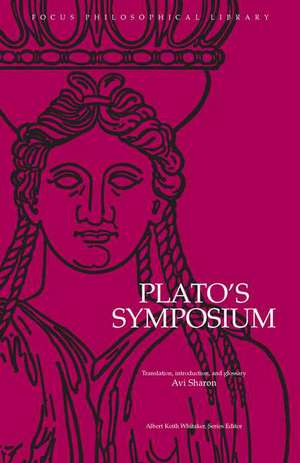
Symposium
Autor Plato Avi Sharonen Limba Engleză Paperback – 1998
This is an English translation of Plato account of an important dialogue on the nature of love between Phaedrus, Pausanias, Eryximachus, Aristophanes, Agathon, Socrates and Alcibiades.
Focus Philosophical Library translations are close to and are non-interpretative of the original text, with the notes and a glossary intending to provide the reader with some sense of the terms and the concepts as they were understood by Plato’s immediate audience.
Preț: 87.59 lei
Puncte Express: 131
Carte disponibilă
Livrare economică 13-27 noiembrie
Livrare prin curier în România Termenul estimat este afișat lângă disponibilitate.
Transport gratuit de la 400.00 lei Plată online sau ramburs, în funcție de opțiunile comenzii.
Retur gratuit în 14 zile Comandă securizată și suport în română.
Specificații
ISBN-13: 9780941051569
ISBN-10: 0941051560
Pagini: 80
Ilustrații: Illustrations
Dimensiuni: 140 x 216 x 5 mm
Greutate: 0.14 kg
Ediția:First Edition
Editura: Hackett Publishing Company,Inc
Colecția Focus
Locul publicării:United States
ISBN-10: 0941051560
Pagini: 80
Ilustrații: Illustrations
Dimensiuni: 140 x 216 x 5 mm
Greutate: 0.14 kg
Ediția:First Edition
Editura: Hackett Publishing Company,Inc
Colecția Focus
Locul publicării:United States
V-ar putea interesa
-
 Eve Was FramedHelena Kennedy-31%Preț: 64.55 lei93.14 lei
 -
 The Art of WarSun Tzu-37%Preț: 40.10 lei63.73 lei
 -
 The PrinceNiccolo Machiavelli-20%Preț: 45.17 lei56.59 lei
 -
 NatureRalph Waldo EmersonPreț: 56.55 lei
 -
 JusticeMichael J. Sandel-31%Preț: 64.75 lei93.26 lei
 -
 On ConspiraciesNiccolo Machiavelli-19%Preț: 45.84 lei56.72 lei
 -
 Socrates' DefencePlato-39%Preț: 17.33 lei28.43 lei
 -
 How Much Land Does A Man Need?Leo Tolstoy-39%Preț: 17.47 lei28.47 lei
 -
 The Communist ManifestoFriedrich Engels-39%Preț: 17.49 lei28.48 lei
 -
 The RepublicPlato-17%Preț: 66.98 lei80.62 lei
 -
 The PrinceNiccolò MachiavelliPreț: 41.84 lei
 -
 -27%Preț: 76.89 lei105.15 lei
 -
 ParapsychologyJ. B. RhinePreț: 117.23 lei
 -
 The Greatest Minds and Ideas of All TimeWill Durant-20%Preț: 86.00 lei106.87 lei
 -
 Preț: 200.22 lei
 -
 Brave and BoldHoratio AlgerPreț: 125.17 lei
 -
 The Lessons of HistoryWill Durant-14%Preț: 60.89 lei70.93 lei
 -
 Discourses and Selected WritingsEpictetusPreț: 140.80 lei
 -
 21 Lessons for the 21st CenturyYuval Noah Harari-16%Preț: 79.37 lei95.03 lei
 -
 Music Theory in Practice, Grade 3Eric Taylor-8%Preț: 63.65 lei69.08 lei
 -
 Music Theory in Practice, Grade 4Eric Taylor-8%Preț: 67.12 lei72.98 lei
 -
 Music Theory in Practice, Grade 5Eric Taylor-9%Preț: 70.62 lei77.77 lei
 -
 Preț: 139.70 lei
Recenzii
"The Symposium challenges the translator who is also a poet in its range of styles which is unique among the Platonic dialogues. Not only does the translator have to mimic the distinct style of the narrator, Apollodoros, and the seven symposiasts . . . he has to mind and represent the action in this the most dramatic of the Platonic dialogues. Sharon's translation meets these challenges and is a brilliant recovery of the style and drama of the Symposium. I know of no other translation that is so appropriately various in the styles adopted by and for the speakers or which is so attentive to the drama of this dialogue which celebrates a tragic victory." --Diskin Clay, Duke University
English translation. Introduction and glossary. The glossary of key terms is a unique addition to Platonic literature by which concepts central to each dialogue are discussed and cross-referenced as to their occurrences throughout the work. In such a way students are encouraged to see beyond the words into concepts.
Notă biografică
Plato was an ancient Greek philosopher born in Athens during the Classical period in Ancient Greece. In Athens, Plato founded the Academy, a philosophical school where he taught the philosophical doctrines that would later become known as Platonism. Plato (or Platon) was a pen name derived, apparently, from the nickname given to him by his wrestling coach - allegedly a reference to his physical broadness. According to Alexander of Miletus quoted by Diogenes of Sinope his actual name was Aristocles, son of Ariston, of the deme Collytus (Collytus being a district of Athens).Plato was an innovator of the written dialogue and dialectic forms in philosophy. He raised problems for what later became all the major areas of both theoretical philosophy and practical philosophy. His most famous contribution is the Theory of forms, which has been interpreted as advancing a solution to what is now known as the problem of universals. He is also the namesake of Platonic love and the Platonic solids.His own most decisive philosophical influences are usually thought to have been, along with Socrates, the pre-Socratics Pythagoras, Heraclitus, and Parmenides, although few of his predecessors' works remain extant and much of what we know about these figures today derives from Plato himself.[a]Along with his teacher, Socrates, and his student, Aristotle, Plato is a central figure in the history of philosophy.[b] Unlike the work of nearly all of his contemporaries, Plato's entire body of work is believed to have survived intact for over 2,400 years.[6] Although their popularity has fluctuated, Plato's works have consistently been read and studied. Through Neoplatonism Plato also greatly influenced both Christian and Islamic philosophy (through e.g. Al-Farabi). In modern times, Alfred North Whitehead famously said: "the safest general characterization of the European philosophical tradition is that it consists of a series of footnotes to Plato.
Cuprins
The SymposiumPreface
Introduction
The Symposium
Notes
Select Bibliography
Introduction
The Symposium
Notes
Select Bibliography