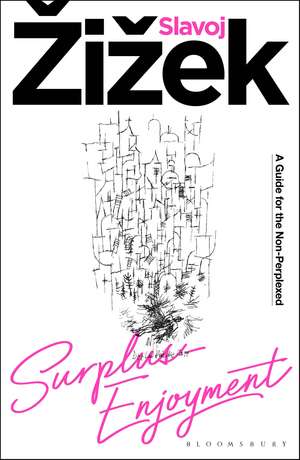
Surplus-Enjoyment: A Guide For The Non-Perplexed
Autor Slavoj Zizeken Limba Engleză Hardback – 10 aug 2022
| Toate formatele și edițiile | Preț | Express |
|---|---|---|
| Paperback (1) | 109.87 lei 3-5 săpt. | +28.19 lei 7-13 zile |
| BLOOMSBURY ACADEMIC – 19 oct 2023 | 109.87 lei 3-5 săpt. | +28.19 lei 7-13 zile |
| Hardback (1) | 124.43 lei 3-5 săpt. | +170.47 lei 7-13 zile |
| Bloomsbury Publishing – 10 aug 2022 | 124.43 lei 3-5 săpt. | +170.47 lei 7-13 zile |
Preț: 124.43 lei
Preț vechi: 269.24 lei
-54% Nou
22.02€ • 25.82$ • 19.34£
Carte disponibilă
Livrare economică 15-29 ianuarie 26
Livrare express 01-07 ianuarie 26 pentru 180.46 lei
Specificații
ISBN-10: 1350226254
Pagini: 400
Dimensiuni: 129 x 198 x 31 mm
Greutate: 0.54 kg
Editura: Bloomsbury Publishing
Colecția Bloomsbury Academic
Locul publicării:London, United Kingdom
Caracteristici
Notă biografică
Slavoj Zizek is a Hegelian philosopher, a Lacanian psychoanalyst, and a Communist. He is International Director at the Birkbeck Institute for Humanities, University of London, UK, Visiting Professor at the New York University, USA, and Senior Researcher at the Department of Philosophy, University of Ljubljana, Slovenia.
Cuprins
Ouverture: Living In A Topsy-Turvy World 1. Where Is The Rift? Marx, Capitalism, And Ecology2. A Non-binary Difference? Psychoanalysis, Politics, And Philosophy3. Surplus-Enjoyment, Or, Why Do We Enjoy Our OppressionFinale: Subjective Destitution As A Political CategoryBibliographyIndex
Recenzii
Surplus-Enjoyment is the author at his most supple, addressing urgent current concerns and the need for a global solidarity that cannot be divorced from egalitarianism. ... Zizek is a pick-me-up for fatigued brains, a true radical and an authentic left-wing conservative who wants to prevent the social disintegration that threatens our civic life.
Descriere
Contemporary life is defined by excess. There must always be more, there is never enough. We need a surplus to what we need to be able to truly enjoy what we have. Slavoj Zizek's guide to surplus (and why it's enjoyable) begins by arguing that what is surplus to our needs is by its very nature unsubstantial and unnecessary. But, perversely, without this surplus, we wouldn't be able to enjoy, what is substantial and necessary. Indeed, without the surplus we wouldn't be able to identify what was the perfect amount. Is there any escape from the vicious cycle of surplus enjoyment or are we forever doomed to simply want more? Engaging with everything from The Joker film to pop songs and Thomas Aquinas to the history of pandemics, Zizek argues that recognising the society of enjoyment we live in for what it is can provide an explanation for the political impasses in which we find ourselves today. And if we begin, even a little bit, to recognise that the nuggets of 'enjoyment' we find in excess are as flimsy and futile, might we find a way out?