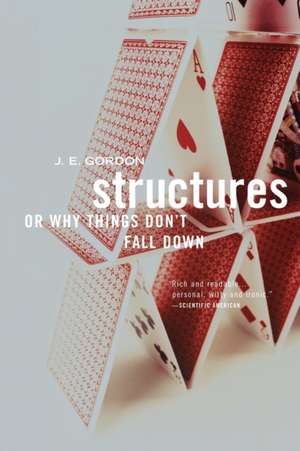
Structures
Autor J. E. Gordonen Limba Engleză Paperback – 10 iul 2003
În analiza volumului Structures, observăm o abordare practică remarcabilă, care reușește să elimine bariera formalismului matematic excesiv pentru a dezvălui mecanismele fundamentale ale lumii construite. Suntem de părere că forța acestei lucrări rezidă în raportul echilibrat dintre conceptele teoretice și aplicațiile lor imediate: de la modul în care un pod suspendat gestionează traficul intens, până la presiunea exercitată asupra barajelor. J. E. Gordon nu se rezumă la ingineria civilă, ci extinde principiile structurale asupra regnului biologic, explicând designul natural al unui cangur cu aceeași rigoare aplicată unui zgârie-nori. Descoperim aici un stil narativ plin de spirit, care transformă concepte complexe în intuiții clare. Pe linia practică a lucrării How Structures Work – Design and Behaviour from Bridges to Buildings 2e de D Yeomans, dar cu un focus mai pronunțat pe explicarea cauzalității și a eșecului structural, Structures servește ca o punte între curiozitatea generală și expertiza tehnică. Dacă în The New Science of Strong Materials autorul analiza de ce materialele rezistă sau cedează la nivel molecular, în volumul de față el ridică perspectiva asupra ansamblului, examinând modul în care geometria și forțele interacționează pentru a menține stabilitatea. Această ediție publicată de Penguin Books păstrează claritatea didactică ce l-a consacrat pe Gordon. Spre deosebire de Tony Hunt's Structures Notebook, care este conceput mai degrabă ca un instrument vizual de învățare pentru studenții de la arte, Structures oferă o narațiune coerentă și bogată în detalii istorice și tehnice, fiind esențială pentru oricine dorește să înțeleagă „de ce nu cad lucrurile”.
Preț: 128.50 lei
Carte disponibilă
Livrare economică 02-16 noiembrie
Specificații
ISBN-10: 0306812835
Pagini: 420
Dimensiuni: 152 x 229 x 25 mm
Greutate: 0.43 kg
Ediția:2. Auflage
Editura: Da Capo Press
Locul publicării:United States
V-ar putea interesa
-
 Executive PresenceSylvia Ann HewlettPreț: 143.50 lei
 -
 The 48 Laws of PowerRobert GreenePreț: 152.54 lei
 -
 -25%Preț: 59.80 lei79.95 lei
 -
 Rise of the RobotsMartin FordPreț: 108.15 lei
 -
 PoeticsAristotle-19%Preț: 20.09 lei24.92 lei
 -
 RhetoricAristotlePreț: 56.04 lei
 -
 PeakAnders EricssonPreț: 95.33 lei
 -
 Preț: 117.03 lei
 -
 -27%Preț: 68.48 lei93.21 lei
 -
 -20%Preț: 73.36 lei92.11 lei
 -
 We Found a HatJon Klassen-6%Preț: 61.99 lei65.79 lei
 -
 -26%Preț: 79.53 lei107.86 lei
 -
 Hard Choices: A MemoirHillary Rodham Clinton-16%Preț: 67.92 lei80.77 lei
 -
 The Industries of the FutureAlec Ross-10%Preț: 64.30 lei71.05 lei
 -
 Einstein: His Life and UniverseWalter IsaacsonPreț: 75.92 lei
 -
 The Moon is a Harsh MistressRobert A. Heinlein-25%Preț: 59.74 lei79.93 lei
 -
 Principles: Life and WorkRay Dalio-22%Preț: 173.47 lei221.01 lei
 -
 Shark TalesBarbara CorcoranPreț: 166.59 lei
 -
 -25%Preț: 148.10 lei196.54 lei
 -
 Theory U: Leading from the Future as It EmergesC. Otto Scharmer-18%Preț: 289.44 lei352.76 lei
 -
 Tribe of MentorsTimothy Ferriss-17%Preț: 120.71 lei145.72 lei
 -
 The Miracle Of MindfulnessThich Nhat Hanh-27%Preț: 61.44 lei83.73 lei
 -
 Einstein: His Life and UniverseWalter Isaacson-21%Preț: 65.55 lei83.03 lei
 -
 The Art of LovingErich FrommPreț: 71.06 lei
 -
 -20%Preț: 62.56 lei78.07 lei
 -
 De la zero la unuBlake MastersPreț: 37.57 lei
De ce să citești această carte
Recomandăm această carte oricărui cititor pasionat de modul în care funcționează lumea, de la studenți la inginerie până la arhitecți sau simpli curioși. Veți câștiga o înțelegere profundă a forțelor invizibile care susțin orașele noastre, totul fără a fi intimidați de ecuații complexe. Este un exercițiu de logică aplicată care transformă modul în care priviți orice obiect, de la o clădire la un organism viu.
Despre autor
J. E. Gordon a fost un pionier în domeniul științei materialelor și al biomecanicii, recunoscut pentru capacitatea sa rară de a comunica idei tehnice publicului larg. Cariera sa a fost marcată de o curiozitate interdisciplinară, explorând de ce lemnul este rezistent sau de ce sticla este casantă în lucrări precum The New Science of Strong Materials. Prin scrierile sale, Gordon a umanizat ingineria, combinând rigoarea științifică cu o perspectivă istorică și filosofică asupra designului structural, lăsând în urmă texte fundamentale care rămân relevante și astăzi.
Descriere
For anyone who has ever wondered why suspension bridges don't collapse under eight lanes of traffic, how dams hold back-or give way under-thousands of gallons of water, or what principles guide the design of a skyscraper or a kangaroo, this book will ease your anxiety and answer your questions. J. E. Gordon strips engineering of its confusing technical terms, communicating its founding principles in accessible, witty prose.
Notă biografică
For several frustrating years he worked in industry on the strength of glass and the growth of strong 'whisker' crystals. In 1962 he returned to government service as superintendent of an experimental branch at Waltham Abbey concerned with research and development of entirely new structural materials, most of which were based on 'whiskers'. He was Industrial Fellow Commoner at Churchill College, Cambridge, and became Professor of Materials Technology at the University of Reading, where he was later Professor Emeritus. He was awarded the British Silver Medal of the Royal Aeronautical Society for work on aircraft plastics and also the Griffith Medal of the Materials Science Club for contributions to material science. His book, Structures or Why Things Don't Fall Down, is also published in Penguin.
Professor Gordon died in 1998. In its obituary The Times wrote of him that he was 'one of the founders of materials science' and that he wrote 'two books of outstanding literary quality ... at once entertaining and informative, providing absorbing interest for both expert and student'.