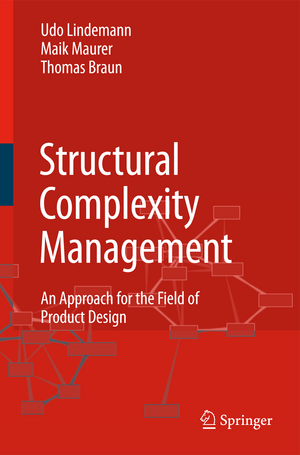
Structural Complexity Management
Autor Udo Lindemann, Maik Maurer, Thomas Braunen Limba Engleză Hardback – 15 oct 2008
The book presents a methodology that enables the analysis, control and optimization of complex structures, and the applicability of domain-spanning problems. The methodology allows significant improvements on handling system complexity by creating improved system understanding on the one hand and optimizing product design that is robust for system adaptations on the other hand. Developers can thereby enhance project coordination and improve communication between team members and as a result shorten development time. The practical application of the methodology is described by means of two detailed examples.
Preț: 667.01 lei
Preț vechi: 784.71 lei
-15%
Puncte Express: 1001
Carte tipărită la comandă
Livrare economică 28 noiembrie-12 decembrie
Livrare prin curier în România Termenul estimat este afișat lângă disponibilitate.
Transport gratuit pentru acest produs Plată online sau ramburs, în funcție de opțiunile comenzii.
Retur gratuit în 14 zile Comandă securizată și suport în română.
Specificații
ISBN-13: 9783540878889
ISBN-10: 3540878882
Pagini: 252
Ilustrații: X, 240 p. 127 illus., 85 illus. in color.
Dimensiuni: 160 x 241 x 20 mm
Greutate: 0.5 kg
Ediția:2009
Editura: Springer
Locul publicării:Berlin, Heidelberg, Germany
ISBN-10: 3540878882
Pagini: 252
Ilustrații: X, 240 p. 127 illus., 85 illus. in color.
Dimensiuni: 160 x 241 x 20 mm
Greutate: 0.5 kg
Ediția:2009
Editura: Springer
Locul publicării:Berlin, Heidelberg, Germany
V-ar putea interesa
-
 The Infinite AlphabetCésar A. HidalgoPreț: 191.23 lei
 -
 Design Structure Matrix Methods and ApplicationsSteven D. Eppinger-9%Preț: 403.65 lei442.20 lei
 -
 Computational Intelligence in Design and ManufacturingAndrew Kusiak-14%Preț: 930.45 lei1081.92 lei
 -
 Notes on the Synthesis of FormChristopher AlexanderPreț: 235.55 lei
 -
 Design-Tech: Building Science for ArchitectsJason Alread-8%Preț: 496.29 lei539.45 leiRecomandat
 -
 -14%Preț: 738.12 lei858.27 lei
 -
 Preț: 231.49 lei
 -
 Preț: 216.26 lei
 -
 Preț: 183.97 lei
 -
 -19%Preț: 526.02 lei649.41 lei
 -
 Modern Systems Analysis and Design, Global EditionJoseph Valacich-8%Preț: 606.91 lei659.70 lei
 -
 -18%Preț: 945.22 lei1152.70 lei
 -
 Project ManagementHarold R. Kerzner-23%Preț: 694.25 lei901.62 lei
 -
 Research Methods for Product DesignAlex Milton-31%Preț: 158.71 lei228.66 lei
 -
 Drawing for Product DesignersKevin Henry-30%Preț: 160.26 lei229.64 lei
 -
 Components Operationally: Reversibility and System EngineeringClaudio Antares Mezzina-20%Preț: 389.32 lei486.66 lei
 -
 Methodical Development of Modular Product FamiliesDieter Krause-15%Preț: 701.31 lei825.06 lei
 -
 Delft Design Guide (revised edition): Perspectives - Models - Approaches - MethodsAnnemiek van Boeijen-20%Preț: 208.96 lei260.00 lei
 -
 Design. Think. Make. Break. Repeat.: Revised editionMartin Tomitsch-22%Preț: 178.54 lei227.56 lei
Public țintă
Professional/practitionerCuprins
The challenge of complexity.- Complexity in the context of product design.- Methods for managing complex data in product design.- The procedure of structural complexity management.- Modeling the Multiple-Domain Matrix.- Information acquisition.- Deduction of indirect dependencies.- Structure analysis.- Product design application.- Use case: Automotive safety development.- Use case: Development of high pressure pumps.- Literature.
Notă biografică
Dr.-Ing. Helena Hashemi Farzaneh is a researcher at the Technical University of Munich. She studied mechanical engineering and received her PhD studying the collaboration between engineers and biologists. Her current research focuses on bio-inspired design and its integration into the innovation process.
Professor Dr.-Ing. Udo Lindemann is a professor emeritus of the Technical University of Munich. He was formerly head of the Institute of Product Development (1995-2016). Udo Lindemann is active on several advisory boards, the National Academy of Science and Engineering, and is part of the Bavarian Industry Association Future council. For his outstanding achievements, he received the honorary title of "TUM Emeritus of Excellence".
Textul de pe ultima copertă
Product design is characterized by a steady increase in complexity. The main focus of this book is a structural approach on complexity management. This means, system structures are considered in order to address the challenge of complexity in all aspects of product design. Structures arise from the complex dependencies of system elements. Thus, the identification of system structures provides access to the understanding of system behavior in practical applications.
The book presents a methodology that enables the analysis, control and optimization of complex structures, and the applicability of domain-spanning problems. The methodology allows significant improvements on handling system complexity by creating improved system understanding on the one hand and optimizing product design that is robust for system adaptations on the other hand. Developers can thereby enhance project coordination and improve communication between team members and as a result shorten development time. The practical application of the methodology is described by means of two detailed examples.
The book presents a methodology that enables the analysis, control and optimization of complex structures, and the applicability of domain-spanning problems. The methodology allows significant improvements on handling system complexity by creating improved system understanding on the one hand and optimizing product design that is robust for system adaptations on the other hand. Developers can thereby enhance project coordination and improve communication between team members and as a result shorten development time. The practical application of the methodology is described by means of two detailed examples.
Caracteristici
Major shortcomings of existing methods and the applicability of comprehensive and domain-spanning problems Network visualization in graphs and matrices in order to allow for better system understanding and user interaction Practical procedures for the analysis, control, and optimization of complex system structures have been generated Includes supplementary material: sn.pub/extras