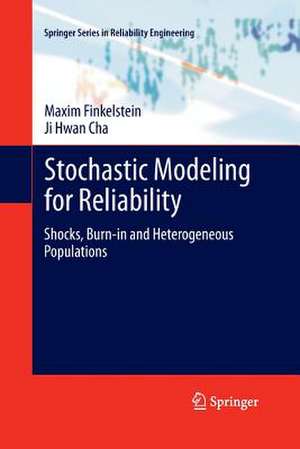
Stochastic Modeling for Reliability: Springer Series in Reliability Engineering
Autor Maxim Finkelstein, Ji Hwan Chaen Limba Engleză Paperback – 22 mai 2015
The populations of manufactured items in industry are usually heterogeneous. However, the conventional reliability analysis is performed under the implicit assumption of homogeneity, which can result in distortion of the corresponding reliability indices and various misconceptions. Stochastic Modeling for Reliability fills this gap and presents the basics and further developments of reliability theory for heterogeneous populations. Specifically, the authors consider burn-in as a method of elimination of ‘weak’ items from heterogeneous populations. The real life objects are operating in a changing environment. One of the ways to model an impact of this environment is via the external shocks occurring in accordance with some stochastic point processes. The basic theory for Poisson shock processes is developed and also shocks as a method of burn-in and of the environmental stress screening for manufactured items areconsidered.
Stochastic Modeling for Reliability introduces and explores the concept of burn-in in heterogeneous populations and its recent development, providing a sound reference for reliability engineers, applied mathematicians, product managers and manufacturers alike.
Din seria Springer Series in Reliability Engineering
- 18%
 Preț: 1128.08 lei
 - 18%
 Preț: 1123.42 lei
 - 18%
 Preț: 1351.86 lei
 - 18%
 Preț: 956.24 lei
 - 18%
 Preț: 1254.71 lei
 - 20%
 Preț: 1231.61 lei
 - 20%
 Preț: 1022.51 lei
 - 18%
 Preț: 987.39 lei
 - 18%
 Preț: 921.40 lei
 - 15%
 Preț: 676.83 lei
 - 15%
 Preț: 614.19 lei
 - 18%
 Preț: 1391.53 lei
 - 18%
 Preț: 1387.76 lei
 - 18%
 Preț: 987.18 lei
 - 18%
 Preț: 1274.05 lei
 - 18%
 Preț: 980.24 lei
 - 18%
 Preț: 1281.51 lei
 - 18%
 Preț: 1427.74 lei
 - 20%
 Preț: 1279.82 lei
 - 15%
 Preț: 667.47 lei
 - 18%
 Preț: 1151.90 lei
 - 15%
 Preț: 638.58 lei
 - 15%
 Preț: 674.81 lei
 - 18%
 Preț: 980.56 lei
 - 18%
 Preț: 983.19 lei
 - 18%
 Preț: 1178.86 lei
 - 18%
 Preț: 991.14 lei
 - 15%
 Preț: 669.59 lei
 - 18%
 Preț: 986.71 lei
 - 18%
 Preț: 1387.41 lei
 - 15%
 Preț: 663.95 lei
 - 18%
 Preț: 991.61 lei
 - 18%
 Preț: 922.81 lei
 - 18%
 Preț: 916.27 lei
 -
 Preț: 402.50 lei
 - 18%
 Preț: 922.55 lei
 - 18%
 Preț: 1261.20 lei
 - 18%
 Preț: 914.22 lei
 - 20%
 Preț: 1041.04 lei
 - 18%
 Preț: 917.15 lei
 - 18%
 Preț: 1224.24 lei
 - 18%
 Preț: 984.39 lei
 - 18%
 Preț: 983.14 lei
 - 18%
 Preț: 1900.16 lei
 - 15%
 Preț: 663.05 lei
Preț: 954.08 lei
Preț vechi: 1163.51 lei
-18%
Puncte Express: 1431
Carte tipărită la comandă
Livrare economică 25 noiembrie-09 decembrie
Livrare prin curier în România Termenul estimat este afișat lângă disponibilitate.
Transport gratuit pentru acest produs Plată online sau ramburs, în funcție de opțiunile comenzii.
Retur gratuit în 14 zile Comandă securizată și suport în română.
Specificații
ISBN-13: 9781447158554
ISBN-10: 1447158555
Pagini: 404
Ilustrații: XIV, 388 p.
Dimensiuni: 155 x 235 x 22 mm
Greutate: 0.61 kg
Ediția:2013
Editura: Springer
Colecția Springer Series in Reliability Engineering
Seria Springer Series in Reliability Engineering
Locul publicării:London, United Kingdom
ISBN-10: 1447158555
Pagini: 404
Ilustrații: XIV, 388 p.
Dimensiuni: 155 x 235 x 22 mm
Greutate: 0.61 kg
Ediția:2013
Editura: Springer
Colecția Springer Series in Reliability Engineering
Seria Springer Series in Reliability Engineering
Locul publicării:London, United Kingdom
V-ar putea interesa
-
 -30%Preț: 513.43 lei733.18 lei
 -
 Preț: 472.19 lei
 -
 -15%Preț: 479.52 lei564.15 lei
 -
 RCM--Gateway to World Class MaintenanceAnthony M. Smith-25%Preț: 431.78 lei574.51 lei
 -
 -18%Preț: 1121.20 lei1367.32 lei
 -
 Reliability of Software Intensive SystemsMichael A. Friedman-20%Preț: 298.22 lei372.78 lei
 -
 -34%Preț: 788.70 lei1191.81 lei
 -
 Fuzzy Hierarchical Model for Risk AssessmentHing Kai Chan-15%Preț: 663.25 lei780.30 lei
 -
 Simulator-based Human Factors Studies Across 25 YearsAnn Britt Skjerve-18%Preț: 1186.97 lei1447.52 lei
 -
 Real-time Systems' Quality of ServiceRoman Gumzej-28%Preț: 556.39 lei776.78 lei
 -
 Quality Management in Reverse LogisticsYiannis Nikolaidis-15%Preț: 612.98 lei721.14 lei
 -
 E-maintenanceKenneth Holmberg-18%Preț: 961.80 lei1172.94 lei
 -
 -18%Preț: 910.11 lei1109.89 lei
 -
 Risk Analysis in Engineering: Techniques, Tools, and TrendsMohammad Modarres-18%Preț: 1301.40 lei1587.07 lei
 -
 Failure Rate Modelling for Reliability and RiskMaxim Finkelstein-18%Preț: 980.24 lei1195.41 lei
 -
 Failure Rate Modelling for Reliability and RiskMaxim Finkelstein-18%Preț: 918.74 lei1120.41 lei
 -
 Machinery Failure Analysis Handbook: Sustain Your Operations and Maximize UptimeLuiz Octavio Amaral Affonso-22%Preț: 758.14 lei973.69 lei
 -
 Preț: 166.66 lei
 -
 Point Processes for Reliability AnalysisJi Hwan Cha-18%Preț: 1123.39 lei1369.98 lei
 -
 Advances in Safety Management and Human FactorsPedro Miguel Ferreira Martins Arezes-18%Preț: 1212.34 lei1478.46 lei
 -
 Reflexionsverhalten von FahrbahnbelägenWerner LeinsPreț: 421.30 lei
 -
 Fringe 2013Wolfgang Osten-18%Preț: 1925.98 lei2348.76 lei
 -
 FORMS/FORMAT 2010Eckehard Schnieder-18%Preț: 1182.86 lei1442.51 lei
 -
 Fringe 2009Wolfgang Osten-18%Preț: 1799.47 lei2194.47 lei
 -
 Reliability EngineeringStefan Bracke-15%Preț: 684.27 lei805.03 lei
Public țintă
ResearchCuprins
1.Introduction.- 2.Basic Stochastics for Reliability Analysis.- 3.Shocks and Degradation.- 4.Advanced Theory for Poisson Shock Models.- 5.Heterogeneous Populations.- 6.The basics of Burn-in.- 7.Burn-in for Repairable Systems.- 8.Burn-in for Heterogeneous Populations.- 9.Shocks as Burn-in.- 10.Stochastic Models for Environmental Stress Screening.
Recenzii
From the reviews:
“This book is a major work for studying and learning reliability theory. … The book is aimed at graduate students or researchers in reliability or applied probability, engineering, mathematics, and statistics. … this book is an extremely valuable contribution to the literature on reliability. It is very well written, and will have a major impact on future research in reliability. It is up-to-date and gives the reader excellent insight into important areas.” (Myron Hlynka, Mathematical Reviews, January, 2014)
“In the framework of stochastic modeling for reliability a combination of the three areas shock models, burn-in and stochastic modeling in heterogeneous populations is presented. … The book can be recommended for reliability engineers, statisticians working in reliability engineering, as well as for courses in advanced methods for reliability models and methods.” (Kurt Marti, zbMATH, Vol. 1271, 2013)
“This book is a major work for studying and learning reliability theory. … The book is aimed at graduate students or researchers in reliability or applied probability, engineering, mathematics, and statistics. … this book is an extremely valuable contribution to the literature on reliability. It is very well written, and will have a major impact on future research in reliability. It is up-to-date and gives the reader excellent insight into important areas.” (Myron Hlynka, Mathematical Reviews, January, 2014)
“In the framework of stochastic modeling for reliability a combination of the three areas shock models, burn-in and stochastic modeling in heterogeneous populations is presented. … The book can be recommended for reliability engineers, statisticians working in reliability engineering, as well as for courses in advanced methods for reliability models and methods.” (Kurt Marti, zbMATH, Vol. 1271, 2013)
Notă biografică
Dr. Ji Hwan Cha received his B.S. degree in Computer Science and Statistics from Seoul National University, Korea, in 1993 and his M.S. and Ph.D. degrees in Statistics from Seoul National University in 1995 and 1999, respectively.
He is a Professor at the Department of Statistics and Ewha Fellow (similar to "Distinguished Professor"), Ewha Womans University, Seoul, Korea. He is an Associate Editor of Journal of the Korean Statistical Society. He has published more than 70 papers in various international journals and two books on Introductory Statistics and Reliability Theory, respectively (in Korean). His research interests include applied probability, reliability theory, stochastic processes, survival analysis, multivariate distribution theory, life insurance, demography, operations research, management science. His book "Stochastic modelling for reliability: Shocks, burn-in and heterogeneous populations" (co-authored with Dr. Finkelstein) was published by Springer in 2013.
Dr. Maxim Finkelstein received his M.Sc in Mathematical Physics from Leningrad State University (1971), Ph.D in OR from Leningrad Elektropribor Institute, 1979 and Doctor of Science (habilitation) in OR from St.-Petersburg Elektropribor Institute (1993). From 1971 till 1998 he was with the Saint Petersburg Elektropribor Institute (the leading Russian company in the field of navigation and control systems).
Currently he is a Distinguished Professor at the Department of Mathematical Statistics, University of the Free State, Republic of South Africa and a visiting professor at the Max Planck Institute for Demographic Research, Rostock, Germany and at the ITMO University, St. Petersburg, Russia.
His more than 40 years of professional experience combines academic skills and expertise with those of a researcher in industry. This combination is very helpful for this book.
His main research interests are: reliabilitytheory and applications, survival analysis, risk and safety modelling, applied stochastic processes.
He has published more than 180 papers and 5 books on different aspects of reliability and stochastics. His last two books "Failure rate modelling for reliability and risk" and "Stochastic modelling for reliability: Shocks, burn-in and heterogeneous populations" (co-authored with Dr. Cha) were published by Springer in 2008 and 2013, respectively.
Textul de pe ultima copertă
Focusing on shocks modeling, burn-in and heterogeneous populations, Stochastic Modeling for Reliability naturally combines these three topics in the unified stochastic framework and presents numerous practical examples that illustrate recent theoretical findings of the authors.
The populations of manufactured items in industry are usually heterogeneous. However, the conventional reliability analysis is performed under the implicit assumption of homogeneity, which can result in distortion of the corresponding reliability indices and various misconceptions. Stochastic Modeling for Reliability fills this gap and presents the basics and further developments of reliability theory for heterogeneous populations. Specifically, the authors consider burn-in as a method of elimination of ‘weak’ items from heterogeneous populations. The real life objects are operating in a changing environment. One of the ways to model an impact of this environment is via the external shocks occurring in accordance with some stochastic point processes. The basic theory for Poisson shock processes is developed and also shocks as a method of burn-in and of the environmental stress screening for manufactured items areconsidered.
Stochastic Modeling for Reliability introduces and explores the concept of burn-in in heterogeneous populations and its recent development, providing a sound reference for reliability engineers, applied mathematicians, product managers and manufacturers alike.
The populations of manufactured items in industry are usually heterogeneous. However, the conventional reliability analysis is performed under the implicit assumption of homogeneity, which can result in distortion of the corresponding reliability indices and various misconceptions. Stochastic Modeling for Reliability fills this gap and presents the basics and further developments of reliability theory for heterogeneous populations. Specifically, the authors consider burn-in as a method of elimination of ‘weak’ items from heterogeneous populations. The real life objects are operating in a changing environment. One of the ways to model an impact of this environment is via the external shocks occurring in accordance with some stochastic point processes. The basic theory for Poisson shock processes is developed and also shocks as a method of burn-in and of the environmental stress screening for manufactured items areconsidered.
Stochastic Modeling for Reliability introduces and explores the concept of burn-in in heterogeneous populations and its recent development, providing a sound reference for reliability engineers, applied mathematicians, product managers and manufacturers alike.
Caracteristici
Provides methods for decreasing the cost of burn-in Can be used as a basis for a postgraduate course on reliability engineering Describes new settings and approaches that can be useful to researchers