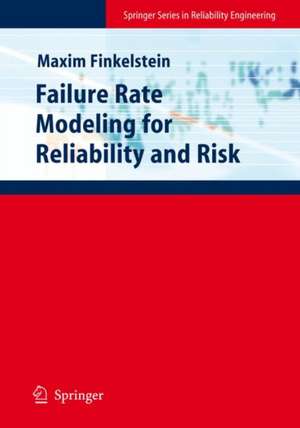
Failure Rate Modelling for Reliability and Risk: Springer Series in Reliability Engineering
Autor Maxim Finkelsteinen Limba Engleză Hardback – dec 2008
Din seria Springer Series in Reliability Engineering
- 18%
 Preț: 1128.08 lei
 - 18%
 Preț: 1123.42 lei
 - 18%
 Preț: 1351.86 lei
 - 18%
 Preț: 987.03 lei
 - 18%
 Preț: 1254.71 lei
 - 20%
 Preț: 1231.61 lei
 - 20%
 Preț: 1022.51 lei
 - 18%
 Preț: 987.39 lei
 - 18%
 Preț: 921.40 lei
 - 15%
 Preț: 676.83 lei
 - 15%
 Preț: 614.19 lei
 - 18%
 Preț: 1391.53 lei
 - 18%
 Preț: 1387.76 lei
 - 18%
 Preț: 987.18 lei
 - 18%
 Preț: 1274.05 lei
 - 18%
 Preț: 1281.51 lei
 - 18%
 Preț: 1427.74 lei
 - 20%
 Preț: 1279.82 lei
 - 15%
 Preț: 667.47 lei
 - 18%
 Preț: 1151.90 lei
 - 15%
 Preț: 638.58 lei
 - 15%
 Preț: 674.81 lei
 - 18%
 Preț: 980.56 lei
 - 18%
 Preț: 983.19 lei
 - 18%
 Preț: 1178.86 lei
 - 18%
 Preț: 991.14 lei
 - 15%
 Preț: 669.59 lei
 - 18%
 Preț: 986.71 lei
 - 18%
 Preț: 1387.41 lei
 - 15%
 Preț: 663.95 lei
 - 18%
 Preț: 991.61 lei
 - 18%
 Preț: 922.81 lei
 - 18%
 Preț: 916.27 lei
 -
 Preț: 402.50 lei
 - 18%
 Preț: 922.55 lei
 - 18%
 Preț: 1261.20 lei
 - 18%
 Preț: 914.22 lei
 - 20%
 Preț: 1041.04 lei
 - 18%
 Preț: 917.15 lei
 - 18%
 Preț: 1224.24 lei
 - 18%
 Preț: 984.39 lei
 - 18%
 Preț: 983.14 lei
 - 18%
 Preț: 1900.16 lei
 - 15%
 Preț: 663.05 lei
Preț: 980.24 lei
Preț vechi: 1195.41 lei
-18%
Puncte Express: 1470
Carte tipărită la comandă
Livrare economică 26 noiembrie-10 decembrie
Livrare prin curier în România Termenul estimat este afișat lângă disponibilitate.
Transport gratuit pentru acest produs Plată online sau ramburs, în funcție de opțiunile comenzii.
Retur gratuit în 14 zile Comandă securizată și suport în română.
Specificații
ISBN-13: 9781848009851
ISBN-10: 1848009852
Pagini: 304
Ilustrații: XII, 290 p.
Dimensiuni: 160 x 241 x 22 mm
Greutate: 0.57 kg
Ediția:2008
Editura: Springer
Colecția Springer Series in Reliability Engineering
Seria Springer Series in Reliability Engineering
Locul publicării:London, United Kingdom
ISBN-10: 1848009852
Pagini: 304
Ilustrații: XII, 290 p.
Dimensiuni: 160 x 241 x 22 mm
Greutate: 0.57 kg
Ediția:2008
Editura: Springer
Colecția Springer Series in Reliability Engineering
Seria Springer Series in Reliability Engineering
Locul publicării:London, United Kingdom
V-ar putea interesa
-
 System Signatures and their Applications in Engineering ReliabilityFrancisco J. Samaniego-18%Preț: 832.84 lei1015.66 lei
 -
 Game Theoretic Risk Analysis of Security ThreatsVicki M. Bier-15%Preț: 670.17 lei788.44 lei
 -
 Stochastic Modeling for ReliabilityMaxim Finkelstein-18%Preț: 990.58 lei1208.01 lei
 -
 Stochastic Modeling for ReliabilityMaxim Finkelstein-18%Preț: 954.08 lei1163.51 lei
 -
 Handbook of Reliability, Availability, Maintainability and Safety in Engineering DesignRudolph Frederick Stapelberg-18%Preț: 2693.51 lei3284.78 lei
 -
 Occupational Injuries from Electrical Shock and ARC Flash EventsRichard B CampbellPreț: 392.24 lei
 -
 Recent Advances in Maintenance and Infrastructure ManagementRoberto Davide Cigolini-18%Preț: 1222.23 lei1490.53 lei
 -
 Springer Handbook of Engineering StatisticsHoang Pham-18%Preț: 2171.80 lei2648.54 lei
 -
 Preț: 166.66 lei
 -
 -15%Preț: 638.04 lei750.64 lei
 -
 Beyond Safety TrainingCorinne BiederPreț: 171.03 lei
 -
 Fusion Methodologies in Crisis ManagementGalina Rogova-24%Preț: 913.03 lei1201.35 lei
 -
 -15%Preț: 613.00 lei721.18 lei
 -
 Point Processes for Reliability AnalysisJi Hwan Cha-18%Preț: 1123.39 lei1369.98 lei
 -
 Catalogue of RisksDirk Proske-18%Preț: 976.44 lei1190.79 lei
 -
 -11%Preț: 472.87 lei531.31 lei
 -
 Statistische VersuchsplanungKarl Siebertz-13%Preț: 929.70 lei1068.62 lei
 -
 -15%Preț: 641.11 lei754.26 lei
 -
 Handbuch QualitätWalter Geiger-18%Preț: 1064.12 lei1297.71 lei
 -
 FMEA - Einführung und ModerationMartin Werdich-11%Preț: 530.90 lei596.53 lei
 -
 Practical Acoustic Emission TestingThe Japanese Society for Non-Destructive-19%Preț: 608.44 lei751.16 lei
 -
 Paradigms of Knowledge Management: With Systems Modelling Case StudiesKrishna Nath Pandey-24%Preț: 653.17 lei859.43 lei
 -
 Supplier SelectionKrishnendu Mukherjee-15%Preț: 635.19 lei747.27 lei
 -
 Quantitative Risk Assessment of Hazardous Materials Transport SystemsM. Nicolet-Monnier-18%Preț: 1498.07 lei1826.90 lei
 -
 Scientific Uncertainty and Its Influence on the Public Communication ProcessVirginia H. Sublet-15%Preț: 613.49 lei721.74 lei
 -
 Perspectives on Uncertainty and Risk: The PRIMA Approach to Decision SupportMarjolein B.A. van Asselt-18%Preț: 914.83 lei1115.64 lei
 -
 -15%Preț: 620.86 lei730.42 lei
 -
 Fire Science and Technology 2015Kazunori Harada-24%Preț: 1862.07 lei2450.09 lei
 -
 FMEA Using Uncertainty Theories and MCDM MethodsHu-Chen Liu-18%Preț: 915.48 lei1116.44 lei
 -
 -18%Preț: 1086.53 lei1325.04 lei
Public țintă
ResearchCuprins
Failure Rate and Mean Remaining Lifetime.- More on Exponential Representation.- Point Processes and Minimal Repair.- Virtual Age and Imperfect Repair.- Mixture Failure Rate Modelling.- Limiting Behaviour of Mixture Failure Rates.- ‘Constructing’ the Failure Rate.- Failure Rate of Software.- Demographic and Biological Applications.
Notă biografică
Dr. Ji Hwan Cha received his B.S. degree in Computer Science and Statistics from Seoul National University, Korea, in 1993 and his M.S. and Ph.D. degrees in Statistics from Seoul National University in 1995 and 1999, respectively.
He is a Professor at the Department of Statistics and Ewha Fellow (similar to "Distinguished Professor"), Ewha Womans University, Seoul, Korea. He is an Associate Editor of Journal of the Korean Statistical Society. He has published more than 70 papers in various international journals and two books on Introductory Statistics and Reliability Theory, respectively (in Korean). His research interests include applied probability, reliability theory, stochastic processes, survival analysis, multivariate distribution theory, life insurance, demography, operations research, management science. His book "Stochastic modelling for reliability: Shocks, burn-in and heterogeneous populations" (co-authored with Dr. Finkelstein) was published by Springer in 2013.
Dr. Maxim Finkelstein received his M.Sc in Mathematical Physics from Leningrad State University (1971), Ph.D in OR from Leningrad Elektropribor Institute, 1979 and Doctor of Science (habilitation) in OR from St.-Petersburg Elektropribor Institute (1993). From 1971 till 1998 he was with the Saint Petersburg Elektropribor Institute (the leading Russian company in the field of navigation and control systems).
Currently he is a Distinguished Professor at the Department of Mathematical Statistics, University of the Free State, Republic of South Africa and a visiting professor at the Max Planck Institute for Demographic Research, Rostock, Germany and at the ITMO University, St. Petersburg, Russia.
His more than 40 years of professional experience combines academic skills and expertise with those of a researcher in industry. This combination is very helpful for this book.
His main research interests are: reliabilitytheory and applications, survival analysis, risk and safety modelling, applied stochastic processes.
He has published more than 180 papers and 5 books on different aspects of reliability and stochastics. His last two books "Failure rate modelling for reliability and risk" and "Stochastic modelling for reliability: Shocks, burn-in and heterogeneous populations" (co-authored with Dr. Cha) were published by Springer in 2008 and 2013, respectively.
Textul de pe ultima copertă
Failure Rate Modelling for Reliability and Risk focuses on reliability theory and, specifically, on the failure rate (the hazard rate, the force of mortality) modelling and its generalizations, on systems operating in a random environment and on repairable systems. The failure rate is one of the crucial probabilistic characteristics for a number of disciplines; including reliability, survival analysis, risk analysis and demography.
Failure Rate Modelling for Reliability and Risk presents a systematic study of the failure rate and related indices, and covers a number of important applications where the failure rate plays the major role. Applications in engineering systems are studied, together with some actuarial, biological and demographic examples.
Covering material previously available only in the journal literature, Failure Rate Modelling for Reliability and Risk provides a survey of this broad and interdisciplinary subject which will be invaluable to researchers and advanced students in reliability engineering and applied statistics, as well as to demographers, econometricians, actuaries and many other mathematically oriented researchers.
Failure Rate Modelling for Reliability and Risk presents a systematic study of the failure rate and related indices, and covers a number of important applications where the failure rate plays the major role. Applications in engineering systems are studied, together with some actuarial, biological and demographic examples.
Covering material previously available only in the journal literature, Failure Rate Modelling for Reliability and Risk provides a survey of this broad and interdisciplinary subject which will be invaluable to researchers and advanced students in reliability engineering and applied statistics, as well as to demographers, econometricians, actuaries and many other mathematically oriented researchers.
Caracteristici
Provides a systematic study of the failure rate and related indices Includes supplementary material: sn.pub/extras