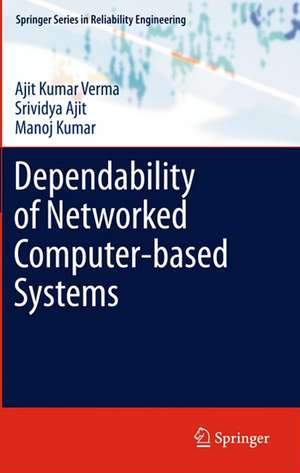
Dependability of Networked Computer-based Systems: Springer Series in Reliability Engineering
Autor Ajit Kumar Verma, Srividya Ajit, Manoj Kumaren Limba Engleză Hardback – 21 iul 2011
Dependability of Networked Computer-based Systems gives an overview of basic dependability modeling concepts and addresses new challenges in dependability modeling of networked computer-based systems, as well as new trends, their capabilities and limitations. It covers a variety of dependability modeling methods:
- stochastic processes,
- Markov and semi-Markov models,
- response-time distribution,
- stochastic Petri-net-based modeling formalisms, and
- Monte Carlo simulation models.
Din seria Springer Series in Reliability Engineering
- 18%
 Preț: 1128.08 lei
 - 18%
 Preț: 1123.42 lei
 - 18%
 Preț: 1351.86 lei
 - 18%
 Preț: 987.03 lei
 - 18%
 Preț: 1254.71 lei
 - 20%
 Preț: 1231.61 lei
 - 20%
 Preț: 1022.51 lei
 - 18%
 Preț: 987.39 lei
 - 18%
 Preț: 921.40 lei
 - 15%
 Preț: 676.83 lei
 - 15%
 Preț: 614.19 lei
 - 18%
 Preț: 1391.53 lei
 - 18%
 Preț: 1387.76 lei
 - 18%
 Preț: 987.18 lei
 - 18%
 Preț: 1274.05 lei
 - 18%
 Preț: 980.24 lei
 - 18%
 Preț: 1281.51 lei
 - 18%
 Preț: 1427.74 lei
 - 20%
 Preț: 1279.82 lei
 - 15%
 Preț: 667.47 lei
 - 18%
 Preț: 1151.90 lei
 - 15%
 Preț: 638.58 lei
 - 15%
 Preț: 674.81 lei
 - 18%
 Preț: 983.19 lei
 - 18%
 Preț: 1178.86 lei
 - 18%
 Preț: 991.14 lei
 - 15%
 Preț: 669.59 lei
 - 18%
 Preț: 986.71 lei
 - 18%
 Preț: 1387.41 lei
 - 15%
 Preț: 663.95 lei
 - 18%
 Preț: 991.61 lei
 - 18%
 Preț: 922.81 lei
 - 18%
 Preț: 916.27 lei
 -
 Preț: 402.50 lei
 - 18%
 Preț: 922.55 lei
 - 18%
 Preț: 1261.20 lei
 - 18%
 Preț: 914.22 lei
 - 20%
 Preț: 1041.04 lei
 - 18%
 Preț: 917.15 lei
 - 18%
 Preț: 1224.24 lei
 - 18%
 Preț: 984.39 lei
 - 18%
 Preț: 983.14 lei
 - 18%
 Preț: 1900.16 lei
 - 15%
 Preț: 663.05 lei
Preț: 980.56 lei
Preț vechi: 1195.81 lei
-18%
Puncte Express: 1471
Carte tipărită la comandă
Livrare economică 26 noiembrie-10 decembrie
Livrare prin curier în România Termenul estimat este afișat lângă disponibilitate.
Transport gratuit pentru acest produs Plată online sau ramburs, în funcție de opțiunile comenzii.
Retur gratuit în 14 zile Comandă securizată și suport în română.
Specificații
ISBN-13: 9780857293176
ISBN-10: 0857293176
Pagini: 220
Ilustrații: XVIII, 202 p.
Dimensiuni: 160 x 241 x 16 mm
Greutate: 0.45 kg
Ediția:2011
Editura: Springer
Colecția Springer Series in Reliability Engineering
Seria Springer Series in Reliability Engineering
Locul publicării:London, United Kingdom
ISBN-10: 0857293176
Pagini: 220
Ilustrații: XVIII, 202 p.
Dimensiuni: 160 x 241 x 16 mm
Greutate: 0.45 kg
Ediția:2011
Editura: Springer
Colecția Springer Series in Reliability Engineering
Seria Springer Series in Reliability Engineering
Locul publicării:London, United Kingdom
V-ar putea interesa
-
 -15%Preț: 413.93 lei486.98 lei
 -
 Your Best BodyManoj KumarPreț: 157.55 lei
 -
 -18%Preț: 1343.87 lei1638.86 lei
 -
 Quality Management in Reverse LogisticsYiannis Nikolaidis-15%Preț: 612.98 lei721.14 lei
 -
 E-maintenanceKenneth Holmberg-18%Preț: 961.80 lei1172.94 lei
 -
 -18%Preț: 910.11 lei1109.89 lei
 -
 -20%Preț: 612.81 lei766.01 lei
 -
 -15%Preț: 608.90 lei716.36 lei
 -
 Sensory Evaluation in Quality ControlAlejandra M. Munoz-18%Preț: 696.90 lei849.88 lei
 -
 Statistical Quality Control for the Food IndustryMerton Hubbard-15%Preț: 618.03 lei727.08 lei
 -
 -18%Preț: 917.09 lei1118.40 lei
 -
 Fringe 2009Wolfgang Osten-18%Preț: 1799.47 lei2194.47 lei
 -
 Chemische Betriebskontrolle in der FettindustrieHugo DubovitzPreț: 395.89 lei
 -
 Preț: 392.17 lei
 -
 Zerstörungsfreie Werkstoffprüfung - MagnetpulverprüfungKarlheinz Schiebold-15%Preț: 553.05 lei650.65 lei
 -
 Zerstörungsfreie Werkstoffprüfung - SichtprüfungKarlheinz Schiebold-11%Preț: 503.84 lei566.11 lei
 -
 Zerstörungsfreie Werkstoffprüfung - DurchstrahlungsprüfungKarlheinz Schiebold-15%Preț: 478.80 lei563.29 lei
 -
 -15%Preț: 611.54 lei719.47 lei
 -
 Reliability Theory and Its Application in Structural and Soil MechanicsP. Thoft-Christensen-18%Preț: 1761.61 lei2148.31 lei
 -
 Heavy Gas and Risk Assessment - IIS. HartwigPreț: 422.87 lei
 -
 Contingency Table Analysis for Road Safety StudiesG. A. FleischerPreț: 374.88 lei
 -
 Reliability EngineeringK.K. Aggarwal-18%Preț: 912.69 lei1113.03 lei
 -
 -15%Preț: 501.85 lei590.42 lei
 -
 Sustainable Power SystemsNava Raj Karki-18%Preț: 752.75 lei917.98 lei
 -
 Textbook of Seismic DesignG. R. Reddy-23%Preț: 956.76 lei1242.56 lei
 -
 -20%Preț: 1134.21 lei1417.76 lei
 -
 Air Pollution and Greenhouse GasesZhongchao Tan-15%Preț: 739.99 lei870.58 lei
Public țintă
ResearchCuprins
1. Introduction.- 2. Probability Theory.- 3. Stochastic Processes and Models.- 4. Dependability Models of Computer-based Systems.- 5 Network Technologies for Real-time systems.- 6. Response-time Models and Timeliness Hazard Rate.- 7. Dependability of Networked Computer-based Systems.
Notă biografică
Dr Sachin Kumar is Assistant Professor of Computer Science at Cluster Innovation Centre (CIC), University of Delhi (UoD), Delhi, India. He is also an executive officer of the University of Delhi Foundation, an endowment fund section 8, not-for-profit company of UoD. He has been awarded a PhD degree from the Department of Computer Science, University of Delhi(UoD) on a thesis titled "Modeling and Prediction of Building Energy Performance Using Machine Learning Approaches". His research work has been published in the domain of intelligent information systems, urban computing and smart systems reputed international high-impact factor SCI/SCIE/Scopus journals and conferences such as Energy and Buildings (Elsevier, IF=7.6), Sustainable Cities and Societies (Elsevier, IF=10.5), Sustainable Energy, Grids and Networks (Elsevier, IF=5.6). His thesis primarily focuses on developing models for energy performance optimization through modelling and prediction of energy usage toimprove energy conservation in residential and commercial buildings in order to achieve the goal of sustainable cities and societies to contribute to Sustainable Development Goals (SDGs). He secured several placement offers during MCA and after completion served as a software development engineer(SDE) with IHS Markit Information Mosaic, United Kingdom(UK). He is offering courses and supervising research and development in the area of Artificial Intelligence/Machine Learning/Deep Learning, Industry 4.0, Digital Transformation and Governance, Smart Cities, Urban Computing, Information Systems and Computational Social Systems. He has published more than 25 peer review research publications in high-impact factor SCI/SCIE/Scopus-indexed journals and conferences. He has also written a book on operating systems titled "Operating Systems: Concept Building and Problem Solving Approach'' published by Cengage Publication, USA. He has participated in and demonstrated his research works at domain-specific several highly reputed international conferences such as IEEE-ELM, ISTA, ISDA, IEEE-WCCI, IEEE-IJCNN, ACM-ICEGOV, etc. He has been invited as a resource person to many conferences, faculty development programs (FDPs), refresher courses, and workshops to share his knowledge and expertise. His main thrust is to develop technological artefacts to solve societal problems with the application of technology and specifically Artificial Intelligence/Machine Learning, Big data analytics and their deployment in a real-world environment. He also writes on technology and social issues in national newspapers and news web portals and creates digital content for creating awareness about technology and social issues on the youtube channel "Professor and Mentor". He has been continuously providing his consultations to corporations and startups. He is also promoting interdisciplinary research, innovation, and entrepreneurship, through project-driven pedagogy, research publication outputs, and startup promotion.
Prof. Ajit Kumar Verma is a Professor in the Faculty of Technology, Environmental and Social Sciences, Western Norway University of Applied Sciences, Haugesund, Norway (since 2012) and was a Professor/ Senior( HAG) scale Professor for around 15 years with the Reliability Engg/Department of Electrical Engineering at IIT Bombay with a research focus in RAMS, Risk & Safety Engineering, Computational Intelligence applications in various domains. He was awarded (2017) 'Honorary Professor' at Amity University, India and also a Life Time Achievement award at IIT Madras by SRESA. He has supervised/co-supervised 39 PhDs and over 100 Masters theses( IITB; HVL,Norway; Univ.of Gåvle,Sweden; LJM Univ,UK; WMG, Warwick Univ, UK) in the area of Electronic Systems Reliability, Software Reliability, Reliable Computing, Power Systems Reliability, Reliability Centred Maintenance , Soft Computing in RAMS for Complex Engineering Systems and Probabilistic Safety/Risk Assessment in power plant
Textul de pe ultima copertă
The measurement of dependability attributes on real systems is a very time-consuming and costly affair, making analytical or simulation modeling the only viable solutions. Dependability of Networked Computer-based Systems explores reliability, availability and safety modeling of networked computer-based systems used in life-critical applications such as avionics, nuclear power plants, automobiles and chemical process industries.
Dependability of Networked Computer-based Systems gives an overview of basic dependability modeling concepts and addresses new challenges in dependability modeling of networked computer-based systems, as well as new trends, their capabilities and limitations. It covers a variety of dependability modeling methods:
Dependability of Networked Computer-based Systems gives an overview of basic dependability modeling concepts and addresses new challenges in dependability modeling of networked computer-based systems, as well as new trends, their capabilities and limitations. It covers a variety of dependability modeling methods:
- stochastic processes,
- Markov and semi-Markov models,
- response-time distribution,
- stochastic Petri-net-based modeling formalisms, and
- Monte Carlo simulation models.