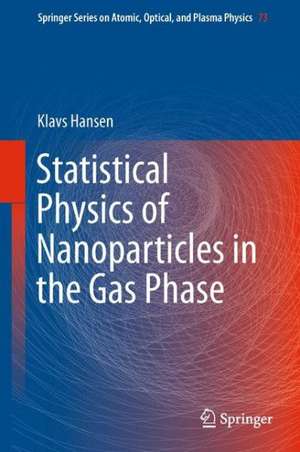
Statistical Physics of Nanoparticles in the Gas Phase
Autor Klavs Hansenen Limba Engleză Hardback – 27 noi 2012
This book has the twofold aim to present coherently the relevant results coming from the recent scientific literature and to guide the readers through the process of deriving results, enabling them to explore the limits of the mathematical approximations and test the power of the method. The book is focused on the fundamental properties of nanosystems in the gas phase. For this reason there is a strong emphasis on microcanonical physics. Each chapter is enriched with exercises and 3 Appendices provide additional useful materials.
| Toate formatele și edițiile | Preț | Express |
|---|---|---|
| Paperback (2) | 676.35 lei 6-8 săpt. | |
| Springer International Publishing – 30 ian 2019 | 676.35 lei 6-8 săpt. | |
| SPRINGER NETHERLANDS – 13 dec 2014 | 739.75 lei 38-45 zile | |
| Hardback (3) | 622.42 lei 6-8 săpt. | |
| Springer – 27 noi 2012 | 622.42 lei 6-8 săpt. | |
| Springer International Publishing – 6 sep 2018 | 919.85 lei 6-8 săpt. | |
| Springer – 6 aug 2025 | 1166.13 lei 38-45 zile |
Preț: 622.42 lei
Preț vechi: 732.26 lei
-15% Nou
Puncte Express: 934
Preț estimativ în valută:
110.12€ • 128.49$ • 96.28£
110.12€ • 128.49$ • 96.28£
Carte tipărită la comandă
Livrare economică 16-30 ianuarie 26
Preluare comenzi: 021 569.72.76
Specificații
ISBN-13: 9789400758384
ISBN-10: 9400758383
Pagini: 296
Ilustrații: XII, 284 p.
Dimensiuni: 160 x 241 x 21 mm
Greutate: 0.61 kg
Ediția:2013
Editura: Springer
Locul publicării:Dordrecht, Netherlands
ISBN-10: 9400758383
Pagini: 296
Ilustrații: XII, 284 p.
Dimensiuni: 160 x 241 x 21 mm
Greutate: 0.61 kg
Ediția:2013
Editura: Springer
Locul publicării:Dordrecht, Netherlands
V-ar putea interesa
-
 Dreams Of A Final TheorySteven WeinbergPreț: 108.28 lei
 -
 The Essential Einstein: His Greatest WorksAlbert Einstein-20%Preț: 82.30 lei103.14 lei
 -
 Elementary Atomic StructureG. K. Woodgate-24%Preț: 372.70 lei491.80 lei
 -
 Molecular BeamsNorman Ramsey-27%Preț: 517.69 lei706.64 lei
 -
 -5%Preț: 366.77 lei384.55 lei
 -
 -18%Preț: 433.44 lei526.20 lei
 -
 -31%Preț: 467.33 lei674.67 lei
 -
 Preț: 372.65 lei
 -
 Introduction to High Energy PhysicsDonald H. Perkins-8%Preț: 547.88 lei595.53 lei
 -
 Preț: 258.51 lei
 -
 -15%Preț: 649.93 lei764.62 lei
 -
 Electron-Atom Scattering: An IntroductionMaurizio Dapor-26%Preț: 869.75 lei1171.31 lei
 -
 Introducing Particle Physics: A Graphic GuideTom WhyntiePreț: 60.82 lei
 -
 Quantum PhysicsAlistair I M RaePreț: 75.88 lei
 -
 Preț: 135.48 lei
Public țintă
GraduateCuprins
The relation between classical and quantum statistics.- Microcanonical temperature.- Thermal properties of vibrations.- Rate constants for emission of atoms, electrons and photons.- The evaporative ensemble.- Abundance distributions; large scale features.- Molecular dynamics and Monte Carlo simulations.- Thermal excitation of valence electrons.- He droplets.
Notă biografică
Klavs Hansen is Associate professor, Atomic, Molecular & Optical Physics at the University of Gothenburg. He has held various positions in the USA, Denmark, Germany, Finland and Japan. His expertise is in statistical and quantum processes in free clusters and large molecules, studied through multiphoton ionization and fragmentation experiments.
Textul de pe ultima copertă
Thermal processes are ubiquitous and an understanding of thermal phenomena is essential for a complete description of the physics of nanoparticles, both for the purpose of modeling the dynamics of the particles and for the correct interpretation of experimental data.
This book has the twofold aim to present coherently the relevant results coming from the recent scientific literature and to guide the readers through the process of deriving results, enabling them to explore the limits of the mathematical approximations and test the power of the method. The book is focused on the fundamental properties of nanosystems in the gas phase. For this reason there is a strong emphasis on microcanonical physics. Each chapter is enriched with exercises and 3 Appendices provide additional useful materials.
This book has the twofold aim to present coherently the relevant results coming from the recent scientific literature and to guide the readers through the process of deriving results, enabling them to explore the limits of the mathematical approximations and test the power of the method. The book is focused on the fundamental properties of nanosystems in the gas phase. For this reason there is a strong emphasis on microcanonical physics. Each chapter is enriched with exercises and 3 Appendices provide additional useful materials.
Caracteristici
Focused on the fundamental properties of nanosystems in the gas phase Contains some necessary basic notions of statistical physics Includes fundamental results, applications and illustrative examples Detailed derivations of results illustrate the applicability and limitations of approximations and demonstrate the power of the methods Enriched with 74 exercises Includes supplementary material: sn.pub/extras
Descriere
Descriere de la o altă ediție sau format:
Each chapter contains exercises spanning from easy to advance and four appendices provide additional useful information. This revised and updated third edition provides the reader with new sections, a new chapter on kinetic energy distributions, a new appendix on probability distributions and a wealth of exercises.
Each chapter contains exercises spanning from easy to advance and four appendices provide additional useful information. This revised and updated third edition provides the reader with new sections, a new chapter on kinetic energy distributions, a new appendix on probability distributions and a wealth of exercises.