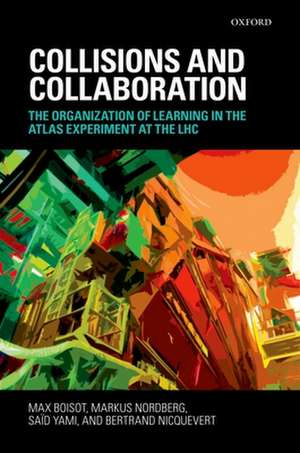
Collisions and Collaboration: The Organization of Learning in the ATLAS Experiment at the LHC
Autor Max Boisot, Markus Nordberg, Saïd Yami, Bertrand Nicqueverten Limba Engleză Hardback – 28 iul 2011
Preț: 364.97 lei
Preț vechi: 461.42 lei
-21%
Puncte Express: 547
Carte disponibilă
Livrare economică 12-18 noiembrie
Livrare prin curier în România Termenul estimat este afișat lângă disponibilitate.
Transport gratuit de la 400.00 lei Plată online sau ramburs, în funcție de opțiunile comenzii.
Retur gratuit în 14 zile Comandă securizată și suport în română.
Specificații
ISBN-13: 9780199567928
ISBN-10: 0199567921
Pagini: 336
Ilustrații: Numerous figures and tables and colour plate section
Dimensiuni: 153 x 236 x 24 mm
Greutate: 0.68 kg
Editura: OUP OXFORD
Colecția OUP Oxford
Locul publicării:Oxford, United Kingdom
ISBN-10: 0199567921
Pagini: 336
Ilustrații: Numerous figures and tables and colour plate section
Dimensiuni: 153 x 236 x 24 mm
Greutate: 0.68 kg
Editura: OUP OXFORD
Colecția OUP Oxford
Locul publicării:Oxford, United Kingdom
V-ar putea interesa
-
 Knocking On Heaven's DoorLisa Randall-19%Preț: 74.83 lei92.95 lei
 -
 -20%Preț: 291.80 lei366.39 lei
 -
 Team of TeamsStanley McChrystalPreț: 86.01 lei
 -
 BreakthroughCamilla PangPreț: 78.73 lei
 -
 The Infinite AlphabetCésar A. HidalgoPreț: 191.23 lei
 -
 Verschure, P: Nature and Dynamics of CollaborationPaul Verschure, F.M.J.-14%Preț: 469.65 lei546.11 lei
 -
 ColliderPaul HalpernPreț: 92.57 lei
 -
 The Leader's Guide to CollaborationGuy LubitshPreț: 120.92 lei
 -
 The Collaboration BookMikael KrogerusPreț: 94.96 lei
 -
 The New Nature of BusinessAndre HoffmannPreț: 116.02 lei
 -
 The Collective EdgeColin M. Fisher-22%Preț: 95.04 lei122.53 leiRecomandat
 -
 The Large Hadron ColliderDon LincolnPreț: 240.50 lei
 -
 Preț: 131.99 lei
 -
 Smashing PhysicsJon Butterworth-26%Preț: 68.82 lei93.41 lei
 -
 Strong GroundBrené BrownPreț: 161.31 lei
 -
 The Particle at the End of the UniverseSean CarrollPreț: 78.91 lei
 -
 Great by ChoiceJim CollinsPreț: 146.95 lei
 -
 CollisionLucy CaldwellPreț: 94.15 lei
Notă biografică
Max Boisot was Professor at ESADE in Barcelona, Associate Fellow at the Saïd Business School, Oxford University, and Senior Research Fellow at the Snider Center for Entrepreneurial Research, The Wharton School, the University of Pennsylvania. Between 1984 and 1989 he was Dean and Director of the China-Europe Management Program in Beijing. This has since evolved into the China-Europe International Business School (CEIBS) in Shanghai. Max Boisot has published in Administrative Science Quarterly, Organization Science, Research Policy, and The Journal of Evolutionary Economics. His book, Knowledge Assets: Securing Competitive Advantage in the Information Economy (Oxford University Press, 1998) was awarded the Ansoff Prize for the best book on strategy in 2000.Dr Markus Nordberg is the Resources Coordinator of the ATLAS project at CERN, Switzerland, where his responsibilities include budget planning and resources allocation for the ATLAS project. He has also served as Visiting Senior Research Fellow at the Centrum voor Bedrijfseconomie, Faculty ESP-Solvay Business School, University of Brussels, and as a member of the Academy of Management, Strategic Management Society and the Association of Finnish Parliament Members and Scientists, TUTKAS. He has a degree both in Physics and in Business Administration.Saïd Yami is associate Professor at the University of Montpellier 1 and Professor at EUROMED Management (France) in Strategic Management. He has published many research articles and several books. His main research relates to competitive relationships through the topics of rivalry and disruptive strategies, collective strategies, and coopetition. He also develops research on entrepreneurship and strategy in high-tech industries. His main field of analysis is the knowledge-based economy. Among his more recent publications is Coopetition: Winning Strategies for the 21st Century (edited by Yami S, Castaldo S., Le Roy F., and Dagnino G.B. Elgar 2010).Bertrand Nicquevert is a Project Engineer at CERN. Within the ATLAS collaboration, he held various positions: as a member of the technical coordination, he was in charge of the geometrical integration he led the technical design office, he was the project leader of the main ATLAS structure and the coordinator of various zones, such as the so-called shielding disc. He then joined the Large Hadron Collider installation coordination, and worked on the design of the next generation of linear colliders. He is now work package holder for the integration and design of the MedAustron project for oncological hadrontherapy. In addition to his function of engineer, Bertrand Nicquevert has taken part of various research programs, in the field of history and sociology of science (with Peter Galison from Harvard University), and of design research, mainly in close collaboration with the Grenoble University.
Cuprins
- Introduction - Big Science Challenges in the Twenty-First Century
- 1: Peter Jenni, Markus Nordberg and Max Boisot: What is ATLAS?
- 2: Max Boisot and Markus Nordberg: A Conceptual Framework: The I-Space
- 3: Timo J. Santalainen, Markus Nordberg, Ram B. Baliga, and Max Boisot: Emergent Strategies and New Research management Models: Lessons from the ATLAS Adhocracy
- 4: Philipp Tuertscher, Raghu Garud, Markus Nordberg, and Max Boisot: The Concept of an Atlas Architecture
- 5: Saïd Yami, Markus Nordberg, Bertrand Nicquevert, and Max Boisot: ATLAS as Collective Strategy
- 6: Olli Vuola and Max Boisot: Buying under Conditions of Uncertainty: A Proactive Approach
- 7: Erkko Autio, Marilena Streit-Bianchi, Ari-Pekka Hameri, Markus Nordberg, and Max Boisot: Learning and Innovation in Procurement: The Case of ATLAS-type Projects
- 8: Marko Arenius and Max Boisot: A Tale of four Atlas Suppliers
- 9: Bertrand Nicquevert, Saïd Yami, Markus Nordberg, and Max Boisot: From Russia With Love: A Contributing Country Perspective
- 10: Beatrice Bressan and Max Boisot: The Individual in the ATLAS Collaboration: A Learning Perspective
- 11: Shantha Liyanage and Max Boisot: Leadership in the ATLAS Collaboration
- 12: Hans Hoffmann, Markus Nordberg, and Max Boisot: ATLAS and e-Science
- 13: Max Boisot and Markus Nordberg: ATLAS and the Future of High-Energy Physics