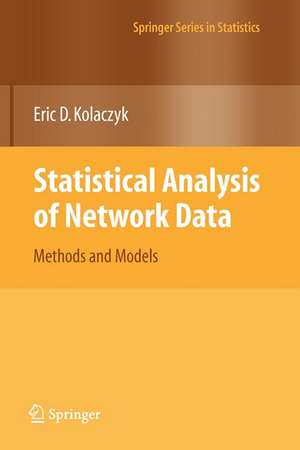
Statistical Analysis of Network Data
Autor Eric D. Kolaczyken Limba Engleză Paperback – 6 dec 2010
Diferența majoră dintre această lucrare și documentația tehnică fragmentată rezidă în capacitatea autorului Eric D. Kolaczyk de a unifica metodele statistice sub o singură umbrelă teoretică. Putem afirma că, deși există numeroase resurse axate pe discipline specifice, Statistical Analysis of Network Data reușește să umple un gol critic prin oferirea unei taxonomii moderne, aplicabile oricărui sistem conceptualizat ca rețea. Notăm cu interes modul în care autorul abordează complexitatea datelor de tip high-throughput, transformând observațiile brute în modele matematice riguroase.
Structura volumului reflectă o progresie logică și tehnică: pornim de la fundamente și maparea rețelelor, trecem prin analiza descriptivă a caracteristicilor grafurilor și ajungem la subiecte avansate precum inferența topologiei și analiza fluxului de date. Dacă Networks de Mark Newman v-a oferit cadrul teoretic extins asupra rețelelor complexe, această carte oferă instrumentele practice de analiză statistică necesare pentru cercetarea aplicată. Găsim în acest volum o rigoare care lipsește adesea din ghidurile pur computaționale, punând accent pe estimare și modelare predictivă.
În contextul operei autorului, acest titlu reprezintă fundamentul teoretic pentru lucrarea sa ulterioară, Statistical Analysis of Network Data with R. Dacă volumul de față stabilește „ce” și „de ce” în analiza rețelelor, continuarea sa se concentrează pe „cum” prin intermediul limbajului R. De asemenea, lucrarea Topics at the Frontier of Statistics and Network Analysis extinde aceste concepte către zonele de cercetare emergente, însă volumul de față rămâne resursa de referință pentru stăpânirea metodelor de bază în ceea ce numim astăzi „network science”.
Preț: 711.37 lei
Preț vechi: 889.21 lei
-20%
Carte tipărită la comandă
Livrare economică 07-21 decembrie
Specificații
ISBN-10: 144192776X
Pagini: 400
Ilustrații: XII, 386 p.
Dimensiuni: 155 x 235 x 22 mm
Greutate: 0.6 kg
Ediția:Softcover reprint of hardcover 1st edition 2009
Editura: Springer
Locul publicării:New York, NY, United States
V-ar putea interesa
-
 Preț: 79.69 lei
 -
 Computer Networks: A Systems ApproachLarry L. Peterson-41%Preț: 558.53 lei941.05 lei
 -
 SyncSteven Strogatz-17%Preț: 66.05 lei79.75 lei
 -
 NetworksMark Newman-27%Preț: 536.44 lei736.29 lei
 -
 The Nature of Complex NetworksSergey N. Dorogovtsev-16%Preț: 317.88 lei378.85 lei
 -
 Networks: OxfordGuido Caldarelli-36%Preț: 48.67 lei75.59 lei
 -
 Getting a Job: Study of Contacts and CareersMark GranovetterPreț: 304.01 lei
 -
 The FormulaAlbert-László BarabásiPreț: 103.43 lei
 -
 Analyzing and Securing Social NetworksBhavani Thuraisingham-20%Preț: 400.87 lei501.08 lei
 -
 The Elements of Statistical LearningTrevor Hastie-20%Preț: 547.10 lei683.87 lei
 -
 BurstsAlbert-Laszlo BarabasiPreț: 140.13 lei
 -
 -14%Preț: 128.79 lei148.92 lei
 -
 Preț: 307.11 lei
 -
 The Structure and Dynamics of NetworksMark Newman-19%Preț: 710.03 lei876.59 lei
 -
 Complex Adaptive SystemsJohn H. MillerPreț: 355.58 lei
 -
 Network ScienceAlbert-Laszlo Barabasi-20%Preț: 392.56 lei490.71 lei
 -
 Graph Analysis and VisualizationRichard Brath-20%Preț: 313.72 lei392.15 lei
 -
 Social Network Analysis: Research MethodsProf. John Scott-15%Preț: 131.67 lei154.60 lei
 -
 Statistical Analysis with Python For DummiesJoseph SchmullerPreț: 197.44 lei
 -
 Social Network AnalysisFranziska B Keller-22%Preț: 664.85 lei852.37 lei
 -
 Preț: 379.56 lei
 -
 -20%Preț: 366.40 lei458.00 lei
 -
 Statistics for ScientistsUmberto Michelucci-20%Preț: 279.62 lei349.53 lei
 -
 Networked SystemsSalem Lahlou-20%Preț: 996.76 lei1245.95 lei
 -
 Multilevel Network Analysis for the Social SciencesEmmanuel Lazega-18%Preț: 1158.96 lei1413.37 lei
 -
 Network Analysis LiteracyKatharina A. Zweig-18%Preț: 946.01 lei1153.67 lei
Public țintă
ResearchDe ce să citești această carte
Recomandăm această carte cercetătorilor și studenților la nivel postuniversitar care au nevoie de o metodologie statistică unitară pentru analiza rețelelor complexe. Cititorul câștigă o înțelegere profundă a modului în care pot fi aplicate modelele matematice pe date provenite din biologie, economie sau sociologie, beneficiind de o structură clară ce acoperă de la eșantionare până la inferență topologică.
Descriere scurtă
Cuprins
Recenzii
“…Accessible and easy to read…strikes a balance between concepts and mathematical detail. …This book is a superb introduction to a fascinating area.” (International Statistical Review, 2010, 78, 1, 134-159) “Many disciplines are nowadays involved in network modeling, but it appears as if a common methodological foundation is lacking. The objective of this book is to provide a first attempt at defining such a common methodological foundation from a statistical point of view. … The style of the writing is excellent. … ample references allow quick access to further literature. I can recommend this book to anyone with a serious statistical interest in networks.” (Fred van Eeuwijk, VOC Nieuwsbrief, Issue 44, May, 2010)
“Any reader interested in networks and wanting a perspective beyond that of any single discipline should acquire this book. … Researchers will also appreciate the many points in the book where important open problems are identified. The book can also serve readily and flexibly as the main textbook for either a graduate-level seminar course or for an informally organized reading group. … This book sets itself the challenge of addressing statistics for network science broadly, and in the many ways already noted, it is successful.” (Michael Frey, Technometrics, Vol. 54 (1), February, 2012)
Textul de pe ultima copertă
This book provides an up-to-date treatment of the foundations common to the statistical analysis of network data across the disciplines. The material is organized according to a statistical taxonomy, although the presentation entails a conscious balance of concepts versus mathematics. In addition, the examples—including extended cases studies—are drawn widely from the literature. This book should be of substantial interest both to statisticians and to anyone else working in the area of ‘network science.’
The coverage of topics in this book is broad, but unfolds in a systematic manner, moving from descriptive (or exploratory) methods, to sampling, to modeling and inference. Specific topics include network mapping, characterization of network structure, network sampling, and the modeling, inference, and prediction of networks, network processes, and network flows. This book is the first such resource to present material on all of these core topics in one place.
Eric Kolaczyk is a professor of statistics, and Director of the Program in Statistics, in the Department of Mathematics and Statistics at Boston University, where he also is an affiliated faculty member in the Center for Biodynamics, the Program in Bioinformatics, and the Division of Systems Engineering. His publications on network-based topics include work ranging from the detection of anomalous traffic patterns in computer networks to the prediction of biological function in networks ofinteracting proteins to the characterization of influence of groups of actors in social networks.