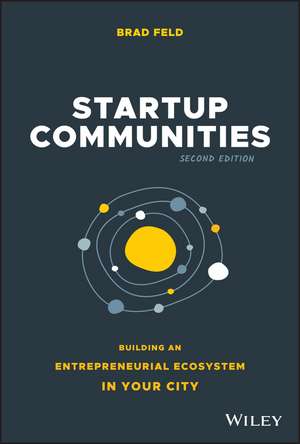
Startup Communities: Building an Entrepreneurial Ecosystem in Your City, Second Edition
Autor Brad Felden Limba Engleză Hardback – 28 iul 2020
Problema centrală a multor orașe care aspiră la statutul de hub tehnologic este convingerea eronată că succesul depinde exclusiv de proximitatea față de Silicon Valley sau de intervenția guvernamentală masivă. Putem afirma că ediția a doua a cărții Startup Communities demontează acest mit, oferind un cadru pragmatic pentru construirea unui ecosistem sustenabil oriunde în lume. Brad Feld revizitează faimoasa sa „Teză Boulder”, transformând un experiment local într-o strategie globală validată în ultimul deceniu. Găsim în această carte o analiză riguroasă a dinamicii dintre participanți, unde autorul distinge clar între lideri (antreprenorii) și susținători (guvern, universități, investitori). Ca și Brad Feld în The Startup Community Way, autorul distilează experiența reală în principii acționabile, punând accent pe colaborare și pe angajamentul pe termen lung. Structura cărții este una progresivă: după stabilirea fundamentelor în primele capitole, textul avansează spre soluții pentru probleme clasice, rolul acceleratoarelor și, în mod inedit, potențialul comunităților startup din zonele rurale. Această lucrare se poziționează ca o continuare firească a operei lui Feld. Dacă în Venture Deals se concentra pe mecanica tranzacțiilor, iar în GiveFirst pe etica mentoratului, Startup Communities oferă contextul macro în care aceste elemente funcționează. Este un ghid despre cum să faci un ecosistem să „vibreze”, evitând stagnarea prin îmbunătățire continuă și prin implicarea strategică a corporațiilor și a mediului academic.
Preț: 153.55 lei
Carte disponibilă
Livrare economică 16-30 noiembrie
Livrare express 30 octombrie-05 noiembrie pentru 36.49 lei
Specificații
ISBN-10: 1119617650
Pagini: 256
Dimensiuni: 162 x 237 x 27 mm
Greutate: 0.46 kg
Ediția:2nd edition
Editura: Wiley
Locul publicării:Hoboken, United States
V-ar putea interesa
-
 Who Moved My Cheese?Spencer Johnson-20%Preț: 50.73 lei63.57 lei
 -
 The PracticeSeth Godin-19%Preț: 88.10 lei108.35 lei
 -
 The Art of GatheringPriya Parker-24%Preț: 65.16 lei86.15 lei
 -
 -25%Preț: 101.85 lei136.71 lei
 -
 Steering the CraftUrsula K. Le GuinPreț: 90.00 lei
 -
 The Lean StartupEric Ries-26%Preț: 91.35 lei123.35 lei
 -
 Effectual EntrepreneurshipSaras Sarasvathy-8%Preț: 595.02 lei646.75 leiRecomandat
 -
 The Startup Community WayBrad FeldPreț: 167.06 lei
 -
 Preț: 124.85 lei
 -
 Big Magic: Creative Living Beyond FearElizabeth Gilbert-15%Preț: 42.87 lei50.57 lei
 -
 Preț: 121.21 lei
 -
 Community: The Structure of BelongingPeter Block-35%Preț: 133.93 lei207.15 lei
 -
 -23%Preț: 95.50 lei123.84 lei
 -
 -30%Preț: 65.56 lei93.33 lei
 -
 Tiny House: Live Small, Dream BigBrent Heavener-24%Preț: 105.23 lei138.96 lei
 -
 -23%Preț: 99.72 lei129.05 lei
 -
 The Homegrown CityMatias EchanovePreț: 152.63 lei
 -
 De la zero la unuBlake MastersPreț: 37.57 lei
 -
 Gândire rapidă, gândire lentăDaniel KahnemanPreț: 99.00 lei
 -
 Preț: 59.00 lei
De ce să citești această carte
Recomandăm această carte liderilor locali, investitorilor și antreprenorilor care vor să transforme propriul oraș într-un centru de inovație. Cititorul va câștiga o înțelegere clară a modului în care se pot atrage talentele și cum se pot structura evenimentele comunitare pentru a genera impact real. Este lectura esențială pentru oricine crede că resursele locale pot fi catalizate într-o forță economică globală.
Despre autor
Brad Feld este un investitor de tip early-stage și antreprenor cu o experiență de peste două decenii în tehnologie. Cofondator al Foundry Group și al acceleratorului de renume mondial TechStars, Feld a modelat peisajul investițiilor din Statele Unite prin Mobius Venture Capital și Intensity Ventures. Recunoscut la nivel național ca expert în venture capital, el locuiește în Boulder, Colorado, oraș pe care l-a transformat, prin implicare directă, într-un etalon global pentru comunitățile de startup-uri.
Cuprins
Foreword Introduction to Second Edition Preface Chapter One: Introduction Chapter Two: The Boulder Startup Community Chapter Three: Principles of a Vibrant Startup Community Chapter Four: Participants in a Startup Community Chapter Five: Attributes of Leadership in a Startup Community Chapter Six: Classical Problems Chapter Seven: Activities and Events Chapter Eight: The Power of Accelerators Chapter Nine: University Involvement Chapter Ten: Contrasts between Entrepreneurs and Government Chapter Eleven: How Large Corporations Can Help Chapter Twelve: The Power of the Community Chapter Thirteen: Broadening a Successful Startup Community Chapter Fourteen: Rural Startup Communities Chapter Fifteen: Myths about Startup Communities Chapter Sixteen: Getting Started About the Author Acknowledgments Foreword 1st edition
Descriere
First published in 2012, Startup Communities became a blueprint for what it takes to build a supportive entrepreneurial community. Now regarded as a classic, the "Boulder Thesis" created and popularized by Feld within the book generated enormous media attention nearly a decade ago. At that time, Boulder was an emerging startup laboratory-a hub of innovation building new tech businesses.
It quickly accelerated into a world class ecosystem for entrepreneurs. Boulder's entrepreneurial density, combined with the geographic concentration of entrepreneurial activity around the Boulder downtown core, made it a hotbed of startup activity. Feld was and is still there, as a keen observer and one of its leaders.
As he notes simply in the new edition, humans are wired to start things. In a sense, that short Feld-ism accurately describes the startup revolution still taking hold throughout the world. Boulder is proof that innovation can happen anywhere, in any city.
Thanks in part to the book, what happens in Boulder now leaves Boulder. Rapidly growing startup communities in Atlanta, Detroit, Denver, Kansas City, Nashville, and Indianapolis are just a few examples. Over the last decade, Feld has dispelled the myth that startups can only thrive in Silicon Valley.
Startup communities continue to pop up across the U.S. and around the world, prompting fresh new revelations and stories from Feld about what's happened over the last decade. Startup Communities 2e describes what makes a startup community ecosystem first click, then hum, and in time, excel.
From Boulder to Beijing and beyond, entrepreneurial ecosystems are driving innovation. Startup Communities 2e discusses and the necessary dynamics and pre-conditions of building communities of entrepreneurs who can feed off each other's talent, creativity, and support. In Startup Communities 2e, Feld will help you understand: The core principles of a vibrant startup community, re-examining his Boulder Thesis and exploring other historical frameworks.
The attributes of leadership in a startup community that can help it thrive along with the classical problems any community will face during development. The importance of a university in a startup community, and how large companies can engage effectively with entrepreneurs. The importance of continuous improvement so growth does not stagnate.
The common myths about startup communities. The opportunities to build startup communities in non-urban, or rural, places that are much less populated.