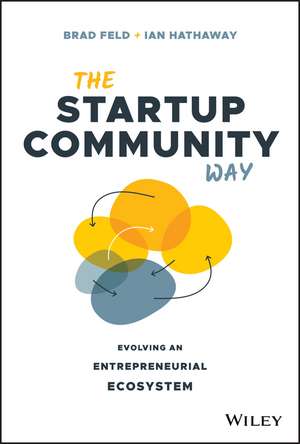
The Startup Community Way
Autor Brad Feld, Ian Hathawayen Limba Engleză Hardback – 28 iul 2020
Credibilitatea autorului Brad Feld este incontestabilă, fiind unul dintre cei mai influenți investitori de tip venture capital din lume, cofondator al TechStars și arhitect al succesului răsunător al comunității din Boulder. În The Startup Community Way, scrisă împreună cu Ian Hathaway, considerăm că autorii reușesc să ridice discuția despre antreprenoriat de la nivelul de simplă rețetă de afaceri la cel de știință a sistemelor complexe. Ne-a atras atenția rigoarea cu care este demontată ideea că un ecosistem de succes poate fi creat artificial prin planificare centralizată, autorii propunând în schimb un model de evoluție organică. Cititorul care a aplicat ideile din Startup Communities va găsi aici instrumentele necesare pentru a naviga într-un mediu aflat în schimbare rapidă, trecând de la „ce trebuie făcut” la „cum funcționează sistemul”. Dacă în Venture Deals Brad Feld se concentra pe mecanica tranzacțiilor, iar în GiveFirst pe etica mentoratului, această nouă lucrare sintetizează aceste teme într-o filosofie de guvernare a comunităților. Față de Startup Ecosystems de Fabio Greco, care analizează componentele statice ale unui ecosistem, lucrarea de față pune accentul pe dinamica legăturilor dintre actori — universități, corporații și guverne — și pe modul în care aceste interacțiuni generează valoare. Textul este structurat pentru a oferi rezultate concrete liderilor de comunități. Veți învăța să aplicați gândirea sistemică pentru a identifica blocajele din propriul oraș și să schimbați mentalitatea stakeholderilor de la una de control la una de facilitare. Este un ghid autoritar care transformă teoria sistemelor complexe într-o strategie aplicabilă pentru orice regiune care aspiră la inovație.
Preț: 167.06 lei
Carte disponibilă
Livrare economică 16-30 noiembrie
Livrare express 31 octombrie-06 noiembrie pentru 37.09 lei
Specificații
ISBN-10: 1119613604
Pagini: 368
Dimensiuni: 164 x 237 x 32 mm
Greutate: 0.58 kg
Editura: Wiley
Locul publicării:Hoboken, United States
V-ar putea interesa
-
 The New Geography of InnovationMehran GulPreț: 123.61 lei
 -
 Entrepreneurship: A Very Short IntroductionPaul Westhead-19%Preț: 57.46 lei71.12 lei
 -
 The Startup WayEric Ries-26%Preț: 102.00 lei137.94 lei
 -
 Effectual EntrepreneurshipSaras Sarasvathy-8%Preț: 595.02 lei646.75 leiRecomandat
 -
 Startup LifeBrad FeldPreț: 150.67 lei
 -
 Preț: 153.55 lei
 -
 -10%Preț: 196.23 lei216.94 lei
 -
 Preț: 225.41 lei
 -
 The New Nature of BusinessAndre HoffmannPreț: 116.19 lei
 -
 -30%Preț: 70.66 lei101.37 lei
 -
 Start-up NationDan SenorPreț: 43.36 lei
 -
 -26%Preț: 90.78 lei122.59 lei
 -
 Startup CapitalismRamon Pacheco PardoPreț: 176.85 lei
 -
 -24%Preț: 150.43 lei198.43 lei
 -
 Preț: 131.29 lei
 -
 Shaping Collaborative Ecosystems for TomorrowAlfonso Reyes-23%Preț: 602.21 lei782.08 lei
 -
 The Entrepreneur WithinMark RobertsPreț: 142.29 lei
 -
 Startup EcosystemsFabio Greco-24%Preț: 764.46 lei1005.87 lei
 -
 Complexity and EntrepreneurshipAndreas Liening-15%Preț: 732.03 lei861.22 lei
De ce să citești această carte
Recomandăm această carte liderilor care doresc să transforme orașul lor într-un pol tehnologic. Cititorul câștigă o înțelegere profundă a modului în care resursele și oamenii interacționează pentru a susține creșterea economică. Este un instrument esențial pentru antreprenori și investitori care vor să depășească barierele birocratice și să construiască rețele de suport reziliente prin colaborare și mentorat autentic.
Despre autor
Brad Feld este un investitor și antreprenor american de renume, activ în domeniul capitalului de risc încă din anii '90. Este cofondator al Foundry Group, un fond de investiții axat pe tehnologia informației, și al rețelei globale de acceleratoare TechStars. Recunoscut la nivel național ca expert în venture capital, Feld a contribuit decisiv la democratizarea accesului la finanțare pentru startup-uri. Experiența sa este dublată de implicarea în numeroase organizații nonprofit, promovând constant filosofia sa de viață și afaceri, „GiveFirst”, care pune accent pe generozitate și sprijin reciproc în comunitatea de afaceri.
Descriere scurtă
Descriere
How to create a thriving startup ecosystem in a location near you--a practical guide
We are in the midst of a global startup revolution. The proliferation of digital technologies, a rising middle-class, and the quest for sustained economic growth have put entrepreneurship on the map for talent, governments, universities, and corporations everywhere. Along with the widely-recognized opportunity presented by entrepreneurship has come a realization that the success of today's startups is determined to a large degree by the complex global and uniquely local environments in which they operate. It is the nature of these external factors--and more importantly, the quality of their linkages with each other--that explains why some places are consistently able to produce high-impact entrepreneurship while many other places are not.
No one tells this story better than acclaimed author and investor Brad Feld and Ian Hathaway, an entrepreneurship expert and startup advisor. The Startup Community Way: Evolving an Entrepreneurial Ecosystem--the much-anticipated sequel to Feld's bestselling book Startup Communities: Building an Entrepreneurial Ecosystem in Your City--explores what makes startup communities thrive and how to improve collaboration in rapidly-changing environments.
The Startup Community Way is a governing philosophy for startup communities, rooted in the theory of complex systems and the practice of community-building in many contexts. This book establishes a robust framework and shares lessons from around the globe that illustrate how to create a flourishing startup ecosystem anywhere. Each of the crucial aspects of community-building, such as the organizing principles of community, the attributes of leadership, the goals and values of a startup community, the application of systems thinking, and methods for changing behavior and mindset are discussed in detail. Advancing the practice of building startup communities, this book:
- Offers practical, real-world advice for entrepreneurs, community builders, and other stakeholders who want to harness the power of startups in their city
- Advances a new framework for effective startup community building grounded in complex adaptive systems and systems thinking
- Discusses the role of key institutions--such as governments, corporations, and universities--in supporting startup communities
- Explores the value of key stakeholders and why leaders are crucial for bringing communities together
- Includes contributions from leading entrepreneurial voices in the field
The Startup Community Way is a must-have resource for entrepreneurs, venture capitalists, C-suite executives, business and community leaders, and anyone wishing to understand how startup communities work anywhere in the world.
Notă biografică
Cuprins
Preface xvii
Chapter One Introduction 1
The Next Generation 2
Our Approach 3
A Deeper Motivation 5
The Boulder Thesis 7
Startup Communities are Complex Adaptive Systems 8
Where We Were in 2012 10
Where We are Now in 2020 12
Using Complexity Theory to Explain Startup Communities 14
Evolving the Boulder Thesis to the Startup Community Way 17
Part I Introduction to Startup Communities 21
Chapter Two Why Startup Communities Exist 23
What Entrepreneurs Do 23
The External Environment 25
Networks over Hierarchies 27
Networks of Trust 29
Density and Agglomeration 33
Quality of Place 35
Chapter Three The Actors 41
Leaders, Feeders, and Instigators 42
Actors 45
Chapter Four The Factors 59
The Seven Capitals 60
Factors 62
Chapter Five Startup Communities
versus Entrepreneurial Ecosystems 75
Entrepreneurial Ecosystems 77
Alignment of Actors 78
Different, but Mutually Reinforcing, Purpose 80
Systems within Systems 81
Entrepreneurial Success 84
Community/Ecosystem Fit 85
Part II Startup Communities as Complex Systems 93
Chapter Six Putting the System Back into Ecosystem 95
Introduction to Systems 96
The Whole System 97
Simple, Complicated, and Complex Activities 103
Moving from Activities to Systems 107
Chapter Seven Unpredictable Creativity 115
Emergence 117
Synergies and Nonlinearity 118
Self-Organization 120
Dynamism 121
The Study of Interactions 125
Chapter Eight The Myth of Quantity 133
More of Everything 134
Outliers, Not Averages 136
Entrepreneurial Recycling 138
Leaders as Supernodes 140
Chapter Nine The Illusion of Control 151
Not Controllable 152
Not Fully Knowable 154
Feedbacks and Contagion 156
Getting Unstuck 158
Letting Go 160
Chapter Ten The Absence of a Blueprint 165
Initial Conditions and Basins of Attraction 168
The Narrative Fallacy 170
Building on Strengths and Learning from Failures 172
Cultivating Topophilia 174
Chapter Eleven The Measurement Trap 183
The Fundamental Measurement Problem 184
Actor and Factor Models: A Categorical Approach 186
Standardized Metrics Models: A Comparative Approach 188
Network Models: A Relational Approach 190
Dynamic Models: An Evolutionary Approach 192
Cultural-Social Models: A Behavioral Approach 194
Logic Models: A Causal Approach 195
Agent-Based Models: A Simulation Approach 198
Applying the Different Models 199
Part III From the Boulder Thesis to the Startup Community Way 207
Chapter Twelve Simplifying Complexity 209
The Boulder Thesis 210
The Rainforest 212
Applying Systems Thinking 214
Looking Deeply 216
Leverage Points 219
Chapter Thirteen Leadership is Key 231
Be a Mentor 234
Entrepreneurs as Role Models 235
Key Leadership Characteristics 237
Chapter Fourteen Think in Generations 243
Progress is Uneven and Often Feels Slow 245
The Endless Long-Term Game 247
Chapter Fifteen Diversity is a Feature, Not a Bug 255
Cultivate Diversity 256
Embracing Diversity 259
Think Broadly about Entrepreneurship 260
Chapter Sixteen Be Active, Not Passive 267
Self-Similarity and Replication 268
Don't Wait or Ask Permission 269
Play a Positive-Sum Game 270
Continuously and Actively Engage 275
Part IV Conclusion 281
Chapter Seventeen Conclusion 283
Reflections 283
Summary of the Book 285
Final Thoughts 291
About the Authors 295
Acknowledgments 297
Notes 301
Index 325