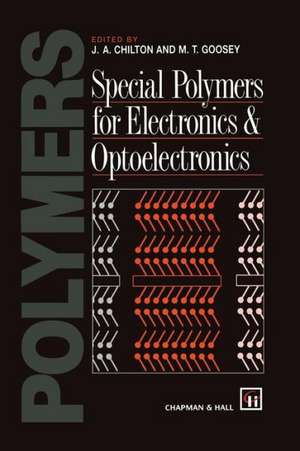
Special Polymers for Electronics and Optoelectronics
Editat de J.A. Chilton, M. Gooseyen Limba Engleză Paperback – 3 oct 2012
Preț: 911.64 lei
Preț vechi: 1111.76 lei
-18%
Puncte Express: 1367
Carte tipărită la comandă
Livrare economică 13-27 noiembrie
Livrare prin curier în România Termenul estimat este afișat lângă disponibilitate.
Transport gratuit pentru acest produs Plată online sau ramburs, în funcție de opțiunile comenzii.
Retur gratuit în 14 zile Comandă securizată și suport în română.
Specificații
ISBN-13: 9789401042529
ISBN-10: 9401042527
Pagini: 380
Ilustrații: XXIV, 351 p.
Dimensiuni: 155 x 235 x 20 mm
Greutate: 0.53 kg
Ediția:Softcover reprint of the original 1st ed. 1995
Editura: SPRINGER NETHERLANDS
Colecția Springer
Locul publicării:Dordrecht, Netherlands
ISBN-10: 9401042527
Pagini: 380
Ilustrații: XXIV, 351 p.
Dimensiuni: 155 x 235 x 20 mm
Greutate: 0.53 kg
Ediția:Softcover reprint of the original 1st ed. 1995
Editura: SPRINGER NETHERLANDS
Colecția Springer
Locul publicării:Dordrecht, Netherlands
V-ar putea interesa
-
 MagnetohydrodynamicsR. J. Moreau-18%Preț: 956.18 lei1166.07 lei
 -
 Advances in Materials Science Research: Volume 21Maryann C Wythers-27%Preț: 1522.29 lei2075.24 lei
 -
 -27%Preț: 1273.65 lei1735.98 lei
 -
 Material Forming ProcessBouchaib Radi-9%Preț: 985.94 lei1083.45 lei
 -
 Springer Handbook of Metrology and TestingHorst Czichos-18%Preț: 1924.34 lei2346.76 lei
 -
 Spiral Grain and Wave Phenomena in Wood FormationJohn M. Harris-15%Preț: 614.24 lei722.63 lei
 -
 -18%Preț: 914.83 lei1115.64 lei
 -
 Liquid ExplosivesJiping Liu-18%Preț: 926.66 lei1130.08 lei
 -
 Soft MatterRoberto PiazzaPreț: 217.34 lei
Public țintă
ResearchCuprins
1 Conductive polymers.- 1.1 Introduction.- 1.2 Traditional routes to conductive polymers.- 1.3 Conduction mechanisms.- 1.4 Conducting polymers.- 1.5 Applications.- 1.6 Conclusions and commercial prospects.- References.- 2 Electrodepositable resists.- 2.1 Introduction.- 2.2 Principles of electrodeposition.- 2.3 Polymers for electrodepositable resists.- 2.4 Electrodepositable resist formulation.- 2.5 Applications of electrodepositable resists.- 2.6 Summary and conclusions.- References.- 3 Polymeric Langmuir—Blodgett films.- 3.1 Introduction.- 3.2 Polymerization of Langmuir—Blodgett materials.- 3.3 Electrical properties.- 3.4 Optical properties.- 3.5 Concluding remarks.- References.- 4 Nonlinear materials.- 4.1 Introduction.- 4.2 Characterization.- 4.3 ?2 polymers.- 4.4 ?2 polymers.- 4.5 Polymeric devices.- References.- 5 Ferroelectric polymers.- 5.1 Introduction.- 5.2 Ferroelectric polymer materials.- 5.3 Properties of ferroelectric polymers.- 5.4 Applications of ferroelectric polymers.- 5.5 Conclusions.- References.- 6 Electroactive composites.- 6.1 Introduction.- 6.2 Composite designs.- 6.3 Diphasic models.- 6.4 Preparation and characterization.- 6.5 Composite poling.- 6.6 Applications.- References.- 7 Thermotropic liquid crystal polymers.- 7.1 Introduction.- 7.2 Liquid crystal polymer fundamentals.- 7.3 Processing.- 7.4 Property profiles.- 7.5 Applications.- 7.6 Outlook.- References.- 8 Photoconductive polymers.- 8.1 Introduction.- 8.2 General background.- 8.3 Materials.- 8.4 Experimental techniques.- 8.5 Applications.- References.- 9 Polymers for optical data storage.- 9.1 Introduction: the need for optical storage.- 9.2 The principles of optical storage.- 9.3 Polymers in the recording layer.- 9.4 Polymers in the manufacture of optical media.- 9.5 Polymers foroptical heads.- 9.6 Polymers for cartridges.- 9.7 Other forms of optical storage.- 9.8 The future for polymers in optical data storage.- References.
Recenzii
...this book is an excellent introduction to the applications of polymer science in the opto-electronic industry...I recommend the book for entry-level researchers or specialists desiring expansion into a new field - Trends in Polymer Science; This book is very timely and brings together, concisely, an authoritative discussion of topics. - Polymer International; This is a fascinating book...each page contains a large amount of information which is presented in a very clear and logical way. This means that although the book is written by a number of different authors, that the book has a coherent style. The text is also well illustrated...this book will be of great interest to those working in the electronics industry and/or, those studying/researching electronics. - Engineering Plastics