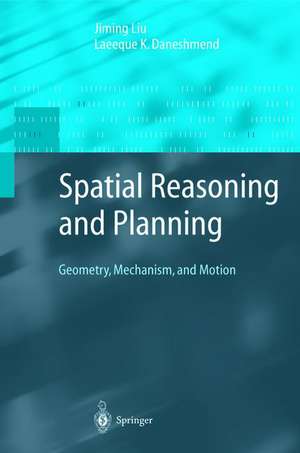
Spatial Reasoning and Planning: Advanced Information Processing
Autor Jiming Liu, Laeeque K. Daneshmenden Limba Engleză Hardback – 4 dec 2003
After a review of previous work in the related areas, Liu and Daneshmend present here a unified framework for qualitative spatial representation and reasoning, which enables the generation of solutions to spatial problems where the geometric knowledge is imprecise. The approach utilizes qualitative spatial representation and reasoning integrated with a quantitative search procedure based on simulated annealing. Many graphical illustrations and detailed algorithm descriptions help the readers to comprehend the solution paths and to develop their own applications.
The book is written as a self-contained text for researchers and graduate students in computer science and related engineering disciplines. The methodologies, algorithmic details, and case studies presented can be used as course material as well as a convenient reference.



Preț: 665.99 lei
Preț vechi: 832.49 lei
-20%
Puncte Express: 999
Carte tipărită la comandă
Livrare economică 23 noiembrie-07 decembrie
Livrare prin curier în România Termenul estimat este afișat lângă disponibilitate.
Transport gratuit pentru acest produs Plată online sau ramburs, în funcție de opțiunile comenzii.
Retur gratuit în 14 zile Comandă securizată și suport în română.
Specificații
ISBN-13: 9783540406709
ISBN-10: 3540406700
Pagini: 196
Ilustrații: XIV, 180 p.
Dimensiuni: 160 x 241 x 16 mm
Greutate: 0.41 kg
Ediția:2004
Editura: Springer
Colecția Advanced Information Processing
Seria Advanced Information Processing
Locul publicării:Berlin, Heidelberg, Germany
ISBN-10: 3540406700
Pagini: 196
Ilustrații: XIV, 180 p.
Dimensiuni: 160 x 241 x 16 mm
Greutate: 0.41 kg
Ediția:2004
Editura: Springer
Colecția Advanced Information Processing
Seria Advanced Information Processing
Locul publicării:Berlin, Heidelberg, Germany
V-ar putea interesa
-
 Introduction to Autonomous Mobile Robots, second editionDavide Scaramuzza-14%Preț: 577.74 lei671.79 lei
 -
 Principles of Robot MotionGeorge A. Kantor-14%Preț: 582.58 lei677.42 lei
 -
 -18%Preț: 427.88 lei521.88 lei
 -
 Notes on the Synthesis of FormChristopher AlexanderPreț: 235.55 lei
 -
 Preț: 384.83 leiRecomandat
 -
 Spatial Data Analysis With RDanlin Yu-9%Preț: 745.68 lei819.42 lei
 -
 -20%Preț: 339.99 lei424.99 lei
 -
 Introduction to Robotics, Global EditionJohn Craig-9%Preț: 596.70 lei655.72 lei
 -
 GIS For DummiesJami DennisPreț: 166.20 lei
 -
 Agentic AI For DummiesPam Baker-20%Preț: 146.02 lei182.53 lei
 -
 The Essential Book of AIAnne Rooney-20%Preț: 74.61 lei93.27 lei
 -
 -30%Preț: 234.18 lei335.86 lei
 -
 Robotics: The Algorithmic Perspective: WAFR 1998Pankaj K. Agarwal-20%Preț: 919.90 lei1149.87 lei
 -
 Spatial Strategies for Interior DesignIan Higgins-28%Preț: 197.91 lei273.12 lei
 -
 -15%Preț: 649.15 lei763.70 lei
 -
 Computational GeometryMark de BergPreț: 450.09 lei
 -
 Computational GeometryMark de BergPreț: 441.16 lei
 -
 -20%Preț: 327.36 lei409.20 lei
 -
 Preț: 356.30 lei
 -
 -24%Preț: 1166.40 lei1534.74 lei
Public țintă
ResearchCuprins
1 Introduction.- 1.1 Motivation.- 1.2 Issues.- 1.3 Scope of the Book.- 1.4 Organization of the Book.- 2 Overview of Spatial Reasoning and Planning Techniques.- 2.1 Computer-Aided Kinematic Design of Mechanisms.- 2.2 Geometric Path Planning.- 2.2.1 Path Search in Configuration Space.- 2.3 Qualitative Reasoning.- 3 Interesting Problems in Spatial Reasoning and Planning.- 3.1 Terminology and Notation.- 3.2 The Problems.- 3.3 Assumptions.- 4 How to Represent Qualitative Spatial Relationships.- 4.1 Qualitative Distance.- 4.2 Qualitative Angle.- 4.3 Notes on Label-Based Distance and Angle Descriptions.- 4.4 Completeness.- 4.5 Minimum-Spanning Edge (m-Edge) between Two Polygons.- 4.6 Qualitative Location in a Convex Polygonal Environment.- 4.7 Graphic Representation of the m-Edge Partitioned Free-Space.- 4.8 Notes on Qualitative Location.- 5 Methodology of Spatial Reasoning and Planning.- 5.1 Spatial Inferencing.- 5.2 Envisionments.- 5.3 Spatial Planning in Q-Space.- 5.4 Quantitative Configuration Generation with Simulated Annealing.- 6 How to Reason about Mechanism Configurations.- 6.1 An Overview of the Method.- 6.2 Qualitative Configuration Analysis.- 6.3 Quantitative Configuration Generation.- 6.4 Discussions.- 6.6 Summary.- 7 How to Reason about Velocity Relationships.- 7.1 Instantaneous Rotation Center.- 7.2 Velocity Relationship Analysis.- 7.3 Examples.- 7.4 Notes on the Application of Velocity Analysis.- 7.5 Relative Motion Method of Analyzing Velocities.- 7.5.2 Kinematic Modeling.- 7.6 Qualitative Analysis of Relative Velocities.- 7.7 An Example.- 7.8 Summary.- 8 How to Plan Robot Motions.- 8.1 An Overview of the Method.- 8.2 Qualitative Route Planning in the m-Edge Partitioned Euclidean Free-Space.- 8.3 Constructing Exact Paths from Qualitative Routes.- 8.4 GraphicalSimulations.- 9 How to Make Spatial Measurements and Maps.- 9.1 Mapping.- 9.2 m-Uncertainty and FS Theory.- 9.3 Incorporating m-Uncertainty.- 9.4 Collective Spatial Map Construction.- 9.5 Self-Organization of a Potential Map.- 9.6 Experiments.- 9.7 Summary.- 10 Concluding Remarks.- 10.1 Key Concepts Revisited.- 10.2 Practical Application.- 10.3 Limitations.- 10.4 Future Challenges.- Appendices.- B The Boltzmann Distribution in Simulated Annealing.- C Qualitative Route Search Based on A. Algorithm.- References.
Recenzii
From the reviews:
"This book especially deals with the problems of spatial reasoning and planning which are especially important for design stages of mechanical systems where system parameters have not yet been specified … . The presentation of the material is very interesting and will be an excellent example for further work at similar problems. … This book can be used for graduate students in several areas, but also … for the continuous education of people that are already working in a given field." (Christian Posthoff, Zentralblatt MATH, Vol. 1054, 2005)
"This book especially deals with the problems of spatial reasoning and planning which are especially important for design stages of mechanical systems where system parameters have not yet been specified … . The presentation of the material is very interesting and will be an excellent example for further work at similar problems. … This book can be used for graduate students in several areas, but also … for the continuous education of people that are already working in a given field." (Christian Posthoff, Zentralblatt MATH, Vol. 1054, 2005)
Caracteristici
Specially designed features that will help readers to understand and apply the techniques presented Balanced emphasis on recent and pioneering work as well as on theoretical aspects and practical applications Unifying engineering-oriented approach together with case studies and comprehensive examples Detailed algorithms and many illustrations for explanation Includes supplementary material: sn.pub/extras
Notă biografică
Prof. Jiming Liu has been Chair Professor in Computer Science at Hong Kong Baptist University since 2010, where he also directs Centre for Health Informatics, as well as Joint Research Laboratory for Intelligent Disease Surveillance and Control (a research partnership with Chinese Center for Disease Control and Prevention). He received his MEng and PhD in Electrical Engineering (Robotics) from McGill University, after earning a BSc in Physics from East China Normal University and an interdisciplinary Master of Arts from Concordia University. He has been a Fellow of the IEEE since 2011. Prof. Liu's research interests include AI for Social Good, Machine Learning, Complex Systems, Data-Driven Modeling, Complex Networks, Web Intelligence (WI), and Autonomy-Oriented Computing (AOC) Paradigms. He has served as Editor-in-Chief of Web Intelligence Journal, and Associate Editor of Big Data and Information Analytics, IEEE Transactions on Knowledge and Data Engineering, IEEE Transactions on Cybernetics, and Computational Intelligence, among a dozen of others.
Dr. Shang Xia is currently an Associate Professor at the National Institute of Parasitic Diseases, Chinese Center for Diseases Control and Prevention (NIPD, China CDC), which is also recognized as the Chinese Center for Tropical Diseases Research (CTDR), and WHO Collaborating Centre for Tropical Diseases. He also works as a member of Joint Research Laboratory for Intelligent Disease Surveillance and Control (a research partnership with Hong Kong Baptist University). He received his PhD degree in Computer Science from Hong Kong Baptist University (HKBU) in Hong Kong, having obtained MEng and BEng degrees from Shanghai Jiao Tong University (SJTU), China. He has completed his Postdoctoral Research Program in the Chinese Center for Diseases Control and Prevention (China CDC) in Beijing, China. He is the committee member of International Society of Geospatial Health (GnosisGIS). He has served as the section editors of BMC Infectious Diseases of Poverty (IDP), and Climate Change Research (in Chinese).