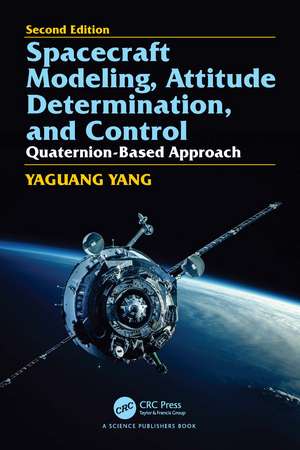
Spacecraft Modeling, Attitude Determination, and Control: Quaternion-Based Approach, Second edition
Autor Yaguang Yangen Limba Engleză Hardback – 24 iun 2025
The book also includes attitude control in some special maneuvers and systems, such as orbital-raising, docking and rendezvous, and multi-body space systems that are normally not discussed in similar books. All design methods are based on state-spaced modern control approaches, such as linear quadratic optimal control, robust pole assignment control, model predictive control, and gain scheduling control. Applications of these methods to spacecraft attitude control problems are provided. Appendices are provided for readers who are not familiar with these topics.
Preț: 1511.01 lei
Preț vechi: 1842.69 lei
-18%
Puncte Express: 2267
Carte tipărită la comandă
Livrare economică 18 noiembrie-02 decembrie
Livrare prin curier în România Termenul estimat este afișat lângă disponibilitate.
Transport gratuit pentru acest produs Plată online sau ramburs, în funcție de opțiunile comenzii.
Retur gratuit în 14 zile Comandă securizată și suport în română.
Specificații
ISBN-13: 9781032952529
ISBN-10: 1032952520
Pagini: 412
Ilustrații: 144
Dimensiuni: 156 x 234 x 24 mm
Greutate: 0.92 kg
Ediția:1
Editura: CRC Press
Colecția CRC Press
ISBN-10: 1032952520
Pagini: 412
Ilustrații: 144
Dimensiuni: 156 x 234 x 24 mm
Greutate: 0.92 kg
Ediția:1
Editura: CRC Press
Colecția CRC Press
V-ar putea interesa
-
 Stick and Rudder: An Explanation of the Art of FlyingWolfgang Langewiesche-33%Preț: 190.92 lei283.16 lei
 -
 Optimal Spacecraft TrajectoriesJohn E. Prussing-22%Preț: 356.85 lei454.94 lei
 -
 Gemini and Mercury RemasteredAndy SaundersPreț: 408.40 lei
 -
 Fault Tolerant Attitude Estimation for Small SatellitesChingiz Hajiyev-8%Preț: 444.46 lei483.11 lei
 -
 Control System DesignBernard Friedland-24%Preț: 171.04 lei224.84 lei
 -
 Optimal Control and EstimationRobert F. Stengel-20%Preț: 207.26 lei259.96 lei
 -
 The Complete Book of SpacecraftMichael H. Gorn-20%Preț: 179.10 lei223.52 lei
 -
 Optimal Estimation of Dynamic SystemsJohn L. Crassidis-8%Preț: 504.66 lei548.54 lei
 -
 Aircraft Control and SimulationBrian L Stevens-23%Preț: 943.44 lei1225.25 lei
 -
 ACS Without an AttitudeHarold L. Hallock-20%Preț: 968.55 lei1210.69 lei
 -
 -25%Preț: 86.96 lei115.88 lei
 -
 Navigation and Tracking in Space: Analysis and AlgorithmsAndrew Dempster-9%Preț: 765.57 lei841.28 lei
 -
 Principles of Spacecraft ControlWalter FichterPreț: 389.10 lei
 -
 Robust and Adaptive ControlEugene LavretskyPreț: 533.14 lei
 -
 A Mathematical Perspective on Flight Dynamics and ControlAndrea L'Afflitto-15%Preț: 476.02 lei560.03 lei
 -
 Advanced Control Systems: Theory and ApplicationsYuriy P. Kondratenko-23%Preț: 686.57 lei891.64 lei
 -
 -15%Preț: 506.94 lei596.40 lei
 -
 -18%Preț: 955.44 lei1165.18 lei
 -
 -24%Preț: 946.47 lei1245.36 lei
 -
 -18%Preț: 866.29 lei1056.45 lei
Public țintă
Academic and PostgraduateCuprins
Preface. Introduction. Orbit Dynamics and Properties. Rotational Sequences and Quaternion. Spacecraft Dynamics and Modeling. Space Environment and Disturbance Torques. Spacecraft Attitude Determination. Astronomical Vector Measurements. Spacecraft Attitude Estimation. Spacecraft Attitude Control. Spacecraft Actuators. Spacecraft Control Using Magnetic Torques. Attitude Maneuver and Orbit-Raising. Attitude MPC Control. Spacecraft Control Using CMG. Spacecraft Rendezvous and Docking. Modeling and Attitude Control of Multi-Body Space Systems. Appendix A. First Order Optimality Conditions. Appendix B. Optimal Control. Appendix C. Robust Pole Assignment. References. Index.
Notă biografică
Yaguang Yang holds B.S. (1982) and M.S. (1985) degrees from Huazhong University of Science and Technology, China. From 1985 to 1990, he was a lecturer at Zhejiang University in China. In 1996 he received a PhD degree from the Department of Electrical and Computer Engineering at the University of Maryland, College Park, Maryland, USA. Since then, he has designed and implemented control systems at UKIRT, CIENA, ITT, and Orbital Sciences Corporation; he has performed theoretical and applied research and published more than 50 papers in controls and optimizations, developed and implemented algorithms in computer codes, and applied to engineering problems, and he has managed nuclear power plant instrument and control research projects at US NRC. He is currently a system engineer with the Goddard Space Flight Center, NASA, where he has worked on several space projects, including The Laser Interferometer Space Antenna (LISA), Enceladus Life Signatures and Habitability (ELSAH), The Large UV/Optical/IR Surveyor (LUVOIR), and is the Principal Investigator (PI) of an applied research project (Model-based optimal engineering design and its application to the advanced trajectory design problem).
Descriere
This book discusses spacecraft modeling, attitude determination, estimation, and controls. A background on rotation sequence and reference frames is provided, followed by the discussion of the attitude determination using vector measurements, and control designs independent of actuators in use.
Recenzii
"This book provides a good and comprehensive overview of spacecraft attitude dynamics, determination and control, including advances in the quaternion-based approach, with application to practical problems such as coupled attitude and orbit control and model predictive optimal control with realistic actuators constraints. In conclusion, the book is a good and useful resource for researchers and research minded engineers wishing to develop a more detailed understanding of some of the latest advances in robust pole placement and model predictive control to spacecraft attitude control. The quaternion based approach is applied to practical attitude estimation and attitude control problems ranging from nadir pointing using reaction wheels or CMGs to momentum dumping using magnetic torquers and coupled attitude and orbit control for spacecraft docking."
— Nadjim Horri, Coventry University, The Aeronautical Journal, Oct 2020
— Nadjim Horri, Coventry University, The Aeronautical Journal, Oct 2020