
Software Testing Automation
Autor Saeed Parsaen Limba Engleză Paperback – 26 mar 2024
Part I describes unit and acceptance tests and proposes a new method called testability-driven development (TsDD) in support of TDD and BDD. TsDD uses a machine learning model to measure testability before and after refactoring. The reader will learn how to develop the testability prediction model and write software tools for automatic refactoring.
Part II focuses on developing tools for automatic fault localization. This part shows the reader how to use a compiler generator to instrument source code, create control flow graphs, identify prime paths, and slice the source code. On top of these tools, a software tool, Diagnoser, is offered to facilitate experimenting with and developing new fault localization algorithms. Diagnoser takes a source code and its test suite as input and reports the coverage provided by the test cases and the suspiciousness score for each statement. Part III proposes using software testing as a prominent part of the cyber-physical system software to uncover and model unknown physical behaviors and the underlying physical rules. The reader will get insights into developing software tools to generate white box test data.
Preț: 1177.35 lei
Preț vechi: 1471.69 lei
-20%
Puncte Express: 1766
Carte disponibilă
Livrare economică 09-16 noiembrie
Livrare express 30 octombrie-05 noiembrie pentru 104.12 lei
Livrare prin curier în România Termenul estimat este afișat lângă disponibilitate.
Transport gratuit pentru acest produs Plată online sau ramburs, în funcție de opțiunile comenzii.
Retur gratuit în 14 zile Comandă securizată și suport în română.
Specificații
ISBN-13: 9783031220593
ISBN-10: 3031220595
Pagini: 604
Ilustrații: XXIV, 580 p. 741 illus., 668 illus. in color.
Dimensiuni: 155 x 235 x 33 mm
Greutate: 0.9 kg
Ediția:2023
Editura: Springer
Locul publicării:Cham, Switzerland
ISBN-10: 3031220595
Pagini: 604
Ilustrații: XXIV, 580 p. 741 illus., 668 illus. in color.
Dimensiuni: 155 x 235 x 33 mm
Greutate: 0.9 kg
Ediția:2023
Editura: Springer
Locul publicării:Cham, Switzerland
V-ar putea interesa
-
 -20%Preț: 347.80 lei434.74 lei
 -
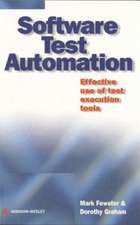 Software Test AutomationDorothy Graham-20%Preț: 654.66 lei818.33 lei
 -
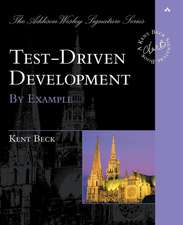 Test Driven Development: By ExampleKent Beck-20%Preț: 279.03 lei348.80 lei
 -
 Growing Object-Oriented Software, Guided by TestsSteve Freeman-20%Preț: 336.20 lei420.25 lei
 -
 -20%Preț: 363.08 lei453.85 lei
 -
 -20%Preț: 203.46 lei254.33 lei
 -
 Lessons Learned in Software Testing - A Context- Driven ApproachBret Pettichord-20%Preț: 258.03 lei322.54 lei
 -
 Taking Testing SeriouslyJames BachPreț: 481.30 lei
 -
 Python Automation For DummiesAlan Simpson-20%Preț: 146.52 lei183.15 lei
 -
 Automated Software Testing Interview Questions You'll Most Likely Be AskedVirbrant Publishers-20%Preț: 79.42 lei99.28 lei
 -
 Foundations of Software Testing ISTQB CertificationDorothy Graham-33%Preț: 341.86 lei510.31 lei
 -
 Modern Software Testing TechniquesIstván Forgács-20%Preț: 216.44 lei270.55 lei
 -
 The Art of Unit TestingRoy Osherove-20%Preț: 370.50 lei463.11 lei
 -
 Software Testing with Generative AIMark Winteringham-20%Preț: 338.95 lei423.69 lei
 -
 Effective Software TestingMauricio Aniche-20%Preț: 339.95 lei424.93 lei
 -
 Introduction to AI TestingIosif Itkin-20%Preț: 287.66 lei359.57 lei
 -
 -20%Preț: 321.81 lei402.26 lei
 -
 -20%Preț: 317.85 lei397.31 lei
 -
 Software Testing StrategiesPanagiotis Leloudas-20%Preț: 234.28 lei292.85 lei
Cuprins
Software Testability.- Unit testing and Test-Driven Development.- Acceptance Testing and Behavior Driven Development.
Textul de pe ultima copertă
This book is about the design and development of tools for software testing. It intends to get the reader involved in software testing rather than simply memorizing the concepts. The source codes are downloadable from the book website. The book has three parts: software testability, fault localization, and test data generation.
Part I describes unit and acceptance tests and proposes a new method called testability-driven development (TsDD) in support of TDD and BDD. TsDD uses a machine learning model to measure testability before and after refactoring. The reader will learn how to develop the testability prediction model and write software tools for automatic refactoring.
Part II focuses on developing tools for automatic fault localization. This part shows the reader how to use a compiler generator to instrument source code, create control flow graphs, identify prime paths, and slice the source code. On top of these tools, a software tool, Diagnoser, is offered to facilitate experimenting with and developing new fault localization algorithms. Diagnoser takes a source code and its test suite as input and reports the coverage provided by the test cases and the suspiciousness score for each statement. Part III proposes using software testing as a prominent part of the cyber-physical system software to uncover and model unknown physical behaviors and the underlying physical rules. The reader will get insights into developing software tools to generate white box test data.
Part I describes unit and acceptance tests and proposes a new method called testability-driven development (TsDD) in support of TDD and BDD. TsDD uses a machine learning model to measure testability before and after refactoring. The reader will learn how to develop the testability prediction model and write software tools for automatic refactoring.
Part II focuses on developing tools for automatic fault localization. This part shows the reader how to use a compiler generator to instrument source code, create control flow graphs, identify prime paths, and slice the source code. On top of these tools, a software tool, Diagnoser, is offered to facilitate experimenting with and developing new fault localization algorithms. Diagnoser takes a source code and its test suite as input and reports the coverage provided by the test cases and the suspiciousness score for each statement. Part III proposes using software testing as a prominent part of the cyber-physical system software to uncover and model unknown physical behaviors and the underlying physical rules. The reader will get insights into developing software tools to generate white box test data.
Caracteristici
Presents advanced topics in software testing Provides in-depth insights into the development of software tools to evaluate, refactor, and generate test data Is a textbook to be used as a reference for postgraduates and software industries