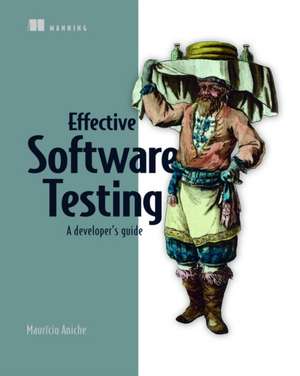
Effective Software Testing
Autor Mauricio Anicheen Limba Engleză Paperback – 4 iul 2022
Notăm cu interes modul în care Effective Software Testing reușește să transforme testarea dintr-o activitate reactivă într-o disciplină riguroasă de inginerie. Autorul, Mauricio Aniche, își ancorează metodologia în exemple practice scrise în Java, însă conceptele sunt direct transferabile către orice ecosistem orientat-obiect. Suntem de părere că valoarea adăugată a acestui volum rezidă în depășirea nivelului de bază al testării unitare, oferind instrumente pentru gestionarea cazurilor de tip „edge case” prin tehnici sistematice. Pe linia practică a volumului Essentials of Software Testing, dar cu un focus pronunțat pe arhitectura software care facilitează testabilitatea, Effective Software Testing ghidează cititorul printr-o progresie logică. Structura este una incrementală: se începe cu testarea bazată pe specificații și acoperirea structurală a codului, trecând rapid către concepte avansate precum proiectarea contractelor (pre-condiții, post-condiții, invarianți) și testarea bazată pe proprietăți. Capitolele centrale despre Test-driven development și utilizarea eficientă a obiectelor de tip mock și stub oferă soluții concrete pentru simplificarea suitelor de teste complexe. Spre deosebire de abordările pur teoretice din Software Testing de Paul C. Jorgensen, lucrarea de față pune accent pe mentenabilitatea codului de test și pe identificarea așa-numitelor „test smells”. Credem că integrarea unor concepte de arhitectură, precum injecția de dependențe sau arhitectura hexagonală, ca premise pentru un cod testabil, face din acest manual un instrument indispensabil pentru inginerii software care urmăresc eficiența procesului de dezvoltare, nu doar simpla bifare a unor metrici de coverage.
Preț: 339.95 lei
Preț vechi: 424.93 lei
-20%
Carte disponibilă
Livrare economică 05-19 noiembrie
Livrare express 22-28 octombrie pentru 36.80 lei
Specificații
ISBN-10: 1633439933
Pagini: 380
Dimensiuni: 187 x 233 x 18 mm
Greutate: 0.54 kg
Editura: Manning Publications
V-ar putea interesa
-
 Clean Code: A Handbook of Agile Software CraftsmanshipRobert Martin-20%Preț: 365.09 lei456.37 lei
 -
 Modern Software EngineeringDavid Farley-20%Preț: 223.44 lei279.30 lei
 -
 Software Design DecodedAndre van der Hoek-20%Preț: 85.23 lei106.54 lei
 -
 Growing Object-Oriented Software, Guided by TestsSteve Freeman-20%Preț: 331.61 lei414.52 lei
 -
 -20%Preț: 363.08 lei453.85 lei
 -
 Lessons Learned in Software Testing - A Context- Driven ApproachBret Pettichord-20%Preț: 258.03 lei322.54 lei
 -
 Code Complete: A practical handbook of software constructionSteve McConnell-20%Preț: 285.38 lei356.73 lei
 -
 Taking Testing SeriouslyJames BachPreț: 481.30 lei
 -
 Coding For Dummies, All New EditionPaul McFedries-20%Preț: 117.52 lei146.90 lei
 -
 Foundations of Software Testing ISTQB CertificationDorothy Graham-34%Preț: 333.75 lei502.01 lei
 -
 Modern Software Testing TechniquesIstván Forgács-20%Preț: 216.44 lei270.55 lei
 -
 The Art of Unit TestingRoy Osherove-20%Preț: 370.50 lei463.11 lei
 -
 Testing Web APIsMark Winteringham-20%Preț: 370.32 lei462.90 lei
 -
 Software Testing with Generative AIMark Winteringham-20%Preț: 339.03 lei423.79 lei
 -
 Introduction to AI TestingIosif Itkin-20%Preț: 282.73 lei353.41 lei
 -
 Testing in ScrumTilo Linz-20%Preț: 264.61 lei330.77 lei
 -
 -20%Preț: 321.81 lei402.26 lei
 -
 Software Testing StrategiesPanagiotis Leloudas-20%Preț: 234.28 lei292.85 lei
De ce să citești această carte
Recomandăm această carte dezvoltatorilor care doresc să treacă de la scrierea intuitivă de teste la o abordare sistemică, bazată pe cercetare și bune practici din industrie. Veți învăța nu doar cum să găsiți bug-uri în zone critice ale codului, ci și cum să proiectați sisteme care sunt în mod natural ușor de testat, economisind timp prețios în ciclul de producție.