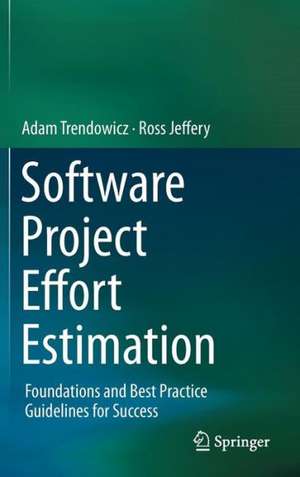
Software Project Effort Estimation
Autor Adam Trendowicz, Ross Jefferyen Limba Engleză Hardback – 16 mai 2014
Trendowicz and Jeffery present a comprehensive look at the principles of software effort estimation and support software practitioners in systematically selecting and applying the most suitable effort estimation approach. Their book not only presents what approach to take and how to apply and improve it, but also explains why certain approaches should be used in specific project situations. Moreover, it explains popular estimation methods, summarizes estimation best-practices, and provides guidelines for continuously improving estimation capability. Additionally, the book offers invaluable insights into project management in general, discussing issues including project trade-offs, risk assessment, and organizational learning.
Overall, the authors deliver an essential reference work for software practitioners responsible for software effort estimation and planning in their daily work and who want to improve their estimation skills. At the same time, for lecturers and students the book can serve as the basis of a course in software processes, software estimation, or project management.
Preț: 361.05 lei
Preț vechi: 451.31 lei
-20%
Puncte Express: 542
Carte tipărită la comandă
Livrare economică 04-18 decembrie
Livrare prin curier în România Termenul estimat este afișat lângă disponibilitate.
Transport gratuit de la 400.00 lei Plată online sau ramburs, în funcție de opțiunile comenzii.
Retur gratuit în 14 zile Comandă securizată și suport în română.
Specificații
ISBN-13: 9783319036281
ISBN-10: 3319036289
Pagini: 492
Ilustrații: XXII, 469 p. 86 illus.
Dimensiuni: 160 x 241 x 32 mm
Greutate: 0.85 kg
Ediția:2014
Editura: Springer
Locul publicării:Cham, Switzerland
ISBN-10: 3319036289
Pagini: 492
Ilustrații: XXII, 469 p. 86 illus.
Dimensiuni: 160 x 241 x 32 mm
Greutate: 0.85 kg
Ediția:2014
Editura: Springer
Locul publicării:Cham, Switzerland
V-ar putea interesa
-
 -20%Preț: 272.31 lei340.38 lei
-
 Lost VoicesJoseph SalePreț: 83.85 lei
-
 JuniperRoss JefferyPreț: 215.63 lei
-
 Software Engineering EducationNorman E. Gibbs-20%Preț: 323.39 lei404.23 lei
-
 Software Engineering EducationLionel E. Deimel-20%Preț: 315.82 lei394.77 lei
-
 -20%Preț: 487.31 lei609.15 lei
-
 -20%Preț: 941.67 lei1177.09 lei
-
 Shipping GreatnessChris Vander Mey-20%Preț: 134.87 lei168.58 lei
-
 Handbook of Neuroevolution Through ErlangGene I. Sher-20%Preț: 2004.50 lei2505.63 lei
-
 -20%Preț: 1137.08 lei1421.36 lei
-
 -20%Preț: 1162.16 lei1452.70 lei
-
 Frameworks for Developing Efficient Information SystemsJohn Krogstie-18%Preț: 1114.16 lei1358.73 lei
-
 Mastering Lob Development for Silverlight 5Braulio D. Ez-20%Preț: 354.47 lei443.08 lei
-
 Windows Azure Programming Patterns for Start-UpsRiccardo Becker-20%Preț: 262.80 lei328.50 lei
-
 System Development: A Strategic FrameworkMichael Bronzite-20%Preț: 317.85 lei397.31 lei
-
 Cucumber RecipesIan Dees-20%Preț: 204.78 lei255.98 lei
-
 I Died Too, But They Haven't Buried Me YetRoss JefferyPreț: 117.68 lei
-
 The Encyclopocalypse of Legends and LoreStephanie EllisPreț: 105.78 lei
-
 Aligning Organizations Through MeasurementVictor Basili-20%Preț: 345.62 lei432.02 lei
-
 Coordination Technology for Collaborative ApplicationsWolfram Conen-20%Preț: 321.94 lei402.43 lei
-
 -20%Preț: 662.87 lei828.59 lei
-
 Software Process TechnologyReidar Conradi-20%Preț: 320.32 lei400.41 lei
-
 -20%Preț: 634.94 lei793.68 lei
-
 -15%Preț: 613.00 lei721.18 lei
-
 Managing Software Engineering KnowledgeAybüke Aurum-20%Preț: 628.63 lei785.78 lei
-
 Software Cost Estimation, Benchmarking, and Risk AssessmentAdam Trendowicz-20%Preț: 651.51 lei814.40 lei
Public țintă
Professional/practitionerCuprins
PART I Foundations.- Challenges of Predictable Software Development.- Principles of Effort and Cost Estimation.- Common Factors Influencing Software Project Effort.- Estimation under Uncertainty.- Basic Estimation Strategies.- PART II Selecting An Appropriate Estimation Method.- Classification of Effort Estimation Methods.- Finding the Most Suitable Estimation Method.- PART III Popular Effort Estimation Methods.- Statistical Regression Analysis.- Constructive Cost Model – COCOMO.- Classification and Regression Trees.- Case-Based Reasoning.- Wideband Delphi.- Planning Poker.- Bayesian Belief Networks – BBN.- CoBRA.- PART IV Establishing Sustainable Effort Estimation.- Continuously Improving Effort Estimation.- Effort Estimation Best Practices.- Appendix.
Recenzii
"It is the most complete work on all aspects of software effort estimation that I have seen. It provides an excellent reference for the field and belongs on the bookshelf of every organization that needs to manage a software project." from the foreword by Victor Basili, University of Maryland, USA
"This dense book would serve as a reference in a software library, and would be a great resource for software engineering students, as well as managers, engineers, and architects." Naga Narayanaswamy, ACM Computing Reviews, December 2014
"This dense book would serve as a reference in a software library, and would be a great resource for software engineering students, as well as managers, engineers, and architects." Naga Narayanaswamy, ACM Computing Reviews, December 2014
Notă biografică
Victor Basili is Professor Emeritus of Computer Science at the University of Maryland. He has worked on measuring, evaluating, and improving the software development process and product by applying methods such as Iterative Enhancement (IE), the Goal Question Metric Approach (GQM), the Quality Improvement Paradigm (QIP), and the Experience Factory (EF). He is the recipient of several awards including the NASA Group Achievement Award (1996), ACM SIGSOFT Outstanding Research Award (2000), and the IEEE Computer Society Harlan Mills Award (2003); and he is an IEEE and ACM Fellow.
Adam Trendowicz is a senior consultant at the Fraunhofer Institute for Experimental Software Engineering IESE (Process Management Division) in Kaiserslautern, Germany, where he leads the "Measurement and Prediction" team. He has led multiple measurement-based software improvement activities in software companies of different sizes and various domains worldwide. He has been involved in functional software size estimation and productivity benchmarking in organizations from both industry and the public sector. Last but not least, he has led the development of measurement-based project governance initiatives in the context of software development organizations.
Martin Kowalczyk is a researcher at Technische Universität Darmstadt, Germany. His current research focuses on Business Intelligence and Analytics in the context of organizational decision making processes. Prior to his current position, Martin was a researcher and consultant at Fraunhofer IESE and member of the Processes Management Division. In this position, he provided consulting services for several international organizations from the aerospace, finance, and services industries regarding software process improvement and measurement.
Jens Heidrich is head of the Process Management Division at the Fraunhofer Institute for Experimental Software Engineering IESE and a lecturer at theUniversity of Kaiserslautern, Germany. His research interests are in the areas of software project control, cost estimation, software quality modeling, quality assessment, and measurement of software engineering products and processes.
Carolyn Seaman is an associate professor of information systems at the University of Maryland Baltimore County (UMBC). Her research generally falls under the umbrella of empirical studies of software engineering, with particular emphases on maintenance, organizational structure, communication, measurement, COTS-based development, and qualitative research methods. Prior to this position, she worked in the software industry as a software engineer and consultant, and has conducted most of her research in industrial and governmental settings (e.g., IBM, NASA, Xerox).
Jürgen Münch is a professor in the Department of Computer Science at the University of Helsinki, Finland, and heads its Software Systems Research Group. His research focuses on software measurement and quantitative analysis, process and quality engineering, global software development, and empirical software engineering. Jürgen has been a principal investigator in numerous research and industrial development projects. He was awarded the Distinguished Professor Award FiDiPro of Tekes, and the IFIP TC2 Manfred Paul Award for Excellence in Software Theory and Practice. H. Dieter Rombach has held the Software Engineering Chair in the Department of Computer Science at the University of Kaiserslautern, Germany, since 1992. In addition, he is the founding and Executive Director of the Fraunhofer Institute for Experimental Software Engineering IESE in Kaiserslautern, Germany. Among the many awards he has received are the "Presidential Young Investigator Award" of the National Science Foundation (NSF) in the U.S. (1990) and the Federal Cross of Merit on Ribbon of the Federal Republic of Germany (2009). He is a Fellow of both the ACM and the IEEEComputer Society.
Textul de pe ultima copertă
Software effort estimation is one of the oldest and most important problems in software project management, and thus today there are a large number of models, each with its own unique strengths and weaknesses in general, and even more importantly, in relation to the environment and context in which it is to be applied.
Trendowicz and Jeffery present a comprehensive look at the principles of software effort estimation and support software practitioners in systematically selecting and applying the most suitable effort estimation approach. Their book not only presents what approach to take and how to apply and improve it, but also explains why certain approaches should be used in specific project situations. Moreover, it explains popular estimation methods, summarizes estimation best-practices, and provides guidelines for continuously improving estimation capability. Additionally, the book offers invaluable insights into project management in general, discussing issues including project trade-offs, risk assessment, and organizational learning.
Overall, the authors deliver an essential reference work for software practitioners responsible for software effort estimation and planning in their daily work and who want to improve their estimation skills. At the same time, for lecturers and students the book can serve as the basis of a course in software processes, software estimation, or project management.
Caracteristici
Most comprehensive reference work on all aspects of software estimation Authors have more than 20 years experience in academia, the industry and public sector Explains the what, how and why of all major software estimation methods Also offers invaluable insights into general project management, risk management and organizational learning Includes supplementary material: sn.pub/extras