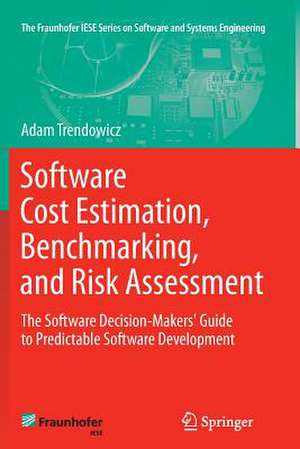
Software Cost Estimation, Benchmarking, and Risk Assessment: The Fraunhofer IESE Series on Software and Systems Engineering
Autor Adam Trendowiczen Limba Engleză Paperback – 29 ian 2015
In this book, Adam Trendowicz presents the CoBRA method (an abbreviation for Cost Estimation, Benchmarking, and Risk Assessment) for estimating the effort required to successfully complete a software development project, which uniquely combines human judgment and measurement data in order to systematically create a custom-specific effort estimation model. CoBRA goes far beyond simply predicting the development effort; it supports project decision-makers in negotiating the project scope, managing project risks, benchmarking productivity, and directing improvement activities. To illustrate the method’s practical use, the book reports several real-world cases where CoBRA was applied in various industrial contexts. These cases represent different estimation contexts in terms of software project environment, estimation objectives, and estimation constraints.
This book is the result of a successful collaboration between the process management division of Fraunhofer IESE and many software companies in the field of software engineering technology transfer. It mainly addresses software practitioners who deal with planning and managing software development projects as part of their daily work, and is also of interest for students or courses specializing in software engineering or software project management.
Preț: 651.51 lei
Preț vechi: 814.40 lei
-20%
Puncte Express: 977
Carte tipărită la comandă
Livrare economică 02-16 decembrie
Livrare prin curier în România Termenul estimat este afișat lângă disponibilitate.
Transport gratuit pentru acest produs Plată online sau ramburs, în funcție de opțiunile comenzii.
Retur gratuit în 14 zile Comandă securizată și suport în română.
Specificații
ISBN-13: 9783642433658
ISBN-10: 3642433650
Pagini: 348
Ilustrații: XXVI, 322 p.
Dimensiuni: 155 x 235 x 19 mm
Greutate: 0.53 kg
Ediția:2013
Editura: Springer
Colecția The Fraunhofer IESE Series on Software and Systems Engineering
Seria The Fraunhofer IESE Series on Software and Systems Engineering
Locul publicării:Berlin, Heidelberg, Germany
ISBN-10: 3642433650
Pagini: 348
Ilustrații: XXVI, 322 p.
Dimensiuni: 155 x 235 x 19 mm
Greutate: 0.53 kg
Ediția:2013
Editura: Springer
Colecția The Fraunhofer IESE Series on Software and Systems Engineering
Seria The Fraunhofer IESE Series on Software and Systems Engineering
Locul publicării:Berlin, Heidelberg, Germany
V-ar putea interesa
-
 Project ManagementMatthew BatchelorPreț: 109.73 lei
 -
 Preț: 118.40 lei
 -
 What You Need to Know about Project ManagementFergus O'ConnellPreț: 129.38 lei
 -
 Managing ProjectsRussellPreț: 370.31 lei
 -
 Second Order Project ManagementMichael Cavanagh-15%Preț: 454.41 lei534.60 lei
 -
 Green Project ManagementRichard Maltzman-20%Preț: 618.19 lei772.74 lei
 -
 Successful Project Management PracticesParviz F. Rad-23%Preț: 718.89 lei933.63 lei
 -
 Dictionary of Project Management TermsJ Leroy WardPreț: 506.04 lei
 -
 -15%Preț: 613.00 lei721.18 lei
Public țintă
ResearchCuprins
Part I Predictable Software Development.-Why Software Effort Estimation?.- What is a Good Estimate?.- Why the CoBRA Method?.- Part II The CoBRA Method.- Principles of the CoBRA Method.- Model Development and Validation.- Model Application.- Usage Scenarios of a CoBRA Model.- Part III Industrial Applications.- Software design & management, Germany.- Allette Systems, Australia.- Oki Electric, Japan.- Siemens Information Systems, India.- Japan Manned Space Systems, Japan.- Bibliography.
Recenzii
From the reviews:
“The scope of the book is the cost estimation, benchmarking, and risk assessment (CoBRA) method, launched in 1998. … The author thoroughly explains the basics and presents real practical cases throughout the book, in a way that any metrics engineer will be able to understand. Readers who finish the book will be able to set up a CoBRA method easily.” (Jair Merlo, Computing Reviews, September, 2013)
“The CoBRA method is a way of integrating the "Art" and the "Science" of software estimation, which is usually believed to be a "Black Art". The CoBRA method demystifies the Black Art of software estimation.” Yasushi Ishigai, Research Director at Research Center for Information Technology, Mitsubishi Research Institute, Inc., Japan
“We had not been able to imagine building our own software estimation models until we encountered the CoBRA method. As far as combining project data and expert judgment for the purpose of software effort estimation is concerned, we can definitely say that there are no other methods that are comparable to CoBRA.” Morihiko Shinoda, Deputy Department Manager, Yutaka Masaoka, Senior Engineer, Government, Public Sector Systems Division, Hitachi Solutions, Ltd., Japan
“We used the CoBRA method for early-stage estimation of system integration projects. We were very satisfied with CoBRA because we could easily model relevant cost drivers that are specific to our own context as well as base development productivity. From limited use in one group, we have now expanded its use to department-wide activities.” Yasushi Aizaki, Manager at Systems Development Division, NTT Data Sekisui Systems, Japan
“I am convinced that the CoBRA method has a high potential of resolving "acquisition issues" related to the accountability of software costs in IT business, which enduringly persist on the side of IT customers. That's because the models arevery simple and easy to build and can be understood even by non-IT professionals.” Hiroshi Iwakiri, General Manager, Information Systems Business Unit, Mitsubishi Electric Corporation
“We had not been able to imagine building our own software estimation models until we encountered the CoBRA method. As far as combining project data and expert judgment for the purpose of software effort estimation is concerned, we can definitely say that there are no other methods that are comparable to CoBRA.” Morihiko Shinoda, Deputy Department Manager, Yutaka Masaoka, Senior Engineer, Government, Public Sector Systems Division, Hitachi Solutions, Ltd., Japan
“We used the CoBRA method for early-stage estimation of system integration projects. We were very satisfied with CoBRA because we could easily model relevant cost drivers that are specific to our own context as well as base development productivity. From limited use in one group, we have now expanded its use to department-wide activities.” Yasushi Aizaki, Manager at Systems Development Division, NTT Data Sekisui Systems, Japan
“I am convinced that the CoBRA method has a high potential of resolving "acquisition issues" related to the accountability of software costs in IT business, which enduringly persist on the side of IT customers. That's because the models are very simple and easy to build and can be understood even by non-IT professionals.” Hiroshi Iwakiri, General Manager, Information Systems Business Unit, Mitsubishi Electric Corporation
“The scope of the book is the cost estimation, benchmarking, and risk assessment (CoBRA) method, launched in 1998. … The author thoroughly explains the basics and presents real practical cases throughout the book, in a way that any metrics engineer will be able to understand. Readers who finish the book will be able to set up a CoBRA method easily.” (Jair Merlo, Computing Reviews, September, 2013)
“The CoBRA method is a way of integrating the "Art" and the "Science" of software estimation, which is usually believed to be a "Black Art". The CoBRA method demystifies the Black Art of software estimation.” Yasushi Ishigai, Research Director at Research Center for Information Technology, Mitsubishi Research Institute, Inc., Japan
“We had not been able to imagine building our own software estimation models until we encountered the CoBRA method. As far as combining project data and expert judgment for the purpose of software effort estimation is concerned, we can definitely say that there are no other methods that are comparable to CoBRA.” Morihiko Shinoda, Deputy Department Manager, Yutaka Masaoka, Senior Engineer, Government, Public Sector Systems Division, Hitachi Solutions, Ltd., Japan
“We used the CoBRA method for early-stage estimation of system integration projects. We were very satisfied with CoBRA because we could easily model relevant cost drivers that are specific to our own context as well as base development productivity. From limited use in one group, we have now expanded its use to department-wide activities.” Yasushi Aizaki, Manager at Systems Development Division, NTT Data Sekisui Systems, Japan
“I am convinced that the CoBRA method has a high potential of resolving "acquisition issues" related to the accountability of software costs in IT business, which enduringly persist on the side of IT customers. That's because the models arevery simple and easy to build and can be understood even by non-IT professionals.” Hiroshi Iwakiri, General Manager, Information Systems Business Unit, Mitsubishi Electric Corporation
“We had not been able to imagine building our own software estimation models until we encountered the CoBRA method. As far as combining project data and expert judgment for the purpose of software effort estimation is concerned, we can definitely say that there are no other methods that are comparable to CoBRA.” Morihiko Shinoda, Deputy Department Manager, Yutaka Masaoka, Senior Engineer, Government, Public Sector Systems Division, Hitachi Solutions, Ltd., Japan
“We used the CoBRA method for early-stage estimation of system integration projects. We were very satisfied with CoBRA because we could easily model relevant cost drivers that are specific to our own context as well as base development productivity. From limited use in one group, we have now expanded its use to department-wide activities.” Yasushi Aizaki, Manager at Systems Development Division, NTT Data Sekisui Systems, Japan
“I am convinced that the CoBRA method has a high potential of resolving "acquisition issues" related to the accountability of software costs in IT business, which enduringly persist on the side of IT customers. That's because the models are very simple and easy to build and can be understood even by non-IT professionals.” Hiroshi Iwakiri, General Manager, Information Systems Business Unit, Mitsubishi Electric Corporation
Notă biografică
Victor Basili is Professor Emeritus of Computer Science at the University of Maryland. He has worked on measuring, evaluating, and improving the software development process and product by applying methods such as Iterative Enhancement (IE), the Goal Question Metric Approach (GQM), the Quality Improvement Paradigm (QIP), and the Experience Factory (EF). He is the recipient of several awards including the NASA Group Achievement Award (1996), ACM SIGSOFT Outstanding Research Award (2000), and the IEEE Computer Society Harlan Mills Award (2003); and he is an IEEE and ACM Fellow.
Adam Trendowicz is a senior consultant at the Fraunhofer Institute for Experimental Software Engineering IESE (Process Management Division) in Kaiserslautern, Germany, where he leads the "Measurement and Prediction" team. He has led multiple measurement-based software improvement activities in software companies of different sizes and various domains worldwide. He has been involved in functional software size estimation and productivity benchmarking in organizations from both industry and the public sector. Last but not least, he has led the development of measurement-based project governance initiatives in the context of software development organizations.
Martin Kowalczyk is a researcher at Technische Universität Darmstadt, Germany. His current research focuses on Business Intelligence and Analytics in the context of organizational decision making processes. Prior to his current position, Martin was a researcher and consultant at Fraunhofer IESE and member of the Processes Management Division. In this position, he provided consulting services for several international organizations from the aerospace, finance, and services industries regarding software process improvement and measurement.
Jens Heidrich is head of the Process Management Division at the Fraunhofer Institute for Experimental Software Engineering IESE and a lecturer at theUniversity of Kaiserslautern, Germany. His research interests are in the areas of software project control, cost estimation, software quality modeling, quality assessment, and measurement of software engineering products and processes.
Carolyn Seaman is an associate professor of information systems at the University of Maryland Baltimore County (UMBC). Her research generally falls under the umbrella of empirical studies of software engineering, with particular emphases on maintenance, organizational structure, communication, measurement, COTS-based development, and qualitative research methods. Prior to this position, she worked in the software industry as a software engineer and consultant, and has conducted most of her research in industrial and governmental settings (e.g., IBM, NASA, Xerox).
Jürgen Münch is a professor in the Department of Computer Science at the University of Helsinki, Finland, and heads its Software Systems Research Group. His research focuses on software measurement and quantitative analysis, process and quality engineering, global software development, and empirical software engineering. Jürgen has been a principal investigator in numerous research and industrial development projects. He was awarded the Distinguished Professor Award FiDiPro of Tekes, and the IFIP TC2 Manfred Paul Award for Excellence in Software Theory and Practice. H. Dieter Rombach has held the Software Engineering Chair in the Department of Computer Science at the University of Kaiserslautern, Germany, since 1992. In addition, he is the founding and Executive Director of the Fraunhofer Institute for Experimental Software Engineering IESE in Kaiserslautern, Germany. Among the many awards he has received are the "Presidential Young Investigator Award" of the National Science Foundation (NSF) in the U.S. (1990) and the Federal Cross of Merit on Ribbon of the Federal Republic of Germany (2009). He is a Fellow of both the ACM and the IEEEComputer Society.
Textul de pe ultima copertă
Software effort estimation is a key element of software project planning and management. Yet, in industrial practice, the important role of effort estimation is often underestimated and/or misunderstood.
In this book, Adam Trendowicz presents the CoBRA method (an abbreviation for Cost Estimation, Benchmarking, and Risk Assessment) for estimating the effort required to successfully complete a software development project, which uniquely combines human judgment and measurement data in order to systematically create a custom-specific effort estimation model. CoBRA goes far beyond simply predicting the development effort; it supports project decision-makers in negotiating the project scope, managing project risks, benchmarking productivity, and directing improvement activities. To illustrate the method’s practical use, the book reports several real-world cases where CoBRA was applied in various industrial contexts. These cases represent different estimation contexts in terms of software project environment, estimation objectives, and estimation constraints.
This book is the result of a successful collaboration between the process management division of Fraunhofer IESE and many software companies in the field of software engineering technology transfer. It mainly addresses software practitioners who deal with planning and managing software development projects as part of their daily work, and is also of interest for students or courses specializing in software engineering or software project management.
In this book, Adam Trendowicz presents the CoBRA method (an abbreviation for Cost Estimation, Benchmarking, and Risk Assessment) for estimating the effort required to successfully complete a software development project, which uniquely combines human judgment and measurement data in order to systematically create a custom-specific effort estimation model. CoBRA goes far beyond simply predicting the development effort; it supports project decision-makers in negotiating the project scope, managing project risks, benchmarking productivity, and directing improvement activities. To illustrate the method’s practical use, the book reports several real-world cases where CoBRA was applied in various industrial contexts. These cases represent different estimation contexts in terms of software project environment, estimation objectives, and estimation constraints.
This book is the result of a successful collaboration between the process management division of Fraunhofer IESE and many software companies in the field of software engineering technology transfer. It mainly addresses software practitioners who deal with planning and managing software development projects as part of their daily work, and is also of interest for students or courses specializing in software engineering or software project management.
Caracteristici
Both the CoBRA method and its presentation are driven by and aimed at industrial practice A complete and comprehensible specification of all relevant CoBRA processes is presented The methodological concepts and their usage are illustrated by numerous practical examples and case studies from various software organizations Includes supplementary material: sn.pub/extras