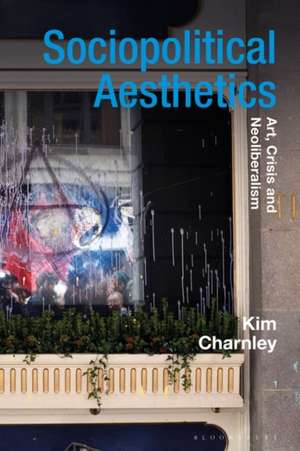
Sociopolitical Aesthetics: Art, Crisis and Neoliberalism: Radical Aesthetics-Radical Art
Autor Kim Charnleyen Limba Engleză Paperback – 11 feb 2021
Drawing upon leading artists and theorists within this field - including Hito Steyerl, Marina Vishmidt, Art & Language, Gregory Sholette, John Roberts and Dave Beech - this book argues for a new interpretation of the relationship between socially-engaged art and neoliberalism. Kim Charnley explores the possibility that neoliberalism has destabilized the art system so that it is no longer able to absorb and neutralize dissent. As a result, the relationship between aesthetics and politics is experienced with fresh urgency and militancy.





Preț: 172.35 lei
Preț vechi: 229.99 lei
-25%
Puncte Express: 259
Carte disponibilă
Livrare economică 11-25 noiembrie
Livrare express 27-31 octombrie pentru 84.32 lei
Livrare prin curier în România Termenul estimat este afișat lângă disponibilitate.
Transport gratuit de la 400.00 lei Plată online sau ramburs, în funcție de opțiunile comenzii.
Retur gratuit în 14 zile Comandă securizată și suport în română.
Specificații
ISBN-13: 9781350008731
ISBN-10: 1350008737
Pagini: 272
Ilustrații: 15 b/w illus
Dimensiuni: 136 x 214 x 18 mm
Greutate: 0.34 kg
Editura: Bloomsbury Publishing
Colecția Bloomsbury Academic
Seria Radical Aesthetics-Radical Art
Locul publicării:London, United Kingdom
ISBN-10: 1350008737
Pagini: 272
Ilustrații: 15 b/w illus
Dimensiuni: 136 x 214 x 18 mm
Greutate: 0.34 kg
Editura: Bloomsbury Publishing
Colecția Bloomsbury Academic
Seria Radical Aesthetics-Radical Art
Locul publicării:London, United Kingdom
V-ar putea interesa
-
 Beauty is in the StreetJoachim C. HäberlenPreț: 94.61 lei
 -
 Preț: 167.79 lei
 -
 Curating the Commons: Socially Engaged Public ArtKatia ArfaraPreț: 348.08 lei
 -
 Feminism. Art. Capitalism.Angela DimitrakakiPreț: 190.73 lei
 -
 ActivismAfonso Dias Ramos-17%Preț: 113.04 lei136.84 lei
 -
 Contemporary Art in the Conflicts of GlobalizationJonathan HarrisPreț: 386.45 lei
 -
 Contemporary Art and Other ObstructionsAdam Geczy-32%Preț: 556.20 lei822.45 lei
 -
 Summer of Our Discontent: The Age of Certainty and the Demise of DiscourseThomas Chatterton Williams-32%Preț: 130.88 lei191.08 lei
 -
 Dissensus: On Politics and AestheticsJacques Rancière-44%Preț: 96.26 lei172.46 lei
 -
 The Refusalist InternationalMikkel Bolt RasmussenPreț: 86.24 lei
 -
 Postpolitics and the Aesthetic ImaginationJuan MenesesPreț: 183.23 lei
 -
 A Mouth Is Always MuzzledNatalie HopkinsonPreț: 153.50 lei
 -
 -18%Preț: 180.93 lei221.52 lei
 -
 Bad New DaysHal FosterPreț: 100.93 lei
 -
 The War of ArtLauren O'Neill-ButlerPreț: 153.25 lei
 -
 Crisis as FormPeter OsbornePreț: 158.59 lei
 -
 Artificial HellsClaire BishopPreț: 162.39 lei
 -
 The Art of Activism and the Activism of ArtGregory SholettePreț: 257.88 lei
 -
 The Social Organization of Arts: A Theoretical CompendiumVolker KirchbergPreț: 364.32 lei
 -
 What about Activism?Steven Henry MadoffPreț: 156.09 lei
Cuprins
Introduction: In what sense 'sociopolitical' aesthetics?
1. Collective impurities
2. Art, economics, reproductive labour
3. Kaleidoscopic Institutions
4. Materialities of the Neoliberal State
5. Art, Ignorance and the Pedagogic Turn
6. Documentary, Post-Truth and Realism
7. Crisis, Criticism and Contemporary Art
Conclusion: Autonomy, Heteronomy, Solidarity?
Bibliography
Index
1. Collective impurities
2. Art, economics, reproductive labour
3. Kaleidoscopic Institutions
4. Materialities of the Neoliberal State
5. Art, Ignorance and the Pedagogic Turn
6. Documentary, Post-Truth and Realism
7. Crisis, Criticism and Contemporary Art
Conclusion: Autonomy, Heteronomy, Solidarity?
Bibliography
Index
Recenzii
Sociopolitical Aesthetics is without doubt the best political analysis of art's 'social turn', which it revisits through a reexamination of the contested meanings of collectivity and a re-reading of debates on aesthetics and politics within the context of neoliberalism, the globalisation of contemporary art and narratives of crisis. Charnley combines first rate art historical scholarship with razor sharp political analysis and an insider's understanding of contemporary art to explain the rise of socially engaged art against the prevailing wisdom that art as an institution must neutralise dissent, through co-optation, absorption, incorporation, and recuperate and by turning politics into aesthetics. What if, Charnley asks, the art system has reached the limit of its ability to contain the critical practices that occupy it.