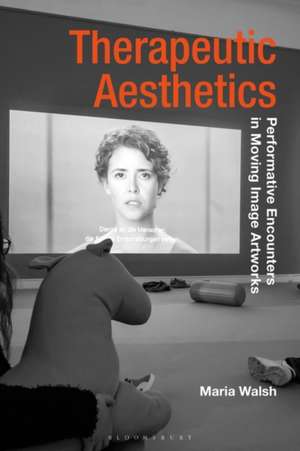
Therapeutic Aesthetics: Performative Encounters in Moving Image Artworks: Radical Aesthetics-Radical Art
Autor Maria Walshen Limba Engleză Paperback – 30 iun 2022
Engaging with a range of philosophers and theorists, including Bernard Stiegler, Franco 'Bifo' Berardi, Judith Butler, Félix Guattari, and Eva Illouz, Maria Walsh proposes that there is no cure, only provisional moments of reparation. To address this idea, she uses the concept of the pharmakon, the Greek term for drug which means both remedy and poison. Through this approach, she maintains the conflict between the curative and the harmful in relation to moving image artworks by artists such as Omer Fast, Liz Magic Laser, Leigh Ledare, Oriana Fox, Gillian Wearing and Rehana Zaman. As transitional spaces, these artworks can enable a toleration of anxiety and conflict that may offer another kind of aesthetic self-cultivation than the subjection to biopolitical governance in cognitive capitalism.



Preț: 204.32 lei
Preț vechi: 216.39 lei
-6%
Puncte Express: 306
Carte tipărită la comandă
Livrare economică 08-22 iunie
Specificații
ISBN-13: 9781350189430
ISBN-10: 135018943X
Pagini: 240
Dimensiuni: 154 x 232 x 16 mm
Greutate: 0.38 kg
Editura: Bloomsbury Publishing
Colecția Bloomsbury Academic
Seria Radical Aesthetics-Radical Art
Locul publicării:London, United Kingdom
ISBN-10: 135018943X
Pagini: 240
Dimensiuni: 154 x 232 x 16 mm
Greutate: 0.38 kg
Editura: Bloomsbury Publishing
Colecția Bloomsbury Academic
Seria Radical Aesthetics-Radical Art
Locul publicării:London, United Kingdom
V-ar putea interesa
-
 -34%Preț: 1102.40 lei1663.45 lei
 -
 Problems in StoicismA. A. Long-22%Preț: 313.56 lei403.95 lei
 -
 Gilles Deleuze: Image and TextProfessor Eugene W. Holland-17%Preț: 266.30 lei319.75 lei
 -
 Heidegger's Later Writings: A Reader's GuideDr Lee Braver-18%Preț: 149.07 lei181.83 lei
 -
 Does God Hate Women?Ophelia Benson-38%Preț: 207.84 lei336.39 lei
 -
 Badiou's 'Being and Event': A Reader's GuideProfessor Christopher Norris-17%Preț: 172.55 lei208.32 lei
 -
 A to Z of PhilosophyDr Alexander Moseley-42%Preț: 97.29 lei166.57 lei
 -
 Mythology, Madness, and Laughter: Subjectivity in German IdealismDr Markus GabrielPreț: 279.69 lei
 -
 -25%Preț: 168.66 lei225.33 lei
 -
 The Empiricists: A Guide for the PerplexedDr Laurence Carlin-18%Preț: 182.01 lei223.01 lei
 -
 -42%Preț: 95.42 lei165.71 lei
 -
 Le Réveil de l'HommeJ. LacôtePreț: 76.36 lei
 -
 La Morale Des Philosophes Chinois: Extraite Des Livres Classiques de la Chine Et de l'AnnamJean-Louis De LanessanPreț: 103.96 lei
 -
 Preț: 178.34 lei
 -
 Index Méthodique, Ou Table Alphabétique. Tome 1Jacques-François-Étienne Le Boys Des GuaysPreț: 229.19 lei
 -
 L'Idéal MoralL. Le ChevallierPreț: 169.87 lei
 -
 de l'Homme À La Science: Philosophie Du Xxe SiècleFélix Le DantecPreț: 169.66 lei
 -
 Le Chaos Et l'Harmonie UniverselleFélix Le DantecPreț: 133.18 lei
 -
 Le Conflit: Entretiens PhilosophiquesFélix Le DantecPreț: 153.01 lei
 -
 Le Diogène de d'Alembert, Ou Diogène Décent, Pensées Libres Sur l'HomeAndré-Pierre Le Guay de PrémontvalPreț: 153.75 lei
 -
 Vues Philosophiques. Vol. 1André-Pierre Le Guay de PrémontvalPreț: 185.65 lei
 -
 Vues Philosophiques. Vol. 2André-Pierre Le Guay de PrémontvalPreț: 193.23 lei
 -
 Preț: 207.36 lei
 -
 Preț: 76.72 lei
 -
 Système Religieux de LeibnitzGottfried Wilhelm LeibnizPreț: 200.18 lei
 -
 Preț: 155.11 lei
 -
 -13%Preț: 924.64 lei1062.80 lei
Cuprins
Introduction
1. Setting the scene - two supplementary vignettes
2. The imbrication of poison and cure in Harun Farocki
3. Homeopathic mimicry in Omer Fast's war trilogy
4. Melanie Gilligan's signifying semiologies and the micro-resistance of collective subjectivity
5. Pharmacological reparation in Liz Magic Laser's Primal Speech
6. Leigh Ledare's pharmacological aesthetics of group analysis
7. Aesthetic modes of performative truth-telling in The O Show and Self Made
8. The transitional pleasures of emotional labour in Lucy Beech's and Rehana Zaman's videos
Conclusion: Toxicity and self-care - two poles of pharmacological aesthetics
References
Index
1. Setting the scene - two supplementary vignettes
2. The imbrication of poison and cure in Harun Farocki
3. Homeopathic mimicry in Omer Fast's war trilogy
4. Melanie Gilligan's signifying semiologies and the micro-resistance of collective subjectivity
5. Pharmacological reparation in Liz Magic Laser's Primal Speech
6. Leigh Ledare's pharmacological aesthetics of group analysis
7. Aesthetic modes of performative truth-telling in The O Show and Self Made
8. The transitional pleasures of emotional labour in Lucy Beech's and Rehana Zaman's videos
Conclusion: Toxicity and self-care - two poles of pharmacological aesthetics
References
Index
Recenzii
Maria Walsh's book marks a decisive step forward in the study of art as a means of addressing trauma. Through sustained analyses of moving image works, she advances a compelling understanding of their power to relieve psychological damage without airbrushing the social and economic forces underlying it.
In a series of encounters between moving image practices and a diverse selection of ideas and theories this wide ranging book diagnoses and develops an original concept of pharmological aesthetics. Walsh is highly attuned to what is fast becoming one of the most urgent issues of today - how certain forms of psychic malaise are increasing as other new ones are emerging - and has identified within certain artistic strategies not so much a cure as a complex treatment for them. A very timely work for those interested in the intersections between therapeutics and contemporary art and indeed in contemporary practices of micro-resistance to our latest form of capitalism.
Applying a feminist politics and drawing on a series of metaphors from medical and therapeutic discourses, Walsh's inspired book Therapeutic Aesthetics shifts attention from traditional definitions of art as transcending the everyday to focus on art as embedded in our current regime of cognitive capitalism.
Maria Walsh draws on a wide range of cultural, philosophical and political references, which she skilfully weaves to put forth her newly developed concept of therapeutic aesthetics.
Walsh masterfully jostles with different bodies of theory - from sociology to psychology, psychoanalysis, philosophy, semiology, as well as media and political theory ... Therapeutic Aesthetics opens a new pathway in aesthetic discourses.
In a series of encounters between moving image practices and a diverse selection of ideas and theories this wide ranging book diagnoses and develops an original concept of pharmological aesthetics. Walsh is highly attuned to what is fast becoming one of the most urgent issues of today - how certain forms of psychic malaise are increasing as other new ones are emerging - and has identified within certain artistic strategies not so much a cure as a complex treatment for them. A very timely work for those interested in the intersections between therapeutics and contemporary art and indeed in contemporary practices of micro-resistance to our latest form of capitalism.
Applying a feminist politics and drawing on a series of metaphors from medical and therapeutic discourses, Walsh's inspired book Therapeutic Aesthetics shifts attention from traditional definitions of art as transcending the everyday to focus on art as embedded in our current regime of cognitive capitalism.
Maria Walsh draws on a wide range of cultural, philosophical and political references, which she skilfully weaves to put forth her newly developed concept of therapeutic aesthetics.
Walsh masterfully jostles with different bodies of theory - from sociology to psychology, psychoanalysis, philosophy, semiology, as well as media and political theory ... Therapeutic Aesthetics opens a new pathway in aesthetic discourses.