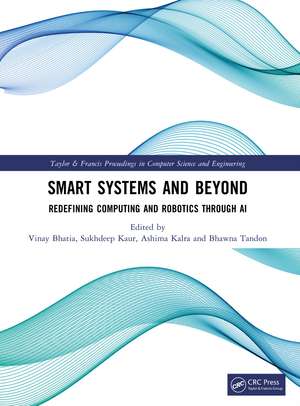
Smart Systems and Beyond: Redefining Computing and Robotics through AI: Taylor and Francis Proceedings in Computer Science and Engineering
Editat de Vinay Bhatia, Sukhdeep Kaur, Ashima Kalra, Bhawna Tandonen Limba Engleză Paperback – 30 sep 2026
This volume brings together multidisciplinary research focusing on artificial intelligence, computational intelligence, smart communication systems, embedded and VLSI technologies, robotics, automation, cybersecurity, cloud computing, data analytics, IoT-enabled platforms, and intelligent decision-making systems. The book explores innovative methodologies, mathematical models, and practical applications that support next-generation technological ecosystems. Contributions include theoretical advancements, simulation-based studies, experimental implementations, and industrial applications in smart environments and AI-integrated systems. The book also discusses recent trends in machine learning, predictive analytics, human-robot interaction, autonomous systems, and sustainable computing architectures, offering valuable insights into the rapidly evolving landscape of communication and computational sciences.
The book is intended for researchers, academicians, scientists, industry professionals, postgraduate students, and practitioners working in the domains of artificial intelligence, communication engineering, computer science, robotics, embedded systems, electronics, and data analytics. It serves as a valuable reference for both academic research and industrial innovation.
Din seria Taylor and Francis Proceedings in Computer Science and Engineering
- 20%
 Preț: 433.51 lei
 - 20%
 Preț: 470.09 lei
 - 20%
 Preț: 439.92 lei
 - 20%
 Preț: 441.41 lei
 - 30%
 Preț: 1225.58 lei
 - 20%
 Preț: 438.78 lei
 - nou
 Preț: 1362.23 lei
 - 20%
 Preț: 393.36 lei
 - nou
 Preț: 436.57 lei
 - 20%
 Preț: 1370.51 lei
 - 29%
 Preț: 2060.42 lei
 - nou
 Preț: 365.06 lei
 - nou
 Preț: 361.83 lei
 - nou
 Preț: 360.63 lei
 - nou
 Preț: 368.88 lei
 - nou
 Preț: 359.93 lei
 - nou
 Preț: 352.13 lei
 - nou
 Preț: 363.92 lei
 - nou
 Preț: 357.28 lei
Preț: 394.16 lei
Preț vechi: 492.71 lei
-20% Nou
Puncte Express: 591
Carte disponibilă
Livrare economică 05-19 noiembrie
Livrare express 22-28 octombrie pentru 43.28 lei
Livrare prin curier în România Termenul estimat este afișat lângă disponibilitate.
Transport gratuit de la 400.00 lei Plată online sau ramburs, în funcție de opțiunile comenzii.
Retur gratuit în 14 zile Comandă securizată și suport în română.
Specificații
ISBN-13: 9781041411420
ISBN-10: 1041411421
Pagini: 418
Dimensiuni: 210 x 280 mm
Greutate: 0.77 kg
Ediția:1
Editura: CRC Press
Colecția Routledge
Seria Taylor and Francis Proceedings in Computer Science and Engineering
ISBN-10: 1041411421
Pagini: 418
Dimensiuni: 210 x 280 mm
Greutate: 0.77 kg
Ediția:1
Editura: CRC Press
Colecția Routledge
Seria Taylor and Francis Proceedings in Computer Science and Engineering
Public țintă
Academic and GeneralCuprins
Session 1 Mathematical and Computational Algorithmic Applications for Smart Systems Engineering Experimental and Statistical Evaluation of Fine-Grained Soil Stabilisation Using Waste Marble Powder as a Sustainable Binder; A Novel Framework for Convergence Ordering and Stability Analysis of Coefficient-Sensitive Iterative Algorithms; Deep Transfer Learning Models for Cancer Classification: A Comparative Study; Smart Toll Management System Using Arduino and IoT; AI-Powered Smart Glasses for Visually Impaired with Indoor and Outdoor Navigation and Object Manipulation Guidance; Short-Term Load Forecasting in Hybrid Energy System for Supporting Demand Response Program; Smart Indoor Navigation System for the Visually Impaired Using SLAM and LiDAR Technologies; Design and Realization of IFF Linear Array Based on Triangular Multi-Layer Planar Patch Antenna; Transfer Learning and Ensemble Models for Improved DR Detection Accuracy; An Overview of Robotics: From Classification to Advanced Control Approaches; Optimization in Energy Harvesting Wireless Networks Using Hybridized Algorithms; Strategic Resource Allocation for Enhanced Market Performance; Intelligent AI Communication Monitoring and Voice Recording Solution with Automated Processing and Message Delivery for Improved Transparency and Accessibility; Session 2 Embedded Systems and VLSI Technologies A Robust Adaptive Control System for Fire Fighting Robots; Deep Learning Approaches for Network Intrusion Detection Systems: Architectures, Challenges, and Future Directions; A Hybrid Strategy for Handwritten Text Recognition to MobileNet, LSTM, and Transformers; Optimization of Integrated MB-OFDM: Fibre Network Performance and Applications to WPAN; Managerial Analysis and Effects of Mental Disorder Health Problem: Dementia; Transformer-Based Machine Learning for Antenna Parametric Optimization; Data-Driven Forecasting of Blood Glucose Levels via ExtraTrees Ensemble Learning; Non-Invasive Brain Cancer Detection with Compact UWB Microstrip Antenna Having Stair Patch Geometry; Ensemble Machine Learning Models for High-Efficiency Antenna Design and Optimization in Next-Generation Wireless Systems; Cross Language Plagiarism Detection in Regional Languages: A Comparative Study of CLPD Models and Approaches; A Performance Evaluation of Machine Learning Models for Maternal Health and High-Risk Pregnancy Dataset; Session 3 Robotics, Control, and Automation in Electronics Design and Implementation of a Simulink Model of Virtual Mouse Using Hand Gestures Control with High Accuracy; Modeling Rational Information Dissemination via Blockchain in Neuro-Sensitive Social Networks; SWeAT: Bridging Reproducibility, Explainability, and Scalability in Software-Based Remote Attestation; Localization of Mobile Nodes in Wireless Sensor Networks Using RGWO Algorithm; Design of Photonic Biosensors for the Detection of Spoiled Fruits and Vegetables; Fuzzy Logic-Based Energy Management for Multi-Port DC-DC Converter in Electric Vehicles: Performance Evaluation and Power Flow Analysis; Adaptive FP-Algorithms for CFD Models: Convergence, Stability, and Superlinear Efficiency; Evaluating the Performance of Multiuser Space-Time Signal Processing Using Hybrid Receiver Selection in Power Limited Cognitive Radios; IRS Assisted Cognitive Radio Networks: Methodologies and Applications; ML-Driven Design Optimization of a Circular Patch Antenna for Predictive Non-Invasive Blood Glucose Monitoring; Harnessing Machine Learning Classifiers as Fitness Functions in Metaheuristic-Based Feature Selection for Mammographic Breast Mass Classification; Session 4 Information Technology and Intelligent Systems
Toward a Theory of AI-Enhanced Accuracy in Climate Change Journalism; Efficient Ambient Sound Energy Harvesting Using Real-Time Sound Analysis; DL-CD: A Deep Learning Generative Models for Accurate Change Detection in Remote Sensing Data; Utilizing Decentralized Blockchain Platforms and Advanced Cryptographic to Mitigate Data Breaches in Healthcare Systems; A Comprehensive Review of Urban Growth Detection Through the Fusion of Remote Sensing and Machine Learning; AI-Assisted Tumor Detection in MRI and CT Scans Using Image Segmentation Techniques; A Hybrid Framework for Motor Imagery EEG Decoding; Real-Time Disease Screening in Public Areas Using Autonomous BOTS; From Cloud to Curb: An Edge AI Framework for Energy-Efficient and Responsive Urban Mobility; Deep Learning-Based Diabetic Retinopathy Detection Using Fundus Images; Design of Efficient Precision Analog Comparator for Amperometric Glucose Sensing; Session 5 Data Science and Analytics Efficient and Lightweight Framework for Confidential Medical Image Diagnosis Using Edge AI; A Nowel Low Power Analog Comparator Design for Biomedical Instrumentation; AI-Based Insider Threat Detection System in Colleges and Laboratories; StrRem-Net: A Blended Deep Learning Model with LSTM for Accurate Rain Streak Removal in Digital Images; Ethical Considerations in the Implementation of Artificial Intelligence in Recruitment Processes; Development of a Selective Refractive Index-Based SPR Sensor for Acetone Detection in Industrial Wastewater; RFID-Based Smart Trolley System for Automated Invoicing and Retail Efficiency; Polymer Optical Fiber (POF)–Powered Passive Optical LAN for Business Applications; REES: A Resource-Efficient and Enhanced-Security Mutual Authentication Scheme for Wireless Sensor Networks; A Detailed Investigations on IOT Applications and Challenges; Cybernexotics: A Holistic Approach to Fusing APIs and Computational Protocols for AI-Driven Threat Intelligence; A Comprehensive Review of Face Detection Algorithms: An In-Depth Analysis of Multitask Cascaded Convolutional Networks (MTCNN)
Toward a Theory of AI-Enhanced Accuracy in Climate Change Journalism; Efficient Ambient Sound Energy Harvesting Using Real-Time Sound Analysis; DL-CD: A Deep Learning Generative Models for Accurate Change Detection in Remote Sensing Data; Utilizing Decentralized Blockchain Platforms and Advanced Cryptographic to Mitigate Data Breaches in Healthcare Systems; A Comprehensive Review of Urban Growth Detection Through the Fusion of Remote Sensing and Machine Learning; AI-Assisted Tumor Detection in MRI and CT Scans Using Image Segmentation Techniques; A Hybrid Framework for Motor Imagery EEG Decoding; Real-Time Disease Screening in Public Areas Using Autonomous BOTS; From Cloud to Curb: An Edge AI Framework for Energy-Efficient and Responsive Urban Mobility; Deep Learning-Based Diabetic Retinopathy Detection Using Fundus Images; Design of Efficient Precision Analog Comparator for Amperometric Glucose Sensing; Session 5 Data Science and Analytics Efficient and Lightweight Framework for Confidential Medical Image Diagnosis Using Edge AI; A Nowel Low Power Analog Comparator Design for Biomedical Instrumentation; AI-Based Insider Threat Detection System in Colleges and Laboratories; StrRem-Net: A Blended Deep Learning Model with LSTM for Accurate Rain Streak Removal in Digital Images; Ethical Considerations in the Implementation of Artificial Intelligence in Recruitment Processes; Development of a Selective Refractive Index-Based SPR Sensor for Acetone Detection in Industrial Wastewater; RFID-Based Smart Trolley System for Automated Invoicing and Retail Efficiency; Polymer Optical Fiber (POF)–Powered Passive Optical LAN for Business Applications; REES: A Resource-Efficient and Enhanced-Security Mutual Authentication Scheme for Wireless Sensor Networks; A Detailed Investigations on IOT Applications and Challenges; Cybernexotics: A Holistic Approach to Fusing APIs and Computational Protocols for AI-Driven Threat Intelligence; A Comprehensive Review of Face Detection Algorithms: An In-Depth Analysis of Multitask Cascaded Convolutional Networks (MTCNN)
Notă biografică
Vinay Bhatia is Professor and Head of the Department of Electronics and Communication Engineering at Chandigarh Engineering College (NBA Accredited), CGC Landran (NAAC A+), Punjab, India. He holds a B.Tech, M.Tech, and Ph.D in Electronics and Communication Engineering. Currently, he is working on routing and security issues pertaining to wireless networks.
Sukhdeep Kaur is Professor, Department of Electronics and Communication Engineering at Chandigarh Engineering College, Landran, Mohali, Punjab. She received her B.Tech degree in Electronics and Communication Engineering from Amravati University(M.S), M.Tech degree in Electronics and communication from G.N.E Ludhiana; and Ph.D. degree in Antenna Designing from Thapar University Patiala; in 2001, 2008 and 2016 respectively.
Ashima Kalra is a distinguished academician and researcher currently serving as Associate Professor in the Electronics and Communication Engineering Department at Chandigarh Engineering College (CGC Landran), with more than 22 years of teaching experience at undergraduate and postgraduate levels. She earned her Ph.D. in Electronics and Communication Engineering from Maharishi University, Noida, in 2023. She completed her M.Tech with distinction from Punjab Technical University, Jalandhar, and is a Gold Medalist in B.Tech in Electronics from Kurukshetra University, Kurukshetra.
Bhawna Tandon received a B.Tech degree from Kurukshetra University, Kurukshetra in 2001, M.E degree from Panjab University in 2009, and a Ph.D. degree from Punjab Engineering College (PEC) (Deemed to be University), Chandigarh in 2018. With a total teaching experience of 24 years and a strong academic and research background, she is currently working as Professor and serving as the IQAC Coordinator at Chandigarh Engineering College - CGC Landran, Mohali where she actively contributes to institutional quality enhancement and academic excellence.
Sukhdeep Kaur is Professor, Department of Electronics and Communication Engineering at Chandigarh Engineering College, Landran, Mohali, Punjab. She received her B.Tech degree in Electronics and Communication Engineering from Amravati University(M.S), M.Tech degree in Electronics and communication from G.N.E Ludhiana; and Ph.D. degree in Antenna Designing from Thapar University Patiala; in 2001, 2008 and 2016 respectively.
Ashima Kalra is a distinguished academician and researcher currently serving as Associate Professor in the Electronics and Communication Engineering Department at Chandigarh Engineering College (CGC Landran), with more than 22 years of teaching experience at undergraduate and postgraduate levels. She earned her Ph.D. in Electronics and Communication Engineering from Maharishi University, Noida, in 2023. She completed her M.Tech with distinction from Punjab Technical University, Jalandhar, and is a Gold Medalist in B.Tech in Electronics from Kurukshetra University, Kurukshetra.
Bhawna Tandon received a B.Tech degree from Kurukshetra University, Kurukshetra in 2001, M.E degree from Panjab University in 2009, and a Ph.D. degree from Punjab Engineering College (PEC) (Deemed to be University), Chandigarh in 2018. With a total teaching experience of 24 years and a strong academic and research background, she is currently working as Professor and serving as the IQAC Coordinator at Chandigarh Engineering College - CGC Landran, Mohali where she actively contributes to institutional quality enhancement and academic excellence.
Descriere
The book highlights emerging developments in intelligent computing, communication technologies, robotics, embedded systems, and data-driven innovations that are shaping the future of smart and autonomous systems.