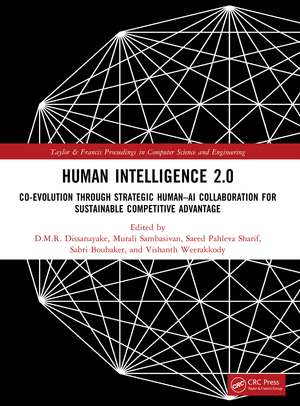
Human Intelligence 2.0: Co-Evolution through Strategic Human–AI Collaboration for Sustainable Competitive Advantage: Taylor and Francis Proceedings in Computer Science and Engineering
Editat de D.M.R. Dissanayake, Murali Sambasivan, Saeed Pahleva Sharif, Sabri Boubaker, Vishanth Weerakkodyen Limba Engleză Paperback – 24 sep 2026
This book brings together research presented under the conference theme, “Human Intelligence 2.0: Co-Evolution through Strategic Human–AI Collaboration for Sustainable Competitive Advantage” featuring peer-reviewed research papers presented across Accounting, Finance and Business Economics; Entrepreneurship, SME, Innovation and Business Development; Marketing, International Business and Strategy; Operations, Logistics and Supply Chain Management; Human Resource Management, Organizational Behaviour and Inclusive Workplace; Business Technology and Digital Transformation, and multidisciplinary tracks.
The book will serve as a valuable reference to academics, researchers, industry professionals, and policymakers
around the globe to share their research findings and discuss current and challenging issues in management, business,
and interdisciplinary domains.
Din seria Taylor and Francis Proceedings in Computer Science and Engineering
- 20%
 Preț: 441.41 lei
 - 20%
 Preț: 433.51 lei
 - 20%
 Preț: 470.09 lei
 - 20%
 Preț: 439.92 lei
 - nou
 Preț: 455.98 lei
 - 20%
 Preț: 438.78 lei
 - 18%
 Preț: 1359.37 lei
 - 20%
 Preț: 394.16 lei
 - nou
 Preț: 444.47 lei
 - 20%
 Preț: 1370.51 lei
 - 29%
 Preț: 2060.42 lei
 - nou
 Preț: 365.61 lei
 - nou
 Preț: 362.38 lei
 - nou
 Preț: 362.86 lei
 - nou
 Preț: 369.47 lei
 - nou
 Preț: 360.48 lei
 - nou
 Preț: 352.68 lei
 - nou
 Preț: 364.47 lei
 - nou
 Preț: 357.62 lei
Preț: 393.36 lei
Preț vechi: 491.70 lei
-20% Nou
Puncte Express: 590
Carte disponibilă
Livrare economică 14-28 noiembrie
Livrare express 03-07 noiembrie pentru 40.27 lei
Livrare prin curier în România Termenul estimat este afișat lângă disponibilitate.
Transport gratuit de la 400.00 lei Plată online sau ramburs, în funcție de opțiunile comenzii.
Retur gratuit în 14 zile Comandă securizată și suport în română.
Specificații
ISBN-13: 9781041408901
ISBN-10: 1041408900
Pagini: 372
Dimensiuni: 210 x 280 mm
Greutate: 0.69 kg
Ediția:1
Editura: CRC Press
Colecția CRC Press
Seria Taylor and Francis Proceedings in Computer Science and Engineering
ISBN-10: 1041408900
Pagini: 372
Dimensiuni: 210 x 280 mm
Greutate: 0.69 kg
Ediția:1
Editura: CRC Press
Colecția CRC Press
Seria Taylor and Francis Proceedings in Computer Science and Engineering
Public țintă
Academic and Undergraduate CoreCuprins
1. Human intelligence in business in the age of artificial intelligence: A systematic literature review on current positioning, dynamic tensions, and the way forward. 2. Work anywhere, perform everywhere: The mediating role of job satisfaction between nomadic work drivers and job performance among digital nomads. 3. Digital Mindfulness for Employee Well-Being: A Systematic Literature Review. 4. ‘Virtual beauty for real!’ Consumer perception towards augmented reality makeup applications: Insights from Sri Lanka. 5. Examining the role of individual factors on the effectiveness of fraud risk assessment among external auditors in Sri Lanka. 6. The impact of financial pressures on financial statement fraud in Sri Lanka. 7. Harnessing industry 4.0 in food and nutrition: Trends, challenges, and future direction. 8. Auditors’ perception towards fraud detection in Sri Lanka. 9. Technostress and cyberloafing in the workplace: The moderating role of computer self-efficacy. 10. Global research trends and collaborative networks on AI in teacher education: A scientometric investigation. 11. The impact of foreign direct investment, corruption and economic growth on tourist arrivals: A study on Sri Lanka from 2000 to 2020. 12. Modelling stock momentum using fuzzy logic: A case study of banking stocks in Sri Lanka’s S&P SL20 index. 13. The impact of climate risk on firm profitability: A meta-analysis of return on assets. 14. From metadata to meaning: An NLP-driven framework for bibliometric analysis in finance research. 15. Challenges and barriers limiting the unrealised potential of operational performance: The case of Colombo Port. 16. The impact of climate finance on financial risk in developing countries: The moderating role of institutional governance. 17. Impact of digital technologies on the success of lean startups in the IT industry in Sri Lanka: A resource-based view approach. 18. Parenting digital consumers: Lived experiences of Sri Lankan parents raising Gen Alpha. 19. Sustainability of the Sri Lankan tea industry: a systematic review. 20. The impact of Enterprise Resource Planning (ERP) systems on decision making quality. 21. Impact of sustainable event practices in attracting attendees to research conference events in Sri Lanka. 22. Podcast marketing: Leveraging podcast communication for niche audiences and brand building awareness. 23. Digital detox and employee well-being: a systematic literature review. 24. The role of institutional factors in shaping citizen involvement in regional development planning: theoretical and conceptual perspectives. 25. Role of perceived value in willingness to pay a premium for ecotourism in Sri Lanka. 26. The effects of foreign direct investment on environmental deterioration using regulatory quality and economic development as moderators: Evidence from South and West Asia. 27. Impact of macroeconomic variables on stock returns: Special evidence from South Asian countries. 28. A qualitative study of the motivations and challenges of Sri Lankan students completing accelerated A-Level before the age of 19 through online learning. 29. Centralized Electronic Health Record (EHR) system for streamlined healthcare management in Sri Lanka. 30. Revealing the corporate contributions to the sustainable development goals through Integrated Reporting (IR): Evidence from South Asian best practices. 31. The impact of sensory brand experience on brand loyalty: A study of fashion retailers at luxury shopping malls in the Colombo District. 32. A comparative study of deep learning models for Sri Lankan treasury bill and bond yields. 33. Reimagining business analytics education: A conceptual framework to foster imaginative thinking. 34. Are innovators cyberloafers? Cyberloafing and innovative work behaviour: The moderating effect of computer self-efficacy. 35. Validity of the Fama-French three-factor model: Evidence from Sri Lanka’s consumer durable & apparel sector of the Colombo stock exchange. 36. Factors affecting travel intention of tourists with the mediation effect of virtual experience in Sri Lanka. 37. Impact of corporate social responsibility disclosure on firm performance: Evidence from Sri Lanka’s food, beverage and tobacco sector. 38. Assessing the impact of dividend policy on stock price volatility: Evidence from Colombo stock exchange. 39. Behavioural drivers of AI-driven smart tourism adoption: A systematic literature review. 40. Managing software development teams: An inquiry into the management skills paradox. 41. Development of an integrated conceptual framework for the internal employer branding, employee engagement and perceived organizational support. 42. The impact of student-GenAI interaction on cognitive engagement: Self-efficacy as a mediator. 43. Impact of paternalistic leadership on employee silence. 44. A Systematic Review of Smart Farming Technology Adaptation – An Analysis of Perceived Barriers, Enablers, and Future Directions. 45. Impact of geomarketing on consumer behaviour in retail: The mediating effect of personalised offers. 46. Does ESG disclosure mitigate corporate risk taking and can chief executive officers override this effect?. 47. The role of social media on brand love: A bibliometric analysis and a future research agenda. 48. Digital leadership and employee creativity: The mediating role of job crafting in selected banks of Batticaloa District. 49. Electronic word-of-mouth (eWoM) and brand tribalism among Gen Z: A stimulus-organism-response (S-O-R) perspective on social media engagement. 50. Presenters’ characteristics and consumer purchase intention: The mediating role of brand personality in Sri Lanka. 51. From experience to loyalty: Examining the mediating role of emotional branding in modern trade retailing in Sri Lanka
Notă biografică
D.M.R. Dissanayake is a Professor in Marketing attached to the Department of Marketing Management, Faculty of Commerce and Management Studies, University of Kelaniya, Sri Lanka, where he previously served as the Head of the Department from 2020 to 2023. In addition to his academic responsibilities in Sri Lanka, he currently serves as an Adjunct Professor at Taylor’s University, Malaysia.
Murali Sambasivan is currently serving as the Director and Professor at Thiagarajar School of Management. He holds a Bachelor of Engineering (B.E.) in Production Engineering from College of Engineering, Guindy and earned his Doctor of Philosophy (Ph.D.) in Management Science from The University of Alabama. Prof. Sambasivan has extensive academic and research experience in the fields of Management Science, Operations and Supply Chain Management, and General Management.
Saeed Pahlevan Sharif is affiliated with the Faculty of Business and Law at Taylor's Business School, Taylor's University. He obtained his Ph.D. in Business from Taylor’s Business School, Taylor’s University, Malaysia. He also holds an MBA from the Faculty of Management at Multimedia University and a Bachelor of Science degree in Electrical Engineering from Amirkabir University of Technology. Prof. Sharif currently serves as an Adjunct Professor at Sunway Business School, Sunway University.
Sabri Boubaker is a Professor in Finance at EM Normandie Business School. He earned his Ph.D. in Finance from University of Paris Est and later obtained the Habilitation for Supervising Doctoral Research from the same institution. Prof. Boubaker is widely recognized for his contributions to the fields of corporate finance, corporate governance, and corporate social responsibility.
Vishanth Weerakkody is the Associate Pro-Vice-Chancellor for Global Engagement and Partnerships and a Professor of Digital Governance at the School of Management, University of Bradford. He has previously held several senior academic leadership positions at the University of Bradford, including Dean of the Faculty for Management, Law and Social Sciences, Associate Dean for International and Enterprise, and Associate Dean for Planning and Resources.
Murali Sambasivan is currently serving as the Director and Professor at Thiagarajar School of Management. He holds a Bachelor of Engineering (B.E.) in Production Engineering from College of Engineering, Guindy and earned his Doctor of Philosophy (Ph.D.) in Management Science from The University of Alabama. Prof. Sambasivan has extensive academic and research experience in the fields of Management Science, Operations and Supply Chain Management, and General Management.
Saeed Pahlevan Sharif is affiliated with the Faculty of Business and Law at Taylor's Business School, Taylor's University. He obtained his Ph.D. in Business from Taylor’s Business School, Taylor’s University, Malaysia. He also holds an MBA from the Faculty of Management at Multimedia University and a Bachelor of Science degree in Electrical Engineering from Amirkabir University of Technology. Prof. Sharif currently serves as an Adjunct Professor at Sunway Business School, Sunway University.
Sabri Boubaker is a Professor in Finance at EM Normandie Business School. He earned his Ph.D. in Finance from University of Paris Est and later obtained the Habilitation for Supervising Doctoral Research from the same institution. Prof. Boubaker is widely recognized for his contributions to the fields of corporate finance, corporate governance, and corporate social responsibility.
Vishanth Weerakkody is the Associate Pro-Vice-Chancellor for Global Engagement and Partnerships and a Professor of Digital Governance at the School of Management, University of Bradford. He has previously held several senior academic leadership positions at the University of Bradford, including Dean of the Faculty for Management, Law and Social Sciences, Associate Dean for International and Enterprise, and Associate Dean for Planning and Resources.
Descriere
The book aims to foster meaningful dialogue to strategically enhance human capabilities through targeted collaboration with AI to secure sustainable competitive advantage in rapidly evolving marketplaces.